

1830년 12월 10일, 미국의 시인이자 소설가로 수수께끼 같은 여성 에밀리 디킨슨 (Emily Elizabeth Dickinson, 1830 ~ 1886) 출생
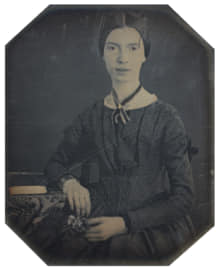
에밀리 엘리자베스 디킨슨 (Emily Elizabeth Dickinson, 1830년 12월 10일 ~ 1886년 5월 15일)은 미국의 시인이다.
미국 매사추세츠 (Massachusetts)주의 앰허스트 (Amherst)에서 태어났다. 디킨슨은 거의 2000편에 달하는 시를 썼는데 주로 사랑, 죽음, 이별, 영혼, 천국 등을 소재로 한 명상시가 대부분이다. 미국에서 가장 천재적인 시인들 중 한 명으로 꼽힌다.
그의 시는 당시의 다른 시들과는 많이 달라 생전에는 대중에게 인정받지 못했고 겨우 4편의 시만이 시집에 쓰였다. 에밀리 디킨슨은 생전에는 재능을 알아본 소수의 시인과 지식인과 꾸준히 서신으로 시를 주고받았다. 그녀의 천재성이 널리 인정받은 것은 사후, 여동생 라비니아 노크로스 디킨슨 (Lavinia Nocross Dickinson)이 에밀리의 시를 모아 시집을 낸 후의 일이다.
외출을 극도로 자제하고 은거한 시인으로 알려져 있으나, 어릴 때는 매일 들판으로 외출하고 동네 아이들을 불러 놀기도 하던 활기찬 성격이었다.
마운트 홀리요크 대학교에 다녔다.
그녀는 시를 쓰다가 55세의 나이로 사망했다.
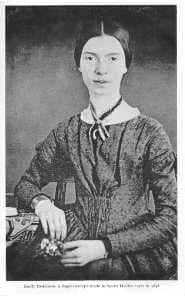
– 에밀리 디킨슨 (Emily Elizabeth Dickinson)
.출생: 1830년 12월 10일, 미국 매사추세츠 애머스트
.사망: 1886년 5월 15일 (55세), 미국 매사추세츠 애머스트
.저서: The complete poems, 디킨슨 시선, 내가 죽음을 위해 멈춰 설 수 없기에, 등
.형제자매: 윌리엄 오스틴 디킨슨, 라비니아 노크로스 디킨슨
.부모: 에드워드 디킨슨, 에밀리 노크로스 디킨슨
에밀리 디킨슨 (Emily Elizabeth Dickinson, 1830년 12월 10일 ~ 1886년 5월 15일)은 19세기와 20세기의 문학적 감수성을 연결하는 역할을 한 소설가이자 시인으로, 미국 매사추세츠 주의 작은 칼뱅주의 마을 애머스트에서 태어나 평생을 보냈으며, 평생 결혼하지 않다. 평생 살며 1,800편의 시를 남겼다. 자신의 시를 직접 출판하거나 세상에 거의 공개하지 않았지만 소수의 친구와 가족, 지인들에게 보여주기를 좋아했다. 자연을 사랑했으며 동물, 식물, 계절의 변화에서 깊은 영감을 얻었다. 말년에는 은둔생활을 했으며 시작 활동을 했다. 에밀리 디킨슨의 시는 매우 높은 지성을 표현하고 있으며 또한 뛰어난 유머 감각도 보여준다. 운율이나 문법에서 파격성이 있어서 19세기에는 인정받지 못했으나, 20세기에는 형이상학적인 시가 유행하면서 더불어 높은 평가를 받았다.
40여 편씩 시를 직접 필사하고 편집한 손제본 형태의 파시클 (fascicle) 40권에 보관했고 더러는 편지봉투를 뜯어 그 안에 적어두기도 했다. 주변의 일상과 자연을 시에 담아 사랑, 죽음, 상실, 영원함, 아름다움, 글쓰기와 읽기의 즐거움을 노래한 시인은 당시 청교도의 엄숙함이나 가부장적 질서, 물질주의 생활양식에 휘둘리지 않고 자신의 리듬과 형식 속에서 세상을 바라보고 사유했다. 현재 독자들에게 가장 사랑받는 미국 시인 가운데 한 명이며, 많은 후배 시인들과 비평가는 물론 음악가와 예술가들에게 큰 영감을 주는 페미니스트 뮤즈이기도 하다.
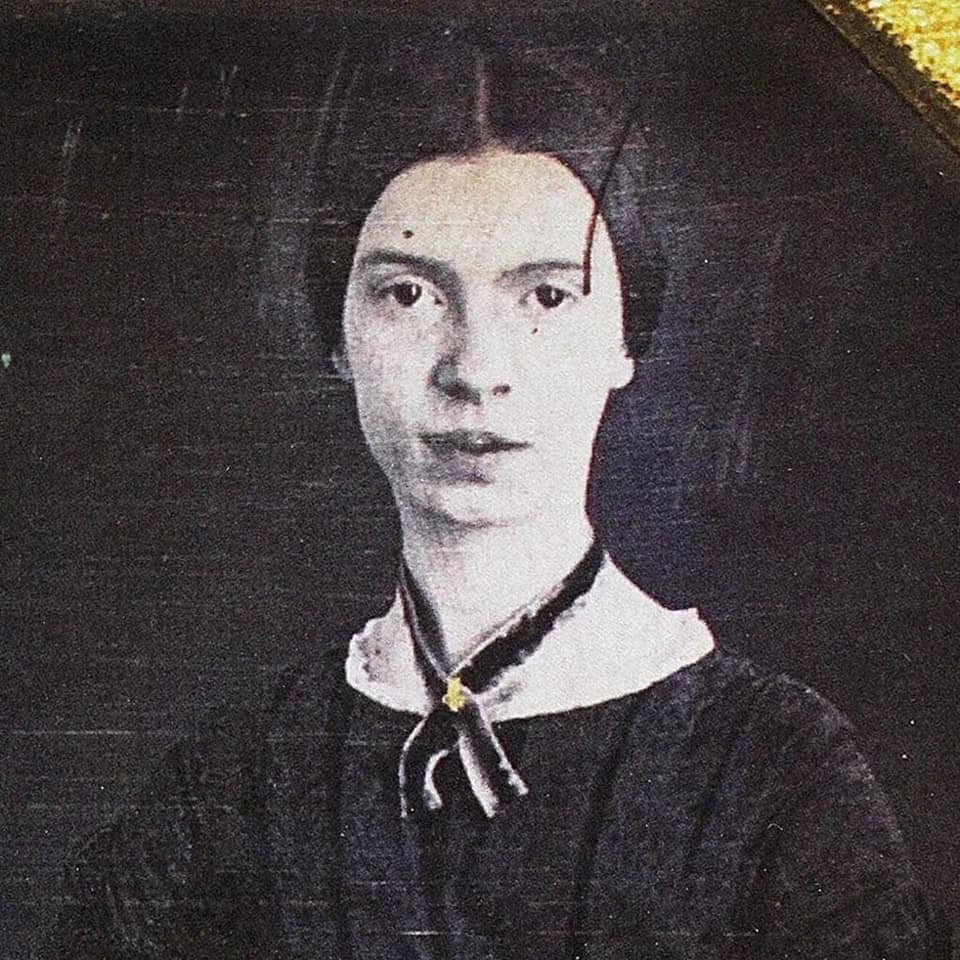
○ 시인으로서의 특징
초등교육 과정을 거친 후 애머스트 아카데미 (Amherst Academy)에서 희망 강좌를 선택해 중·고등학교 수준의 교육과 문예 창작 훈련을 받았으며, 약 1년간 마운트 홀리오크 칼리지에서 신학 교육을 받기도 했지만 이 밖의 정규 학교 교육을 받은 적은 없다. 하지만 성서보다 문학 작품에 더 많은 흥미를 가졌던 그는 독서를 통해 문학적 소양을 기르고 창작에 대한 열의와 영감을 얻었다.
책을 많이 읽지는 않았지만 깊이 탐독하는 습성이 있었다. 디킨슨의 삶과 자아 탐색을 세상과 단절된 것으로만 생각하는 독자들이 많지만, 실제로 접촉하지는 않았어도 서신을 통해 당대 최첨단의 지성을 갖춘 지식인들과 시를 교환하며 부단한 교우 관계를 가졌다. 또한 자선 단체와 어린 시절의 절친한 친구이자 당시 유명한 작가였던 헬렌 헌트 잭슨 (Helen Hunt Jackson)에게 출판을 권유받기도 했지만, 생전에 자신의 시가 출판되는 것을 원치 않았기 때문에 이를 거부했다.
종교의 반항아로서 청교도 신앙에 회의를 품었으며, 구원의 희망에 강한 반발심을 가지고 있었다. 이는 친한 친구를 비롯한 많은 가까운 사람들의 죽음으로 인해 일찍부터 기독교의 하나님에 대해 근본적으로 강한 회의감을 가졌기 때문이다. 이러한 생각은 디킨슨을 전통적인 사고방식과 기존 종교에 대한 불신과 전통적인 시 형식에 대한 반발로 나아가도록 했고, 한 걸음 더 나아가 시에 혁신적인 요소를 불러오며 시의 내용과 형식에 있어 일찍이 선구자적 위치를 차지하도록 했다.
생전에는 본인의 요구에 의해 익명으로 일곱 편밖에 시를 출간하지 못했지만, 사후 동생 러비니아 디킨슨에 의해 44개의 시 꾸러미가 발견되었다. 1890년, 1891년, 1896년에는 평생에 걸쳐 디킨슨의 문학 상담 역할을 해왔던 비평가 겸 작가 토머스 웬트워스 히긴슨 (Thomas Wentworth Higginson) 과 토드 부인 (Mrs. Todd)의 주선에 힘입어 1775편의 시가 3권 연속 출간되었으며, 1894년에는 2권의 서간집이 출간되었다. 생전에 주목받지 못했던 디킨슨은 1920년대에 이르러서야 인정받기 시작했고, 1955년 토머스 존슨 (Thomas H. Johnson)에 의해 시선집이 출판됨으로써 위대한 시인으로 자리매김하게 되었다.
○ 시들
“I taste a liquor never brewed”
“Success is counted sweetest”
“Wild nights – Wild nights!”
“I felt a Funeral, in my Brain”
“I’m Nobody! Who are you?”
“‘Hope’ is the thing with feathers”
“A Bird, came down the Walk”
“Because I could not stop for Death”
“My Life had stood – a Loaded Gun”
“Tell all the truth but tell it slant”
– Translation
Emily Dickinson’s poetry has been translated into languages including French, Spanish, Mandarin Chinese, Persian, Kurdish, Georgian, Swedish, and Russian. A few examples of these translations are the following:
The Queen of Bashful Violets, a Kurdish translation by Madeh Piryonesi published in 2016.
French translation by Charlotte Melançon which includes 40 poems.
Mandarin Chinese translation by Professor Jianxin Zhou
Swedish translation by Ann Jäderlund.
Persian translations: Three Persian translations of Emily Dickinson are available from Saeed Saeedpoor, Madeh Piryonesi and Okhovat.
○ 대표작
– ‘만약 내가‘ (If I can)
If I can stop one heart from breaking,
I shall not live in vain;
If I can ease one life the aching,
Or cool one pain,
Or help one fainting robin
Unto his nest again,
I shall not live in vain.
내가 만약 누군가의 마음의 상처를 막을 수 있다면,
나 헛되이 사는 것 아니리.
내가 만약 한 생명의 고통을 덜고,
기진맥진해서 떨어지는 울새 한 마리를
다시 둥지에 올려놓을 수 있다면,
나 헛되이 사는 것 아니리.
– Success is counted sweetest (1859)
Success is counted sweetest
By those who ne’er succeed.
To comprehend a nectar
Requires sorest need.
Not one of all the Purple Host
Who took the Flag today
Can tell the definition
So clear of Victory
As he defeated – dying –
On whose forbidden ear
The distant strains of triumph
Burst agonized and clear.
– I’m nobody! Who are you? (1861)
I’m Nobody! Who are you?
Are you – Nobody – too?
Then there’s a pair of us!
Don’t tell! they’d advertise – you know!
How dreary – to be – Somebody!
How public – like a Frog –
To tell one’s name – the livelong June –
To an admiring Bog!
– “Hope” is the thing with feathers (1861)
“Hope” is the thing with feathers –
That perches in the soul –
And sings the tune without the words –
And never stops – at all –
And sweetest – in the Gale – is heard –
And sore must be the storm –
That could abash the little Bird
That kept so many warm –
I’ve heard it in the chillest land –
And on the strangest Sea –
Yet – never – in Extremity,
It asked a crumb – of me.
– I felt a Funeral, in my Brain (1861)
I felt a Funeral, in my Brain,
And Mourners to and fro
Kept treading – treading – till it seemed
That Sense was breaking through –
And when they all were seated,
A Service, like a Drum –
Kept beating – beating – till I thought
My Mind was going numb –
And then I heard them lift a Box
And creak across my Soul
With those same Boots of Lead, again,
Then Space – began to toll,
As all the Heavens were a Bell,
And Being, but an Ear,
And I, and Silence, some strange Race
Wrecked, solitary, here –
And then a Plank in Reason, broke,
And I dropped down, and down –
And hit a World, at every plunge,
And Finished knowing – then –
– There’s a certain Slant of light (1861)
There’s a certain Slant of light,
Winter Afternoons –
That oppresses, like the Heft
Of Cathedral Tunes –
Heavenly Hurt, it gives us –
We can find no scar,
But internal difference –
Where the Meanings, are –
None may teach it – Any –
’Tis the seal Despair –
An imperial affliction
Sent us of the Air –
When it comes, the Landscape listens –
Shadows – hold their breath –
When it goes, ’tis like the Distance
On the look of Death –
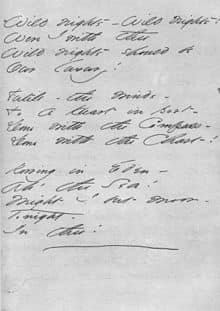
– Wild Nights – Wild Nights! (1861)
Wild Nights – Wild Nights!
Were I with thee
Wild Nights should be
Our luxury!
Futile – the Winds –
To a Heart in port –
Done with the Compass –
Done with the Chart!
Rowing in Eden –
Ah, the Sea!
Might I but moor – Tonight –
In Thee!
– This is my letter to the World (1862)
This is my letter to the World
That never wrote to Me–
The simple News that Nature told–
With tender Majesty
Her Message is committed
To Hands I cannot see–
For love of Her– Sweet– countrymen–
Judge tenderly– of Me
– I dwell in Possibility (1862)
I dwell in Possibility–
A fairer House than Prose–
More numerous of Windows–
Superior– for Doors–
Of Chambers as the Cedars–
Impregnable of Eye–
And for an Everlasting Roof
The Gambrels of the Sky–
Of Visitors– the fairest–
For Occupation– This–
The spreading wide my narrow Hands
To gather Paradise–
– I heard a Fly buzz– when I died (1862)
I heard a Fly buzz– when I died–
The Stillness in the Room
Was like the Stillness in the Air –
Between the Heaves of Storm–
The Eyes around– had wrung them dry–
And Breaths were gathering firm
For that last Onset– when the King
Be witnessed– in the Room–
I willed my Keepsakes– Signed away
What portions of me be
Assignable– and then it was
There interposed a Fly–
With Blue– uncertain– stumbling Buzz–
Between the light– and me –
And then the Windows failed – and then
I could not see to see–
– It was not Death, for I stood up (1862)
It was not Death, for I stood up,
And all the Dead, lie down–
It was not Night, for all the Bells
Put out their Tongues, for Noon.
It was not Frost, for on my Flesh
I felt Siroccos– crawl–
Nor Fire– for just my Marble feet
Could keep a Chancel, cool–
And yet, it tasted, like them all,
The Figures I have seen
Set orderly, for Burial,
Reminded me, of mine–
As if my life were shaven,
And fitted to a frame,
And could not breathe without a key,
And ’twas like Midnight, some–
When everything that ticked– has stopped–
And Space stares– all around–
Or Grisly frosts– first Autumn morns,
Repeal the Beating Ground–
But, most, like Chaos– Stopless– cool–
Without a Chance, or Spar–
Or even a Report of Land–
To justify– Despair.
– Before I got my eye put out (1862)
Before I got my eye put out–
I liked as well to see
As other creatures, that have eyes–
And know no other way–
But were it told to me, Today,
That I might have the Sky
For mine, I tell you that my Heart
Would split, for size of me–
The Meadows– mine –
The Mountains– mine –
All Forests– Stintless stars–
As much of noon, as I could take–
Between my finite eyes–
The Motions of the Dipping Birds–
The Morning’s Amber Road–
For mine– to look at when I liked,
The news would strike me dead–
So safer– guess– with just my soul
Opon the window pane
Where other creatures put their eye –
Incautious– of the Sun–
– After great pain, a formal feeling comes (1862)
After great pain, a formal feeling comes–
The Nerves sit ceremonious, like tombs–
The stiff Heart questions “was it He, that bore,
And “Yesterday, or Centuries before”?
The Feet, mechanical, go round–
A Wooden way
Of Ground, or Air, or Ought–
Regardless grown,
A Quartz contentment, like a stone–
This is the Hour of Lead–
Remembered, if outlived,
As Freezing persons, recollect the snow–
First– Chill– then stupor– then the letting go–
– Because I could not stop for Death (1863)
Because I could not stop for Death–
He kindly stopped for me–
The Carriage held but just Ourselves–
And Immortality.
We slowly drove– He knew no haste
And I had put away
My labor and my leisure too,
For His Civility–
We passed the School, where Children strove
At Recess– in the Ring–
We passed the Fields of Gazing Grain–
We passed the Setting Sun–
Or rather– He passed Us–
The Dews drew quivering and Chill–
For only Gossamer, my Gown–
My Tippet– only Tulle–
We paused before a House that seemed
A Swelling of the Ground–
The Roof was scarcely visible–
The Cornice– in the Ground–
Since then– ’tis Centuries– and yet
Feels shorter than the Day
I first surmised the Horses’ Heads
Were toward Eternity–
– My Life has stood– a Loaded Gun (1862-64)
My Life had stood– a Loaded Gun
In Corners– till a Day
The Owner passed– identified
And carried Me away
And now We roam in Sovereign Woods
And now We hunt the Doe
And every time I speak for Him
The Mountains straight reply
And do I smile, such cordial light
Upon the Valley glow
It is as a Vesuvian face
Had let its pleasure through
And when at Night– Our good Day done
I guard My Master’s Head
‘Tis better than the Eider-Duck’s
Deep Pillow– to have shared
To foe of His– I’m deadly foe
None stir the second time
On whom I lay a Yellow Eye
Or an emphatic Thumb
Though I than He– may longer live
He longer must– than I
For I have but the power to kill
Without–the power to die
– Tell all the truth but tell it slant (1868)
Tell all the truth but tell it slant–
Success in Circuit lies
Too bright for our infirm Delight
The Truth’s superb surprise
As Lightning to the Children eased
With explanation kind
The Truth must dazzle gradually
Or every man be blind–
참고 = 위키백과, 교보문고
크리스천라이프 편집부