
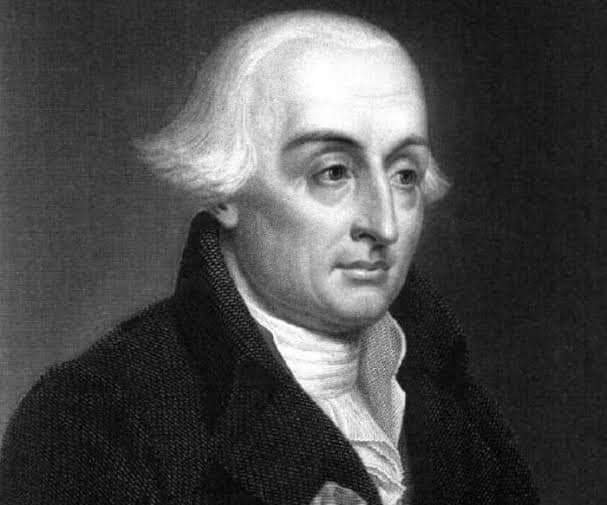
1813년 4월 10일, 이탈리아 태생으로 프랑스와 프로이센에서 활동한 수학자•천문학자 조제프루이 라그랑주 (Joseph-Louis Lagrange, 1736 ~ 1813) 별세
조제프루이 라그랑주 (프: Joseph-Louis Lagrange, 이: Giuseppe Luigi Lagrancia, 1736년 1월 25일 ~ 1813년 4월 10일)는 토리노, 피에몬테에서 태어난 이탈리아 태생, 프랑스와 프로이센에서 활동한 프랑스 수학자이자 천문학자이다.
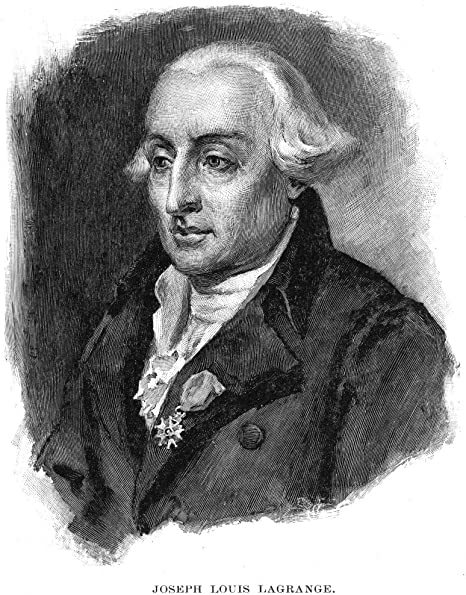
– 조제프루이 라그랑주 (Joseph-Louis Lagrange, 이: Giuseppe Luigi Lagrancia)
.출생: 1736년 1월 25일, 사르데냐 왕국 토리노
.사망: 1813년 4월 10일 (77세), 프랑스 파리
.거주지: 사르데냐 왕국, 프랑스, 프로이센
.시민권: 사르데냐 왕국, 프랑스
.국적: 이탈리아, 프랑스
.분야: 수학, 수리물리학
.소속: 에콜 폴리테크니크
.출신 대학: 토리노 대학교 (학사)
.지도 교수: 레온하르트 오일러
.지도 학생: 조제프 푸리에, 조반니 플라나 (이: Giovanni Plana), 시메옹 드니 푸아송
.주요 업적: 라그랑주 역학, 천체역학, 해석학, 정수론
조제프루이 라그랑주 (Joseph-Louis Lagrange, 1736 ~ 1813)는 이탈리아 태생의 프랑스 수학자이자 천문학자로, 18세기 가장 위대한 수학자 중 한 명으로 꼽힌다.
그는 해석학, 정수론, 그리고 천체역학 분야에 혁신적인 기여를 했다.
○ 생애 및 활동
조제프루이 라그랑주 (Joseph-Louis Lagrange, 1736년 1월 25일 ~ 1813년 4월 10일)는 이탈리아계 프랑스인 수학자이자 물리학자이자 천문학자이다.
조제프루이 라그랑주 (Joseph-Louis Lagrange)는 1736년 1월 25일, 토리노, 피에몬테에서 태어났다.
본명은 주세페 루이지 라그란자 (Giuseppe Luigi Lagrangia)이며 사르데냐 왕국 토리노 출신이다.
그는 해석학, 정수론, 고전역학과 천체역학 전반에 걸쳐 중대한 기여를 했다.
특히 물리학분야에서 기존의 고전역학을 일반화된 새로운 수학적 방식으로 표현한 해석역학은 이론 물리학의 새로운 지평을 열었다.
그는 레온하르트 오일러와 장 르 롱 달랑베르의 추천으로 1766년 베를린에 있는 프로이센 과학 학사원의 수학 부장이 되어 20년 이상 머무르면서 많은 작업을 했으며, 프랑스 과학 아카데미로부터 여러 상을 받았다.
라그랑주의 ‘해석역학’ (Mécanique Analytique, 4. ed., 2 vols. Paris: Gauthier-Villars et fils, 1888–89) 논문은 베를린에서 쓰여 1788년 출판되었으며, 아이작 뉴턴 이래로 고전역학을 가장 포괄적으로 다루었고, 19세기 수리물리학의 발전의 기반을 마련했다.
라그랑주의 증조부는 프랑스인이었지만 그의 부모는 이탈리아인이었다.
1787년, 그가 51세였을 때, 베를린에서 프랑스로 이사해 프랑스 아카데미의 회원이 되었다.
그는 1813년 4월 10일 (77세) 생을 마감할 때까지 프랑스에 머물렀다. 그래서 라그랑주는 프랑스 과학자이자 이탈리아 과학자로 여겨진다.
라그랑주는 프랑스혁명에서 살아남아 에콜 폴리테크니크에서 1794년 개교와 동시에 해석학의 첫 번째 교수가 되었다.
라그랑주는 1799년 상원위원으로 선출되었고 나폴레옹은 1803년에 그에게 레지옹 도뇌르 훈장을 수여하고 1808년 그를 제국의 백작으로 임명했다.
그는 팡테옹에 묻혔으며 그의 이름은 에펠탑에 새겨진 72개의 이름 중 하나로 남아있다.
○ 업적
해석학을 역학에 응용하는 시도를 하여 해석역학을 제창하였으며, 이로 인해 역학은 새로운 발전을 맞이한다.
그 외에 정수론·타원함수론·불변식론 등에 관해 많은 연구 업적이 있다.
- 수학
라그랑주는 범함수의 극값에 대한 오일러-라그랑주 방정식을 유도함으로써 변분법의 창시자 중 한 사람이 되었다.
그는 또한 방법을 확장시켜 가능한 제한조건들을 고려함으로써 라그랑주 승수법에 도달했다.
라그랑주는 매개변수변환법으로 알려진 미분방정식의 해법을 발명했으며 이것은 미분법을 확률론에 적용시켜 방정식의 해에 관하여 중요한 기여를 했다.
그는 모든 자연수는 네 제곱수의 합이라는 것을 증명했다.
그의 논문 ‘해석함수론’ (프: Théorie des fonctions analytiques)은 에바리스트 갈루아에 앞서 군론의 기초를 놓았다.
미적분학에서, 라그랑주는 보간법과 테일러 급수에 대한 새로운 접근을 개발했다.
- 물리학
지구, 태양 그리고 달에 대한 삼체 문제 (1764), 목성의 위성들의 움직임 (1766)에 대해 연구했으며, 1772년에 이 문제의 특수한 경우에 대한 해를 찾았으며 그것은 현재 라그랑주 점이라고 알려져 있는 것이 되었다.
하지만 무엇보다도 그는 뉴턴 역학을 현재 라그랑주 역학이라고 불리는 해석학의 한 영역으로 바꾸었으며, 역학의 “원리”들이 변분법의 단순한 결과라는 것들을 보였다.
○ 라그랑주의 이름이 붙은 것
.라그랑주점
.라그랑지안
.라그랑주 승수법: 제약조건 g(x,y,z)=kg(x,y,z)=k를 만족시키는 f(x,y,z)f(x,y,z)의 최댓값과 최솟값을 쉽게 구할 수 있는 방법. \nabla f(x,y,z) = \lambda \nabla g(x,y,z)∇f(x,y,z)=λ∇g(x,y,z)를 이용한다.
.라그랑주 보간법
.라그랑주의 네 제곱수 정리: 임의의 자연수는 4개의 제곱수(0 포함)의 합으로 나타낼 수 있다.
.라그랑주 역학
○ 저서
조제프루이 라그랑주 (Joseph-Louis Lagrange)는 18세기 수학과 물리학의 거장으로, 해석학을 역학에 완벽하게 도입한 것으로 유명하다. 그의 대표적인 저서는 다음과 같다.
대표 저서
해석역학 (Mécanique Analytique, 1788년): 라그랑주의 가장 위대한 업적으로 꼽히는 저서다. 기하학적 도해 없이 순수하게 해석학 (미분과 적분)만을 사용하여 역학 체계를 서술했으며, 현대 물리학의 기초가 되는 ‘라그랑주 역학’의 토대를 마련했다. 그는 1813년 사망 전까지 이 책의 개정판 작업을 진행했다.
해석함수론 (Théorie des fonctions analytiques, 1797년): 미적분학의 기초를 엄밀하게 다지기 위해 집필된 책이다. 무한급수를 이용해 함수를 정의하려 시도했으며, 현대적 미분 기호인 (f'(x)) (프라임 표기법)를 대중화하는 데 기여했다.
함수 계산 강의 (Leçons sur le calcul des fonctions, 1801년): 《해석함수론》의 내용을 보완하고 강의 형식으로 정리한 저서다.
- 주요 업적 및 논문
그는 평생 동안 100편에서 200편 사이의 논문을 발표하며 수학과 천문학 전반에 걸쳐 방대한 유산을 남겼다.
변분법: 오일러와 함께 오일러-라그랑주 방정식을 완성하여 변분법의 서막을 열었다.
수론 및 대수학: 방정식의 대수적 해법에 관한 연구를 통해 이후 갈루아 이론의 등장을 예고했다.
천문학: 삼체문제의 특수해인 라그랑주 점을 발견하고 행성의 섭동 이론을 연구했다.
- Work in Berlin
.Algebra : The greater number of his papers during this time were, however, contributed to the Prussian Academy of Sciences. Several of them deal with questions in algebra.
His discussion of representations of integers by quadratic forms (1769) and by more general algebraic forms (1770).
His tract on the Theory of Elimination, 1770.
Lagrange’s theorem that the order of a subgroup H of a group G must divide the order of G.
His papers of 1770 and 1771 on the general process for solving an algebraic equation of any degree via the Lagrange resolvents.
In 1773, Lagrange considered a functional determinant of order 3, a special case of a Jacobian. He also proved the expression for the volume of a tetrahedron with one of the vertices at the origin as the one-sixth of the absolute value of the determinant formed by the coordinates of the other three vertices.
.Number theory : Several of his early papers also deal with questions of number theory.
Lagrange (1766–1769) was the first European to prove that Pell’s equation x2 − ny2 = 1 has a nontrivial solution in the integers for any non-square natural number n.
He proved the theorem, stated by Bachet without justification, that every positive integer is the sum of four squares, 1770.
He proved Wilson’s theorem that (for any integer n > 1): n is a prime if and only if (n − 1)! + 1 is a multiple of n, 1771.
His papers of 1773, 1775, and 1777 gave demonstrations of several results enunciated by Fermat, and not previously proved.
His Recherches d’Arithmétique of 1775 developed a general theory of binary quadratic forms to handle the general problem of when an integer is representable by the form ax2 + by2 + cxy.
He made contributions to the theory of continued fractions.
.Other mathematical work : There are also numerous articles on various points of analytical geometry. In two of them, written rather later, in 1792 and 1793, he reduced the equations of the quadrics (or conicoids) to their canonical forms.
During the years from 1772 to 1785, he contributed a long series of papers which created the science of partial differential equations. A large part of these results was collected in the second edition of Euler’s integral calculus which was published in 1794.
.Astronomy : Lastly, there are numerous papers on problems in astronomy. Of these the most important are the following:
Attempting to solve the general three-body problem, with the consequent discovery of the two constant-pattern solutions, collinear and equilateral, 1772. Those solutions were later seen to explain what are now known as the Lagrangian points.
On the attraction of ellipsoids, 1773: this is founded on Maclaurin’s work.
On the secular equation of the Moon, 1773; also noticeable for the earliest introduction of the idea of the potential. The potential of a body at any point is the sum of the mass of every element of the body when divided by its distance from the point. Lagrange showed that if the potential of a body at an external point were known, the attraction in any direction could be at once found. The theory of the potential was elaborated in a paper sent to Berlin in 1777.
On the motion of the nodes of a planet’s orbit, 1774.
On the stability of the planetary orbits, 1776.
Two papers in which the method of determining the orbit of a comet from three observations is completely worked out, 1778 and 1783: this has not indeed proved practically available, but his system of calculating the perturbations by means of mechanical quadratures has formed the basis of most subsequent researches on the subject.
His determination of the secular and periodic variations of the elements of the planets, 1781–1784: the upper limits assigned for these agree closely with those obtained later by Le Verrier, and Lagrange proceeded as far as the knowledge then possessed of the masses of the planets permitted.
Three papers on the method of interpolation, 1783, 1792 and 1793: the part of finite differences dealing therewith is now in the same stage as that in which Lagrange left it.
참고 = 위키백과
크리스천라이프 편집부