
2025 노벨물리학상
존 클라크, 미셸 데보레, 존 마르티니 수상해
거시적 양자역학적 터널링과 전기회로에서의 에너지 양자화 발견
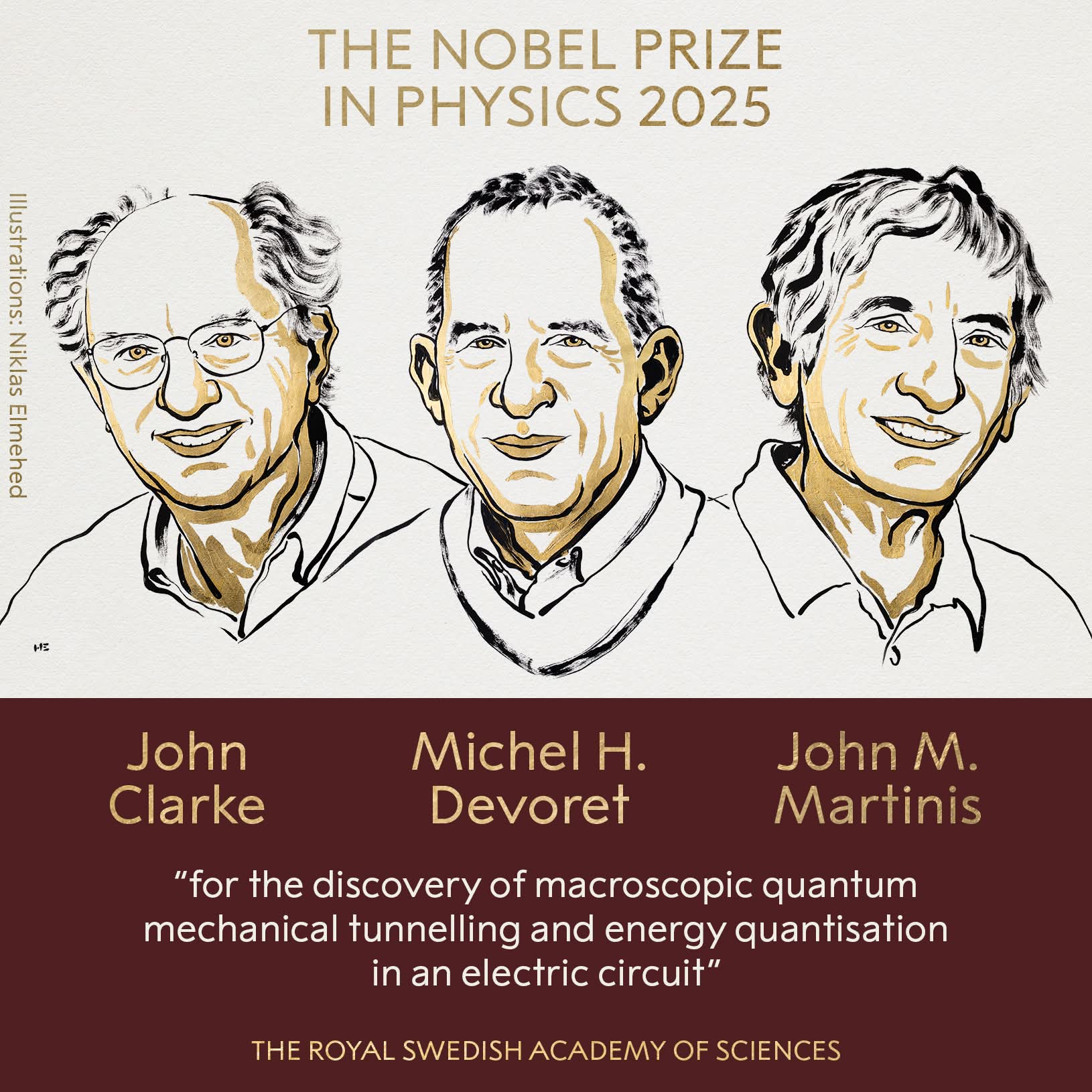
2025년 노벨물리학상 수상자에 존 클라크 미국 캘리포니아대 교수, 미셸 데보레 미국 예일대·미국 캘리포니아대 교수, 존 마르티니 미국 캘리포니아대 교수가 선정됐다.
스웨덴 왕립과학원 노벨위원회는 ″거시적 양자역학적 터널링과 전기회로에서의 에너지 양자화의 발견″의 공로를 인정해 이들 3명에게 노벨 물리학상을 수여한다고 10월 7일 (현지시간) 밝혔다.
수상자들은 상금 1100만 스웨덴 크로나 (약 16억 4000만원)를 나눠서 받게 된다.
노벨위원회는 10월 6일 생리의학상을 시작으로 이날 물리학상 수상자를 발표했고, 8일 화학상, 9일 문학상, 10일 평화상, 13일 경제학상 수상자를 발표한다.
The Royal Swedish Academy of Sciences has decided to award the 2025 NobelPrize in Physics to John Clarke, Michel H. Devoret and John M. Martinis “for the discovery of macroscopic quantum mechanical tunnelling and energy quantisation in an electric circuit.”
This year’s physics laureates’ experiments on a chip revealed quantum physics in action.
A major question in physics is the maximum size of a system that can demonstrate quantum mechanical effects. The 2025 physics laureates conducted experiments with an electrical circuit in which they demonstrated both quantum mechanical tunnelling and quantised energy levels in a system big enough to be held in the hand.
Quantum mechanics allows a particle to move straight through a barrier, using a process called tunnelling. As soon as large numbers of particles are involved, quantum mechanical effects usually become insignificant. The laureates’ experiments demonstrated that quantum mechanical properties can be made concrete on a macroscopic scale.
In 1984 and 1985, John Clarke, Michel H. Devoret and John M. Martinis conducted a series of experiments with an electronic circuit built of superconductors, components that can conduct a current with no electrical resistance. In the circuit, the superconducting components were separated by a thin layer of non-conductive material, a setup known as a Josephson junction. By refining and measuring all the various properties of their circuit, they were able to control and explore the phenomena that arose when they passed a current through it. Together, the charged particles moving through the superconductor comprised a system that behaved as if they were a single particle that filled the entire circuit.
This macroscopic particle-like system is initially in a state in which current flows without any voltage. The system is trapped in this state, as if behind a barrier that it cannot cross. In the experiment the system shows its quantum character by managing to escape the zero-voltage state through tunnelling. The system’s changed state is detected through the appearance of a voltage.
The laureates could also demonstrate that the system behaves in the manner predicted by quantum mechanics – it is quantised, meaning that it only absorbs or emits specific amounts of energy.
The transistors in computer microchips are one example of the established quantum technology that surrounds us. This year’s Nobel Prize in Physics has provided opportunities for developing the next generation of quantum technology, including quantum cryptography, quantum computers, and quantum sensors.
Learn more
Press release: https://bit.ly/42jAlZg
Popular information: https://bit.ly/4gKFvTX
Advanced information: https://bit.ly/48CSBjZ
제공 = 노벨위원회
크리스천라이프 편집부