
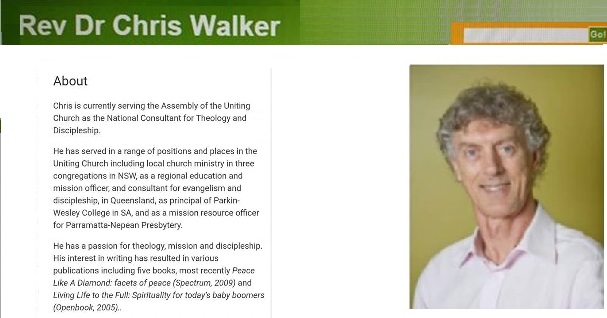
with Rev Dr Chris Walker
Misunderstanding
I am teaching a course on hermeneutics which is about understanding and interpretation, especially of written texts. Friedrich Schleiermacher, a leading nineteenth century German theologian, is regarded as the father of modern hermeneutics. He said that rather than understanding being the norm, it was misunderstanding that was the norm. Hermeneutics has to do with clearing away blockages to understanding so that we can grasp what is said or written rather than misunderstand what is intended. Understanding is not simple and there are methods to use to assist with grasping the thought or ideas.
It is easy to misunderstand others both in terms of content and also in regard to motivation. In our suspicious age, having been influenced by the masters of suspicion such as Marx, Nietzsche and Freud, we suspect that behind what is said is an economic, power or unconscious motivation rather than what is presented. We do well to be suspicious of politicians, business leaders and those who want to influence us in some way. They may claim to be on our side or acting in our best interests, but are they really? Is it in fact a matter of financial gain, power over us or manipulation to serve their interests? We can, however, also mistakenly attribute an ulterior motive to someone when the person is being sincere.
As I listen to the news and hear what various people say, especially politicians, those with vested interests, and those with particular ideologies, it is necessary to listen carefully to what is said, what is implied and what is not said. People in our time can no longer simply assert that they have our best interests or the interests of the nation at heart though there are those that still do this. We need to be convinced by argument and by evidence that they really are on the right track and deserve our support. I am not against politicians working towards a balanced budget, businesses making a profit, and people wanting to foster their own and their family’s well-being. Nevertheless, they should be transparent about this and not try to conceal their actual intentions or actions. I affirm the idea of the triple bottom line which talks about financial, social and environmental considerations, not just profits. Our world is too dominated by economics as though ever-increasing wealth, which is concentrated in the hands of a few, is the primary consideration. I want to live in a society that does have work for people to do, but also has liveable cities and towns, and the environment is cared for so that humans and other creatures can enjoy it.
Because I am suspicious of leaders in politics, business and other professions that benefit from my support, I generally take a somewhat sceptical approach and seek to support those that are closer to my ideals knowing they will always come short. But hopefully I will not be badly misled. There are of course those who have experienced injustice, mistreatment, being cheated and abused by those with power. Unfortunately, the church as an institution is not exempt from this even though it professes to be following the way of Jesus and proclaims him as lord, as the servant leader.
As a Christian I keep coming back to Jesus as the one leader I can trust without reserve. I am motivated by his vision of the kingdom or reign of God in which all people are cared for, justice and peace are practiced, creation is valued for its own sake, everyone has a place, and all people are treated with dignity for God ensures this.
Jesus himself, of course, was often misunderstood. Even his closest followers found it hard to grasp what he was on about. They tended to think in terms of a worldly kingdom with themselves in key positions rather than the kingdom of God which Jesus said you could only enter by recognising your need of God. He wanted disciples who followed his non-violent, compassionate way, not the way of violence and assertion at the expense of others. He was inclusive of people and while warning about those who took advantage of their positions, did not regard anyone as outside the possibility of entering the kingdom of God.
Jesus’ message and example continue to inspire people. Many of the people most admired in the 20th century were people who were motivated by Jesus. Think of Martin Luther King Jr in the USA and his fight for civil rights for black people. Consider Mother Teresa of Calcutta and her followers who sought to care for the poorest of the poor in India and elsewhere. Nelson Mandela and Desmond Tutu in South Africa spoke out against and finally saw the end of apartheid. They ushered in a new day for the nation seeking reconciliation and justice for all. Even Gandhi acknowledged the influence of Jesus, especially his Sermon on the Mount (Matthew 5-7), while remaining a Hindu. It is these people who showed courage, compassion and fortitude that we admire and hold up for emulation. The tyrants of the 20th century such as Hitler, Stalin, Pol Pot and others we recognise to be evil people responsible for the death of millions of lives as they sought to rule and dominate others. Hitler used his rhetorical skills to mislead Germans to follow him believing he would make Germany great. Unfortunately, only a few saw the evil he represented which became only fully evident after the Second World War concluded. The Confessing Church with people such as Karl Barth and Dietrich Bonhoeffer opposed Hitler but were a minority voice.
Understanding is an achievement not always readily made. Misunderstanding is easy for we can quickly think we understand when we have not, or only grasped some of what is said. Let us take the time to really listen to people and evaluate what is said and written for the sake of all people.
Chris Walker
(National Consultant Christian Unity, Doctrine & Worship)
chrisw@nat.uca.org.au
http://revdrchriswalker.wordpress.com/
Chris is currently serving the Assembly of the Uniting Church as the National Consultant for Theology and Discipleship.
He has served in a range of positions and places in the Uniting Church including local church ministry in three congregations in NSW, as a regional education and mission officer, and consultant for evangelism and discipleship, in Queensland, as principal of Parkin-Wesley College in SA, and as a mission resource officer for Parramatta-Nepean Presbytery.
He has a passion for theology, mission and discipleship. His interest in writing has resulted in various publications including five books, most recently Peace Like A Diamond: facets of peace (Spectrum, 2009) and Living Life to the Full: Spirituality for today’s baby boomers (Openbook, 2005).