
NSW 주정부 ‘산불 조사 보고서’ 발표, 76개 권장사항 제시
주원인으로 ‘기후변화와 산림 확장’ 주목 [EXECUTIVE SUMMARY & RECOMMENDATIONS 전문 포함]
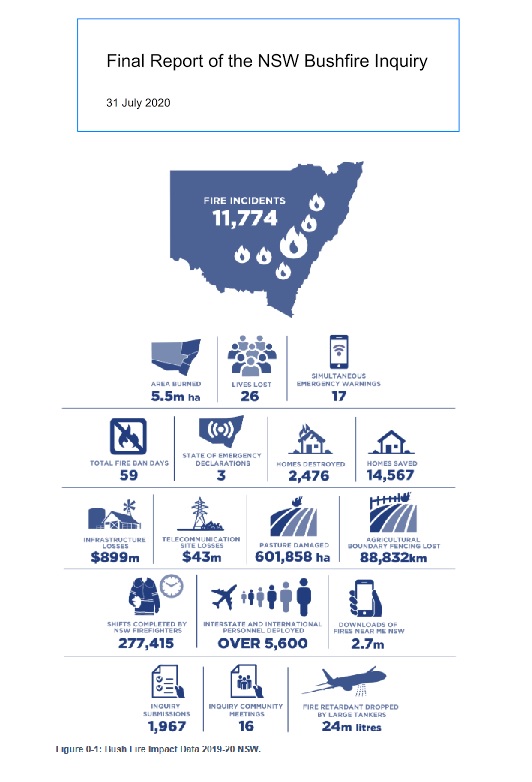
NSW 주정부는 지난 8월 25일(현지시간) 파괴적인 2019-20 산불의 원인, 준비 및 대응을 조사한 독립적인 NSW주 산불 조사 보고서 (Final Report of the NSW Bushfire Inquiry)를 발표했다.
모두 76개 권장사항을 제시했다. 이후 일정에 따라 추가 작업이 수행 될 것이며, 보고서에서 다루지 않은 재산 및 생명 보호와 관련된 모든 문제도 추가로 검토될 것이라고 했다.
Gladys Berejiklian 주총리는 이 보고서를 작성하기 위해 노력한 전 NSW 주경찰 부국장 Dave Owens와 Mary O’Kane AC 교수에게 감사를 표하며 “NSW 주정부는 RFS 및 Resilience NSW와 긴밀히 협력하여 NSW주가 다음 화재 시즌에 대비할 만큼 준비되어 있는지 확인했지만 이 조사를 통해 얻은 교훈은 우리의 준비와 대응을 더욱 향상시키는 데 도움이 될 것”이라고 말했다. 또한 “NSW 주정부는 이미 2020년 5월에 발표된 추가 자금으로 4천5백만 달러 이상을 전달하여 위험을 감소하고 소방 능력을 향상시켰다 … 이것은 끔찍한 산불로부터 사람들과 재산을 보호하도록 취할 수 있는 모든 조치를 살펴볼 것”이라고 했다.
이 보고서는 또한 이러한 파괴적인 화재에 ‘기후 변화와 주 산림의 광대한 확장’이 상당한 동기가 됐다고 판단했다.
John Barilaro 부총리는 “76개 권장 사항은 지난 여름의 재앙적인 산불에서 배운 가혹한 교훈을 기반으로 했다 … 지난 산불은 이전과는 달랐으며 정부의 대응이 필요하다”고 했다.
Police and Emergency Services 장관 David Elliott는 “NSW주가 2020-21 화재 시즌을 대비해 그 어느 때보다 더 준비되어 있다”고 말했다. Elliott 장관은 “우리는 이미 권장 사항을 실행하여 차량을 교체하고 개조하기 시작했으며, 회계 연도가 끝나기 전에 120대의 새로운 트럭과 70대의 리퍼비시 트럭을 갖추었다”고 말했다. 또한 “이 무자비한 산불 시즌에 우리 모두를 자랑스럽게 해준 모든 비상 요원과 자원 봉사자에게 감사드린다”고 인사했다.
다음은 NSW주 산불조사위원회의 보고서 관련 보도자료 전문이다.
NSW Government releases Bushfire Inquiry Report [보도자료 전문]
25 August 2020
The NSW Government has released the independent NSW Bushfire Inquiry, which examined the causes, preparation and response to the devastating 2019-20 bushfires.
All 76 recommendations will be accepted in principle, with further work to be done on specific timelines to give communities assurance that changes will be made to keep them safe.
Any issues not covered in the report that are still relevant to the protection of property and life will also be further examined.
Resilience NSW, led by Commissioner Shane Fitzsimmons, has been tasked with coordinating and overseeing the implementation of the Inquiry’s recommendations as the government finalises its approach.
Premier Gladys Berejiklian thanked former NSW Police Deputy Commissioner Dave Owens and Professor Mary O’Kane AC for their hard work on this report.
“The NSW Government has worked in lock-step with the RFS and Resilience NSW to ensure the state is as prepared as it can be to face the next fire season, but the learnings from this Inquiry will help us further improve our preparedness and response,” said Ms Berejiklian.
“The NSW Government has already delivered more than $45 million in additional funding, announced in May 2020, to fast-track hazard reduction and deliver upgrades to our firefighting capability.
“This was a terrible bushfire season and we will look at all the steps we can take, especially in relation to helping people protect their property.”
The findings of the report show that there is an opportunity to strengthen governance and responsibility, which we are in the process of addressing.
The report also acknowledges the significant contribution of both climate change and the vast expanse of the state’s bushland towards these devastating fires.
Deputy Premier John Barilaro said all 76 recommendations in the Inquiry are based on the harsh lessons learnt from the catastrophic bushfires of last summer.
“Last bushfire season was unlike anything we have ever dealt with before and we need a government response to match,” Mr Barilaro said.
“Things like strategic hazard reduction and better land management no matter the tenure are essential when it comes to keeping our communities safe.”
Minister for Police and Emergency Services David Elliott said NSW is more prepared than ever before for the 2020-21 fire season.
“We have already begun implementing the Inquiry’s recommendation to replace and retrofit the fleet, with 120 new trucks and 70 refurbished trucks to be rolled out before the end of the financial year,” Mr Elliott said.
“I would like to thank all our emergency personnel and volunteers who made us all proud over this relentless bushfire season.”
……………………………….
EXECUTIVE SUMMARY
On 30 January 2020 the Premier announced an Inquiry into the 2019-20 bush fire season to make recommendations in relation to bush fire preparedness and response and to report by 31 July 2020, ahead of the 2020-21 bush fire season.
The Inquiry has worked to understand what happened during the 2019-20 bush fire season and how it was different to seasons that have come before, and to make recommendations for future improvements to how NSW plans and prepares for, and responds to, bush fires, rather than to attribute blame. The Inquiry was not asked to and did not examine bush fire recovery issues.
The focus of this report is to provide analysis and recommendations for change to ensure that, when bush fires like this happen again, there is less damage to property and our environment and, as much as possible, there are no lives lost.
The 2019-20 bush fire season was extreme, and extremely unusual. It showed us bush fires through forested regions on a scale that we have not seen in Australia in recorded history, and fire behaviour that took even experienced firefighters by surprise. The total tally of firegenerated thunderstorms in south-eastern Australia since the early 1980s increased from 60 at the end of 2018-19 to almost 90 at the end of the 2019-20 bush fire season – an increase of almost 50% in one bush fire season. Fire-generated thunderstorms are extremely dangerous phenomena that produce extreme winds, lightning, tornadoes and black hail.
The season showed us what damage megafires can do, and how dangerous they can be for communities and firefighters. And it is clear that we should expect fire seasons like 2019-20, or potentially worse, to happen again. A number of factors combined to make this season so extraordinary. Climate change as a result of increased greenhouse gas emissions clearly played a role in the conditions that led up to the fires and in the unrelenting conditions that supported the fires to spread, but climate change does not explain everything that happened.
The 2019-20 bush fire season challenged conventional assumptions. For example, it
appears that the extreme dryness of forested regions over large continuous areas was the determining factor in the size of the fires. When taken together with the weather conditions experienced, the fires became extreme, burning through forests and across bare earth.
Previous prescribed burning and hazard reduction activity appears to have reduced fire severity in some instances, but in others it appears to have had no effect on the severity and spread of the fires.
This season also challenged assumptions about how we fight fires. The scale of the fires stretched the capacity of fire authorities and the underpinning systems to respond, even with interstate and international support. We couldn’t get to all new fires early enough, many of which were started by lightning in remote or rugged terrain and quickly got to the point where suppression was extremely difficult.
It is also clear that, despite the bravery and ingenuity of our firefighters in the face of enormous risk, capable Incident Management Teams coordinating the responses to the various big fires, and the huge expenditure on fire fighting, we need to know much more about bush fire suppression methods and how effective they are, especially in the face of megafires like these. Techniques and strategies that worked in previous seasons often did not work as well in the 2019-20 season. There is a need for much more research into fire fighting strategies including improving capabilities for immediate detection of new ignitions, especially in remote areas, and fast responses to keep new fires small. There is a need for more research into conventional fire fighting techniques like backburning, and we need to understand and predict better when fires might escalate into dangerous, extreme fires that require firefighters to leave the fireground.
But our systems served us well in many cases. Lessons from the Black Saturday bush fires that have informed much blunter messaging about leaving early seemed to be very effective in getting people out of harm’s way. Many people involved in fighting the fires said that the coordination between different agencies and fire fighting authorities was incredibly effective.
The relatively new NSW RFS State Operations Centre at Homebush proved very successful as an overall operational centre.
This report aims to help NSW and Australia improve systems to be more ready for extreme fires. That said, it shows there are still lots of unknowns requiring continuing work, and many of the Inquiry’s recommendations go to that point.
Some immediate fixes will improve things, for example, checking and auditing that
processes that are supposed to be followed are actually happening, improving accountability processes, and improving safety equipment and systems for firefighters (truck cabin protection, aircraft, respiratory protection, sustenance, personal protection, etc.).
There are important fire fighting enhancements needed – more emphasis on getting fires out early; improved backburning protocols, training and information around heavy plant use; the right mix of aerial fire fighting assets; and increased aerial night fire fighting.
There is also a need for improved telecommunications, both to ensure the community can access the information it needs to make timely and appropriate decisions, and to enhance fire fighting capability. This varies from improving power backup arrangements, to expanding fire information apps, to improving firefighter access to radio public safety networks. When evacuations are required, there are more things we can do to ensure that the community, especially the more vulnerable, are appropriately looked after.
Over the longer term, some major changes are needed. We need to push available
technologies harder, especially fire science, remote sensing, data science and artificial intelligence to equip us better to understand what happens during a bush fire and respond more quickly. Many government systems also need to be improved, especially strengthening cross-agency accountability and governance; training; being more strategic in our land use planning to account for bush fire; and better managing critical infrastructure including fire trails and roads to minimise property and asset damage.
Central to the way forward must be improving local preparedness and resilience. Fires of this kind are hard to suppress, regardless of how well-prepared fire authorities are, and the community needs to be physically and mentally prepared. At the centre must be individual responsibility for managing risk and making properties as safe as possible starting from the most local of levels. Enhanced community education and engagement and individual and community ownership of risk (informed by high-quality information) should be central to the Government’s response.
Inquiries like this one are important, but they must not be the end of the examination of the 2019-20 bush fire season. No one yet fully understands exactly what happened in every location and under every variation in weather, terrain, vegetation type etc. In some ways, this Inquiry will be a success if it is superseded because further research, that was not possible in the timeframe, can bring important new insights that will better inform our approaches to preparing for and responding to bush fires. A good example of this is the Royal Commission into the 2009 Black Saturday bush fires in Victoria. Lessons learned from that event, for example, the evolution of messaging to get people out quicker, appears to have been critical in saving lives during the 2019-20 season. But other issues, like recommendations for an area-based hazard reduction target on public land, have now been superseded by more strategic, risk-based approaches driven by much better data and modelling. We have also seen the understanding of what happened on Black Saturday evolve since that Royal Commission concluded. It was only several years later that further research identified the role of a fire-generated thunderstorm in the fire at Kinglake.
As Richard Thornton, CEO of the Bushfire and Natural Hazards Cooperative Research Centre, states, we need a quantum shift in our thinking and “to pursue the same path is tacitly to say that there is an acceptable number of deaths, injuries and property losses from bush fires in Australia each year”.
The NSW Inquiry thinks that it is inevitable that there will be future property losses, given the settlement patterns in NSW and legacy development issues. But loss of life is never acceptable, and firefighters’ lives should not be put at risk to defend property.
Recognising and accepting what can be defended and what can’t be during an extreme fire season may require a big cultural shift for both the fire services and the community. More trucks and more firefighters are not the answer to the scale of the challenge NSW and Australia was confronted with during the 2019-20 bush fire season. Ideally, technology will be harnessed to minimise the risk to first responders. We need to grab what is becoming possible in terms of unmanned aircraft and vehicles, and think big about what will make fire fighting, and living in the community with fire, safer.
RECOMMENDATIONS
Recommendation 1
That, in order to ensure recommendations accepted by the Government are implemented in a timely and transparent manner, Government establish a central accountability mechanism to track implementation of recommendations from bush fire-related reviews and inquiries and consider expanding this to other policy areas.
Recommendation 2
That at the start of each fire season, based on advice from the Bush Fire Coordinating Committee, Government provide a public statement with an evaluation of the likely fire season risk and the effectiveness of the planning and preparation for the upcoming season.
This should be based on sophisticated monitoring of the key risk factors and signals for an extreme fire season. It should form the basis for clear public communication about these risks on a regional basis and the actions that Government proposes in preparation.
Recommendation 3
That the NSW Government, along with other Australian governments, ask AFAC to establish a national bush fire database. This database would enable:
monitoring of trends in bush fire activity and impacts, including timing, cause, extent and intensity across all land tenures and vegetation types
tracking trends and identifying patterns in associated weather and climate signals that contribute to severe bush fires
evaluation of the cost and effectiveness of risk mitigation efforts, including hazard reduction, and fire suppression activities so we have a better understanding of what works.
Recommendation 4
That, in order to improve capability to detect ignitions and monitor accurately all fire edge intensity and progression automatically across the State in near real time, Government establish a spatial technology acceleration program to maximise the information available from the various remote sensing technologies currently in use and to plan for inclusion of new remote sensing systems that can sense precisely and rapidly through heavy smoke, cloud, fog and dust. This will require work within the State and with partners nationally and internationally.
Recommendation 5
That Government establish NSW as a major world centre of bush fire research, and technology development and commercialisation. This should include:
a) establishing a Bush Fire Technology Fund, modelled on the Medical Devices Fund, to assist with the rapid development of technologies and services to sense, fight, mop up after and protect from bush fires
b) commissioning further research into extreme fire behaviour and building up the research and research training capacity in this field. This will improve our ability to understand, model and predict the likelihood of extreme fire behaviour in the landscape and enable targeting of fire fighting resources to areas where fires are likely to become most damaging.
Recommendation 6
That Government support training initiatives to increase the capacity of fire authorities to fight the kind of megafires seen in the 2019-20 season. The training initiatives should include:
a) targeted training in local weather effects for fire behaviour analysts who are embedded in Incident Management Teams
b) an increase in the number of trained fire behaviour analysts so that, should there be a repeat of the scale of these fires, all Incident Management Teams can have an embedded analyst and there is some redundancy under more normal conditions
c) training of more meteorologists in fire behaviour so there are more expert resources available to embed within the NSW RFS State Operations Centre
d) dedicated training for firefighters in extreme fire behaviour
e) support for research training in challenging firefighting problems.
Recommendation 7
That the NSW RFS Commissioner consult with the Fire and Rescue NSW Commissioner and other emergency services to develop a protocol in the event that simultaneous emergency events necessitate the re-allocation of resources while a Section 44 declaration is in place.
Recommendation 8
That, to strengthen cross-agency accountability and deliver improved bush fire risk management outcomes:
a) Bush Fire Coordinating Committee (BFCC) members from NSW government agencies are at the level of Coordinator General/Deputy Secretary/Agency Head/Deputy Commissioner (or equivalent)
b) the BFCC ensures all Bush Fire Risk Management Plans, Operation Coordination Plans and Fire Access and Fire Trail (FAFT) Plans are compliant with the timeframes outlined in section 52 of the Rural Fires Act as soon as practicable
c) the BFCC develops a risk-based performance auditing cycle to ensure Bush Fire Risk Management Plans, Operation Coordination Plans and FAFT Plans are fit-for-purpose and any opportunities for improvement are identified and actioned
d) the NSW RFS considers the best way of enhancing the transparency of BFCC decisionmaking, for example by publishing BFCC membership and minutes on its website
e) the BFCC endorses the annual statement to Parliament on the likely fire risk and the effectiveness of planning and preparation
f) relevant agencies review Bush Fire Management Committee (BFMC) membership and confirm to the NSW RFS that members have sufficient discretion and authority to agree and implement risk mitigation activities at the local level
g) the NSW RFS Commissioner amends the BFMC Policy to require BFMCs to refer
unresolved issues to the BFCC for resolution.
Recommendation 9
That the NSW RFS work with AFAC to analyse the impact of changing fire seasons on interjurisdictional resource sharing agreements, both domestic and international, and determine any flow-on effects for NSW fire fighting personnel capacity.
Recommendation 10
That, in order to expand NSW’s specialist aviation personnel safety and capacity,
Government expand simulator capabilities at the NSW RFS Training Academy.
Recommendation 11
That, in order to strengthen the capability of local councils in future emergency events:
a) Resilience NSW, in consultation with local government, develop specific training that focuses on the role, responsibilities and expected functions of the Local Emergency Management Officer (LEMO), including regular ‘refresher’ components
b) Councils support their staff to participate in LEMO training on an ongoing basis, and ensure that staff who are LEMOs are appropriately senior and have the authority to commit resources.
Recommendation 12
That Government work with other Australian governments to provide long-term funding certainty to AFAC, including the National Resource Sharing Centre (NRSC) and the National Aerial Firefighting Centre (NAFC).
Recommendation 13
That, to ensure updated resource-sharing arrangements are in place, the NSW and Victorian Governments progress and finalise a multi-agency Memorandum of Understanding before the 2020-21 fire season commences.
Recommendation 14
That in order to provide greater consistency in public information and warnings, especially in border areas:
a) the finalisation of the Australian Warning System be prioritised to provide greater consistency in public information and warnings
b) the NSW State Emergency Management Committee, including the Public Information and Warnings Sub-Committee, prioritise the implementation of the Australian Warning System and data standards for relevant hazards within NSW.
Recommendation 15
That Government commit to:
a) evaluating existing bush fire preparedness programs to determine the most effective and efficient approach given increased frequency of extreme fire seasons, and develop outcomes-based measures to monitor programs’ impact over time
b) post-evaluation roll out the most effective bush fire preparedness programs to all communities and at-risk cohorts in bush fire prone areas across NSW.
Recommendation 16
That, in order to ensure tourism businesses are prepared for natural disasters including bush fires, Resilience NSW work with NSW RFS and Destination NSW to develop bush fire preparedness support for tourism businesses, based on research into existing models. Over time, this support could be expanded to include other natural hazards.
Recommendation 17
That the NSW RFS identifies remote bush fire prone areas that do not already have an indoor Neighbourhood Safer Place (NSP) and upgrades the relevant NSW RFS Stations to meet NSP guidelines. These stations would require adequate Asset Protection Zones and active/passive protection systems to provide short-term protection.
Recommendation 18
That, in order to equip NSW RFS with comprehensive information on all structures and assets at risk of bush fire, Government ensures that:
there is a single whole-of-government procurement and acquisition program for imagery and LiDAR and that Government accelerate the building of the State Digital Twin and associated Digital Workbench
owners/managers of assets (apart from private home owners whose information will be provided through local councils) in bush fire prone land are required to provide to the Digital Twin at least the following information/metadata with quality control certification on an annual basis (with annual census at least two months before the start of the fire season):
• precise geolocation
• description of asset including picture
• value level
• fire treatment on asset
• Asset Protection Zone (APZ) details and how it is maintained
• access details
• what redundancy is available if relevant
• any metadata requirements specific to the asset class
• emergency contact and instructions on how to access where more information is held
• any restrictions on data access and sharing.
The Digital Twin must also be able to incorporate:
information about the hazard reduction results for road verges, fire trails, APZs and other defendable space
local information supplied by organisations such as local NSW RFS brigades.
Recommendation 19
That Government re-commit to the current, regionally based approach to planning and coordinating hazard reduction activities across all tenures through Bush Fire Management Committees but ensure that it is actually being implemented at a high-level of quality across NSW. Getting it to a high-level of quality requires:
a) implementing the Inquiry’s recommendation about performance auditing of Bush Fire Risk Management Plans
b) prioritising implementation of revised processes for bush fire risk management planning that incorporate new modelling and methods for quantifying risk and the residual risk profile as a result of proposed hazard reduction works
c) ensuring regional priorities for hazard reduction, and how they are determined, are communicated clearly to the community, and their implementation is reported on transparently. This will include being very clear about the objectives of hazard reduction activities and communicating that hazard reduction does not eliminate the risk of fire affecting properties
d) the methodology for assessing and planning for risk reduction becomes an ongoing area of research and the frameworks are formally reviewed every three years.
Recommendation 20
That Government, noting that hazard reduction targeted in proximity to assets is on balance more likely to provide help than hinder, should:
a) support local councils and partner agencies to implement more comprehensive hazard reduction at a local level around towns/cities, communities and local infrastructure assets, and provide incentives for communities to organise themselves to prioritise and implement local hazard reduction initiatives. This will involve a suite of hazard reduction techniques depending on the landscape including prescribed burning, clearing, mowing, and mechanical treatments, and easy disposal of green waste into processors turning it into bioenergy or biofuels
xi
b) beyond the local level priorities for hazard reduction, prioritise prescribed burning in parts of the landscape where fuel treatment may help reduce probability of fires escalating quickly and where terrain and potential atmospheric interactions are likely to escalate fires into fire-generated thunderstorms. This will likely involve a proactive program of treating ridge tops that are prone to dry lightning where reduced fuels may help reduce speed of spread when the fire first starts, or particular windward or lee-slopes that are susceptible to generating extreme fire behaviour and drive fire towards towns.
Recommendation 21
That, in order to improve understanding of optimal hazard reduction techniques and their application in the landscape:
a) Government extend the recently introduced program of mitigation crews so that hazard reduction activities can be undertaken when conditions are optimal (throughout the week and potentially at night)
b) all fire authorities review prescribed burning techniques and their implementation, and commission further research into optimal prescribed burning regimes and techniques.
This should include research to understand critical thresholds that, when breached, may render fuel treatment ineffective (i.e. fuel moisture thresholds), and the short, medium and long-term outcomes of hazard reduction burning regimes
c) Government commission research into a range of other hazard reduction techniques to understand better the cost versus benefit and effectiveness of different practices in various circumstances, including grazing.
Recommendation 22
That, as part of the spatial technology acceleration program, Government support
deployment of remote sensing and picture processing technologies to monitor and audit how well Asset Protection Zones and defendable space are being maintained, especially around towns.
Recommendation 23
That Government amend the Rural Fires Act 1997 so that all public land management agencies be required to forward complaints received about bush fire hazards to the Commissioner of the NSW RFS. As an interim measure, heads of agencies should commence this practice immediately.
Recommendation 24
That government agencies managing land (at all levels and through all agencies) be the best neighbours possible by considering their neighbours when undertaking activities related to bush fire preparation and having clear, two-way communication about these activities, with the aspiration that government landholders will be seen as highly desirable neighbours.
Recommendation 25
That Government adopt the principle that cultural burning is one component of a broader practice of traditional Aboriginal land management and is an important cultural practice, not simply another technique of hazard reduction burning.
Recommendation 26
That, in order to increase the respectful, collaborative and effective use of Aboriginal land management practices in planning and preparing for bush fire, Government commit to pursuing greater application of Aboriginal land management, including cultural burning, through a program to be coordinated by Aboriginal Affairs and Department of Planning, Industry and Environment working in partnership with Aboriginal communities. This should be accompanied by a program of evaluation alongside the scaled-up application of these techniques.
Recommendation 27
That Government commit to shifting to a strategic approach to planning for bush fire, and develop a new NSW Bush Fire Policy similar to the NSW Flood Prone Land Policy in order to accommodate changing climate conditions and the increasing likelihood of catastrophic bush fire conditions; to build greater resilience into both existing and future communities; and to decrease costs associated with recovery and rebuilding.
Recommendation 28
That Government, acknowledging that a strategic approach to planning for bush fire will take time, and in order to protect, prepare and build resilience into existing communities better, should immediately:
prepare, in association with the insurance sector, a model framework and statutory basis for the establishment of an enforcement, compliance and education program which adopts a risk-based approach to routine inspection of local bush fire prone developments to ensure that every local development on bush fire prone land is prepared for future bush fire seasons in accordance with bush fire protection standards of the day, that account for worsening conditions
ensure local government is resourced to enable effective audit, enforcement and
compliance powers in respect of local developments and assets on bush fire land
consider the introduction of subsidies for property owners to undertake site mitigation works to reduce bush fire risk and work with the Insurance Council of Australia to develop an agreed set of measures to insure against with a view to risk reductions resulting in lower insurance premiums
review vegetation clearing policies to ensure that the processes are clear and easy to navigate for the community, and that they enable appropriate bush fire risk management by individual landowners without undue cost or complexity.
Recommendation 29
That, in order to maximise the protection of critical infrastructure in a bush fire, Australian governments revise the regulatory framework for the provision to government authorities of information about all critical infrastructure (public and private) including a possible change to compel the owners of critical assets to provide all needed metadata, updated annually, for appropriate planning, preparation and response for bush fire. This would include information about location, ownership, access, details of service the infrastructure supports, and fire
treatments of building and surrounding zones.
Recommendation 30
That, in order to minimise communication outages and extend basic communication coverage during bush fires, the NSW Government work directly, or together with other Australian governments and/or their relevant power and telecommunications regulatory, policy and market bodies, to:
ensure there are sufficient redundancy options available (e.g. backup diesel generators, deployed temporary telecommunications facilities, etc.) to supply power to essential telecommunication infrastructure or alternative telecommunications infrastructure
ensure that the telecommunication entities’ and electricity network providers’ Bush Fire Risk Management Plans are updated annually and reported on in the NSW RFS Commissioner’s annual statement to Parliament on the upcoming bush fire season and include details of all actions taken to mitigate those risks including maintenance of APZs and access roads
ensure there is appropriate auditing of distributors’ preparedness for risks arising from network assets being affected by bush fire, as well as the risk of networks initiating a bush fire
facilitate cross-carrier roaming arrangements between carriers and the public for basic text, voice and data during the period of emergency in areas directly affected by fire
enable NSW RFS to require carriers to provide regular information on the status of outages and areas affected by fire.
Recommendation 31
That, in order to improve bush fire planning and protection of road infrastructure and to ensure communities, freight movers and fire fighting agencies have appropriate access and egress in a bush fire event, Government, working with local government as needed:
develop a formal bush fire risk assessment process for all State roads and bridges, to identify:
• ‘high-risk’ communities where access and egress in the event of a fire will be
affected, for example rural communities connected by a single road surrounded by
bushland, and ensure community bush fire planning processes (i.e. Bush Fire Risk
Management Plans (BFRMPs) or Community Protection Plans) include plans to
‘leave early’ or enforce mandatory evacuation orders
• how waterways can be integrated better into the transport network as evacuation
routes or places of shelter when road and rail transport is unavailable – waterways should be included in regional emergency management plans
• route options for rapid identification of needed road closures in the event of fire
• key sections of the State’s road network for future upgrade to ensure whole corridors are resilient to fire impacts, regardless of who manages the asset
audit, through the NSW RFS Audit Unit (to be established) the inclusion of critical road infrastructure in BFRMPs prepared by Bush Fire Management Committees (ensuring that appropriate transport representation is provided to BFMCs) and Local Emergency Management Committees across the State.
In support of these measures, it will be critical that the community is given early warning of bush fire events and has ample time to evacuate prior to or during an emergency.
Recommendation 32
That, in order to ensure outcomes-based roadside vegetation management to reduce roadside tree fall and grass ignitions in planning and preparing for bush fire, Transport for NSW, working with local government and NSW RFS, establish a consistent framework for roadside vegetation management that analyses road priority, utility, amenity, strategic value
and risk. The framework should:
take into consideration landscape characteristics like distance, slope, set back,
vegetation maturity and type. Acceptable outcomes under this framework could include clear verges, or alternatives such as safe zones/pull-outs
tie in formally with other strategic land use and biodiversity processes.
Recommendation 33
That as a matter of urgency, in order to accelerate and finalise a State-wide strategic fire trail network, the NSW RFS Commissioner and Bush Fire Coordinating Committee (BFCC):
set a deadline for Bush Fire Management Committees to complete all outstanding Fire
Access and Fire Trail (FAFT) Plans for submission to BFCC for approval, and a related deadline for BFCC consideration of these
assess the completed suite of FAFT Plans to identify high-priority trails of relative strategic importance across the State for urgent construction or upgrades with particular reference to the needs of upcoming fire seasons
enforce completion of annual fire trail condition assessment reporting by relevant landholders. Following this, the BFCC should, as part of its standard business, undertake an audit of all FAFT Plans and annual fire trail condition assessment reports
develop a single asset management system to capture the outcomes of annual fire trail condition assessment reporting on a tenure-blind basis to support BFCC strategic and budgetary prioritisation and inform funding allocation to agencies for capital works programs
commission a review of FAFT Plans, with particular assessment of containment line potential, following a significant bush fire event in their area, as part of the planned review of BFCC Policy and NSW RFS Standards in 2020-21.
Where it is not feasible to construct a fire trail completely on public land, and private landowners are not satisfied with proposed negotiated arrangements to construct the trail across their land, Government should negotiate acquisition of an easement interest, with appropriate compensation, over private land.
Recommendation 34
That, in order to capture and understand the impacts of bush fire smoke better, Government invest in operational air quality forecasting and alert systems, and public health research and policy development. This would involve investment to:
develop a comprehensive system of forecasting and alerts for air quality incidents and all pollutants of concern, including but not limited to bush fire smoke, ozone and dust, and which is ideally nationally consistent
investigate further the health impacts of bush fire smoke, based on improved data collection and including research on the long-term health impacts of poor air quality as a result of sustained exposure to severe bush fire smoke, particularly for vulnerable and atrisk segments of the community (children, elderly, firefighters, etc).
Recommendation 35
That, in order to improve the provision of evidence-based public health messaging about air quality during bush fire events, Government develop a public education campaign and supporting systems before the next bush fire season. This should include:
a public education campaign (like sun exposure), to help people make their own
decisions about exposure to bush fire smoke
tailored messaging to target:
• smoke-vulnerable cohorts of the community
• general practitioners, particularly in rural and regional areas, so they can advise
patients with relevant, susceptible comorbidities
• employers, to support development of appropriate workplace health and safety
guidance for outdoor workers
an improved air quality alert system such as an enhanced Air Rater app.
Recommendation 36
That Government invest in long-term ecosystem and land management monitoring,
modelling, forecasting, research and evaluation, and harness citizen science in this effort.
This will include, among other things:
tracking and trying to forecast what is happening to ecosystems over decades under projected changes to climate extremes, including fire regime change
better understanding interaction of fire with other disturbances, e.g. drought, hydrological changes in the landscape
commissioning experiments and feasibility studies for ecosystem adaptation experiments – for example, facilitating shift of high conservation-value rainforest vegetation
communities further south as climatic conditions change
better understanding the influence of different land management practices on landscape flammability (in different landscapes) over the short, medium and long-term, and enabling an adaptive management approach.
Recommendation 37
That, in order to ensure all firefighters understand how local situational awareness reflects (or may not reflect) the broader scale situation presented by a large/extreme bush fire and the implications this may have on asset protection and fire suppression strategies, the NSW RFS:
a) develops information packages for all types of operating environments to improve out-ofarea crews’ understanding of the local terrain and fuels, and distributes information to out-of-area crew members from all fire authorities
b) accelerates the roll out of Mobile Data Terminals into all fire fighting vehicles to improve delivery of briefings and incident information/intelligence to field commanders.
Recommendation 38
That, in order to ensure the safety of local landholders on firegrounds, the NSW RFS emphasises the importance of local landholders using protective clothing while fire fighting
as part of the RFS’ ‘Farm Fire Unit Integration’ priority for 2020-21.
Recommendation 39
That, in order to ensure frontline personnel have appropriate personal protective clothing during bush fires:
a) FRNSW review the current design of its bush fire jacket, noting improvements that have been made since 2002 that meet AS/NZS4824:2006 Protective clothing for firefighters, and increase the allocation of bush fire coats to two jackets per member
b) NSW RFS issue two sets of personal protective clothing to operational members, and others as appropriate.
Recommendation 40
That, in order to improve firefighter safety, Government fire authorities:
a) ensure all light tankers used as part of active frontline bush fire fighting operations are fitted with a single point crew protection safety spray system and radiant heat protection blankets as a minimum standard across all NSW fire authorities
b) ensure all medium/heavy tankers are fitted with radiant heat protection blankets, wheel and ‘halo’ sprays fitted as a minimum standard across all NSW fire authorities
c) undertake additional research to determine the most appropriate cabin protection for the different frontline vehicles.
d) provide ongoing investment for NSW RFS fleet upgrades.
Recommendation 41
That, in order to ensure all NSW RFS members can access the mental health support they need, the NSW RFS expands in-house mental health support for members.
Recommendation 42
That, to ensure firefighters can access mental health support through GPs, Government work with the Commonwealth Government to:
a) provide a free mental health screen to firefighters post-fire event and waive any gap payments if additional treatment is required
b) create a new Medicare Benefits Scheme item number to enable Governments to track demand for mental health services from firefighters over time and ensure an appropriate level of support is available.
Recommendation 43
That, in order to ensure firefighter sustenance is of sufficient volume and quality, the NSW RFS reviews food standards and procedures in consultation with volunteers. The review should include catering service standards, including food safety, as well as the viability of sourcing commercial contracts and providing 12-hour food packs to firefighters.
Recommendation 44
That, in order to ensure suitably skilled and experienced personnel operate as Divisional Commanders during major fire incidents, Bush Fire Management Committees identify appropriate personnel as part of their plan of operations.
Recommendation 45
That, in order to prioritise early suppression and keep fires small:
a) Government set a KPI for NPWS regarding the percentage of fires that start on-park and are contained within 10 hectares, and consider whether 70% is an appropriate KPI for the NSW RFS and NPWS
b) NSW fire authorities deploy remote area fire fighting resources based on enhanced research and predictive modelling. In some circumstances, this may require prioritising the deployment of RART to enable rapid initial attack of new remote area ignitions over ongoing suppression operations, where supported by a relative risk assessment.
Recommendation 46
That, in order to improve early fire suppression, the NSW RFS trial initial aerial dispatch in areas of high bush fire risk. The trial should identify the most appropriate and cost-effective mix of aircraft, and any associated infrastructure improvements that would be required.
Recommendation 47
That, in order to enhance fire fighting strategies in severe conditions, the NSW RFS implements the following in respect to backburning:
a) establish protocols for each category (tactical and strategic) within their operational and training doctrine. These protocols should include lessons learnt from the 2019-20 season
b) modify ‘ICON’ to implement the capability to record all backburns, including whether or not they break containment lines
c) when fire conditions are approaching Severe or above, an independent review must be
undertaken at State Operations Level before strategic backburns are implemented
d) where there is significant concern within a community regarding a backburn, the NSW RFS should undertake a community engagement session with affected residents to discuss the backburn, including any investigation and relevant findings.
Recommendation 48
That Government commission further research on the potential risks and benefits of backburning during severe, extreme and catastrophic conditions and/or in particular terrain, and that the NSW RFS use this research to inform future backburning protocols and training.
Recommendation 49
That, in order to maximise the efficiency and effectiveness of heavy plant used in dry fire fighting techniques, the NSW RFS expand and introduce the following in respect to heavy plant:
a) increase the number of trained Heavy Plant Supervisors and Managers to ensure an appropriate level of supervision in future significant fire seasons
b) expand ARENA software to include the Heavy Plant Register, including the introduction of GPS tracking for all agency and contracted plant, to improve contractual compliance and to facilitate better the identification and tasking of appropriate localised heavy plant contractors; and review the feasibility of linkage to the SAP system for invoicing improvements. This should be introduced prior to the 2020-21 fire season
c) review the existing contractual process to ensure all heavy plant is categorised into types, size and functionality along with exploring potential for a standardised hourly rate for that category of equipment
d) work with Soil Conservation Service to ensure appropriate standards for the engagement and management of heavy plant to deliver safe and effective heavy plant service, including the delivery of standards and auditing.
Recommendation 50
That, in order to ensure Australia’s fire fighting aerial capacity capitalises on existing assets and is made up of the right mix, Government:
a) request the Commonwealth to conduct a trial with NSW RFS on the feasibility of
retrofitting RAAF C130 aircraft with modular airborne fire fighting systems to provide the Australian Defence Force with the capacity to augment aerial fire fighting during major disasters
b) work with states and territories through the National Aerial Firefighting Centre to review the current mix of aviation assets and determine whether it is fit-for-purpose, noting the current lack of mid-sized fire fighting aircraft.
Recommendation 51
That, in order to enhance NSW’s ability to improve situational awareness, Government expand FRNSW’s Remotely Piloted Aerial Systems (RPAS) capability (both capital assets and trained operators) to major regional centres and ensure the NSW RFS and other NSW government agencies can access this capability as required.
Recommendation 52
That, in order to enhance NSW’s fire fighting capacity, Government trial aerial fire fighting at night in the 2020-21 season with a view to full implementation if successful.
Recommendation 53
That Government develop and implement a policy on injured wildlife response, rescue and rehabilitation including:
a) a framework for the co-ordination and interaction with emergency management
structures
b) guidelines for Incident Management Plans to include wildlife rescue and rehabilitation as a consideration
c) a requirement for all vets and wildlife rescue volunteers to obtain the Bush Fire
Awareness accreditation
d) guidance for firefighters on handling injured wildlife.
Recommendation 54
That, to ensure mobile generators are sourced and distributed on a priority basis during natural disasters, the EUSFAC work with the NSW Telco Authority, relevant NSW government agencies and commercial stakeholders to develop a mobile asset deployment strategy. The strategy should reduce duplication in purchasing, maintaining and housing mobile generators and improve agility in deployment.
Recommendation 55
That, in order to improve fireground communications between NSW agencies and interstate personnel:
a) Government ensure all NSW fire authority personnel and vehicles can access and utilise the Public Safety Network (PSN). This should include access to NSW RFS Private Mobile Radio networks where PSN coverage is not yet available.
b) the NSW Telco Authority review cross-border communications availability and planning and advise NSW fire authorities on next steps to enable multi-state interoperability for wide area communications.
Recommendation 56
That, in order to ensure the State Emergency Operations Centre (SEOC) can maintain communications during emergencies, the Government provide the SEOC with independent Public Safety Network functionality.
Recommendation 57
That, in order to ensure emergency response agencies can communicate across state and territory borders, the Commonwealth Government allocate 10 + 10 MHz as a dedicated spectrum for Public Safety Mobile Broadband (PSMB) at no cost to states and territories.
Recommendation 58
That, in order to ensure all agencies have a clear understanding of cross-border
communication channels during bush fires, all MoUs between state or territory agencies include an agreed protocol about how agencies will communicate across borders and that these are reflected in Incident Action Plans.
Recommendation 59
That, in order to improve response times to Triple Zero calls, the NSW RFS implements the integrated dispatch system before the 2020-21 fire season commences.
Recommendation 60
That, in order to ensure timely payment and maintain positive ongoing supplier relationships during large-scale bush fires, the NSW RFS implements an automated logistics solution, informed by the outcomes of the Emergency Logistics Project.
Recommendation 61
That, in order to improve cross-agency communication and coordination during bush fires, the NSW RFS review Fire Control Centres (FCCs) in areas that were heavily affected by fire.
The results should be combined with the Emergency Operations Centre (EOC) Facilities Review to identify areas that would benefit from a purpose-built FCC, enabling co-location with the EOC.
Recommendation 62
That, in order to ensure State Emergency Operations Centre (SEOC) interoperability during all natural disasters, Resilience NSW review the current SEOC arrangements and location including responsibilities for ongoing resourcing and maintenance.
Recommendation 63
That, in order to ensure the guiding principles and approval processes are contemporary, streamlined and more flexible, the NSW and Commonwealth Governments review the Defence Assistance to the Civil Community (DACC) arrangements. This review should include the circumstances in which the State can request Commonwealth assistance, and the level of information provided by the ADF to the State on available resources and capabilities.
Recommendation 64
That, in order to expand the pool of trained personnel able to undertake the Public Information Functional Area Coordinator (PIFAC) role, Resilience NSW and the NSW Police Media Unit (PIFAC) develop and deliver a training package for Emergency Management Media Liaison Officers.
Recommendation 65
That, in order to improve information flows and increase public awareness of ABC
emergency broadcasts, Government:
a) include an ABC Manager in the Public Information Functional Area Coordinator (PIFAC) team within the State Operations Centre
b) strategically place roadside signage with local/regional ABC station frequency band throughout the State.
Recommendation 66
That, in order to provide real-time information on evacuation doorknocking during emergency events, Government explore a shared data gateway for NSW agencies based on the NSW State Emergency Service Collector app and a common mapping and analytics platform.
Recommendation 67
That, in order to ensure people can access clear information on cross-border fires, the NSW RFS:
a) incorporate information on fires in neighbouring states and territories into Fires Near Me NSW
b) collaborate with other states and territories to develop a national app as part of the Australian Warning System being developed through the AFAC Warnings Group.
Recommendation 68
That the NSW RFS include the following priorities in the Fires Near Me improvements roadmap:
a) text enlargement functionality
b) a clear statement about the app’s limitations and the importance of heeding public warnings and relying on personal observations
c) fire spread prediction maps on extreme/catastrophic days
d) update fire map information as technology improves.
Recommendation 69
That, in order to ensure evacuation arrangements can be scaled up when needed,
Resilience NSW:
a) ensure staff who are willing to be deployed to evacuation centres are trained as soon as possible to bolster evacuation centre staff surge capacity
b) train council and NSW government regional staff in evacuation centre establishment and management, supported by a one-page ‘start up sheet’ for opening an evacuation centre
c) enable interested community members to be trained to assist in evacuation centre establishment and management and provide an avenue for skilled volunteers to register their interest
d) develop an exercise for the management of multiple evacuation centres dealing with large numbers of people for a protracted period over a widespread area.
Recommendation 70
That, in order to ensure evacuation centres are fit-for-purpose, Resilience NSW work with Local Emergency Management Committees (LEMCs) to:
a) update the guidelines for LEMCs identifying evacuation centres to require a risk
assessment of potential locations, which should include identifying alternate sources of power for use by evacuation centres and recording these appropriately
b) review existing evacuation centre locations to assess compliance with updated LEMC guidelines and report to the State Emergency Management Committee on their suitability.
Recommendation 71
That, in order to ensure people only need to tell their story once to access government agency support following an emergency, Resilience NSW and Service NSW jointly design an inclusive, person-centred approach to information collection at evacuation centres. This should be supported by an opt-in scheme enabling personal information to be shared between NSW government agencies, local councils and non-governmental organisations administering support services for disaster-affected people.
Recommendation 72
That, in order to ensure Aboriginal people can access appropriate support during
evacuation, Resilience NSW work with Local Emergency Management Committees and Aboriginal Affairs to ensure:
a) local Aboriginal communities are included in emergency planning and preparation
b) all staff involved in evacuation centres and support services are culturally competent.
Recommendation 73
That, in order to ensure the safety and wellbeing of vulnerable people during an evacuation, Resilience NSW:
a) identify aged care facilities in fire and flood prone areas, and ensure that emergency plans are in place and comply with the Evacuation Decision Guidelines for Private Health and Residential Care Facilities
b) develop/refresh evacuation centre protocols to specifically address the needs of
vulnerable people.
Recommendation 74
That, in order to ensure equitable access to evacuation centres and associated support services for people in border communities, Resilience NSW ensure cross-border access arrangements are reflected in evacuation centre management guidelines.
Recommendation 75
That, in order to improve support for people evacuating with animals, the Department of Primary Industries:
a) work with Resilience NSW to develop evacuation protocols and procedures to ensure appropriate supports are provided for both people and animals (informed by the findings from Project Ohana), including a process for animal registration at evacuation centres and mutually agreed naming conventions, and provide this information to Local Emergency Management Committees (LEMCs)
b) work with LEMCs to identify overflow sites that can be used for evacuated animals when preferred sites are full
c) further develop the domestic pets evacuation protocol.
Recommendation 76
That Resilience NSW review existing functional area arrangements to ensure they are closely aligned to agencies responsible for direct service delivery.
제공 = NSW
크리스천라이프 편집부