
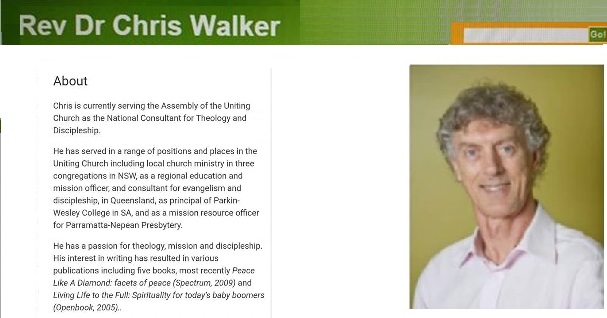
with Rev Dr Chris Walker
The Call to Maturity – personal and political
Bob Dylan has a line in one of his songs which speaks about seeking fortune or fame “though neither of them are what they claim.” For many people, their goal in life is to become rich or at least well off. This dominates their thinking and actions. They become consumed by how to increase their financial position and are distressed by any set-backs in regard to this. Related to this is the desire for fame. Reality television shows give ordinary people the possibility of becoming famous simply by being on television with thousands of people watching. I suspect that the success of social media is that people can talk about themselves and put up pictures which they hope will get many ‘likes’ even from people they do not know. The truth is, however, that it is maturity not fortune or fame which is what we should really be seeking.
This applies to all people. I am sometimes amazed by political leaders and the immature things they say and do. At present, we have a dangerous situation in North Korea with its leader carrying out nuclear and missile tests seeking to get attention and display his power. The response of the President of the USA is not much better with threats of overwhelming force if anything happens. The United Nations request for a mature response and negotiation goes unheeded. A mature leader would be more interested in the well-being of his people than with displays of military force that are enormously expensive and hopefully will never be used against anyone. We are all called to grow towards maturity and wisdom in life.
When we are born we are inevitably self-oriented. Babies assume they will be provided for and that their cries will be heard and responded to. This is necessary and appropriate at this stage of life. As we grow, however, we come to recognize the needs of others and not just our own. Admittedly some people continue to be self-focused. Even when they acknowledge the needs of others, they still are dominated by their own interests and requirements. Mature people realise that while we have our own legitimate needs, so too do others. We are called to grow towards maturity in which we appreciate that others have their requirements and we are to have a mutually beneficial and caring relationship. We may even be willing to sacrifice for the sake of others which means putting people’s welfare ahead of our own.
I have been teaching a course on Emerging Christian Theology at Murdoch University here in WA looking at the development of Christian thinking in the early centuries of the church. A significant thinker in the second century was Irenaeus, bishop of Lyons. He wrote about the first humans as being immature and needing to grow and learn which inevitably meant making mistakes. The goal is to become like Christ. In the Pauline letter to the Ephesians we have the statement that leaders of the church are to equip the people for the work of ministry and for building up the body of Christ. They are to do so, “until all of us come to the unity of the faith and of the knowledge of the Son of God, to maturity, to the measure of the full stature of Christ” (Ephesians 4:13).
Maturity has to do with living rightly, caring for others, and having broad interests and concerns. It would lead us to value others, accept differences, and not be excessively critical. Paul has some helpful comments in regard to this. He encouraged the Christians at Rome to live sacrificially before God and “not be conformed to this world but be transformed by the renewing of your minds” (Romans 12: 1-2). Rather than conforming to this world with its emphasis on self-interest, we are to be transformed in our thinking to seeking God’s good purposes for all. The goal is to discern and act on what is the will of God. It is not always easy to know what is the best course of action. The Holy Spirit can assist both to discern and then to carry out God’s will which involves what is best for all. Paul says that we should not think of ourselves more highly than we ought to think but to think with sober judgment. We are to use our gifts for the building up of the body. He says, “Let love be genuine; hate what is evil, hold fast to what is good; love one another with mutual affection; outdo one another in showing honour…. Rejoice in hope, be patient in suffering, persevere in prayer” (Romans 12:9-12).
In relation to those who are against us he calls for a very different response to the usual one of wanting to get back at such people. He says, “Bless those who persecute you; bless and do not curse them.” We are to rejoice with those who rejoice and weep with those who weep. Instead of repaying evil with evil, he recommends that we consider what is noble in the sight of all. As far as it depends on us we are to live peaceably with all. Rather than seek to avenge ourselves we are to leave it to God. We are to do the opposite of what is expected, namely to give our enemies food and drink, to overcome evil with good. This may perhaps have an impact on them leading to change.
Would that the leaders of the nations would act in more mature ways seeking to resolve issues peacefully and cooperatively rather than resorting to war, violence and displays of military power. If the leaders were more mature they would be primarily concerned about the needs of their people, and indeed the needs of others and the planet itself. They would move away from military spending and actions which are hugely expensive and destructive, to focusing on ways to improve the lives of people and ensure the sustainability of the planet.
Chris Walker
(National Consultant Christian Unity, Doctrine & Worship)
chrisw@nat.uca.org.au
http://revdrchriswalker.wordpress.com/
Chris is currently serving the Assembly of the Uniting Church as the National Consultant for Theology and Discipleship.
He has served in a range of positions and places in the Uniting Church including local church ministry in three congregations in NSW, as a regional education and mission officer, and consultant for evangelism and discipleship, in Queensland, as principal of Parkin-Wesley College in SA, and as a mission resource officer for Parramatta-Nepean Presbytery.
He has a passion for theology, mission and discipleship. His interest in writing has resulted in various publications including five books, most recently Peace Like A Diamond: facets of peace (Spectrum, 2009) and Living Life to the Full: Spirituality for today’s baby boomers (Openbook, 2005).