
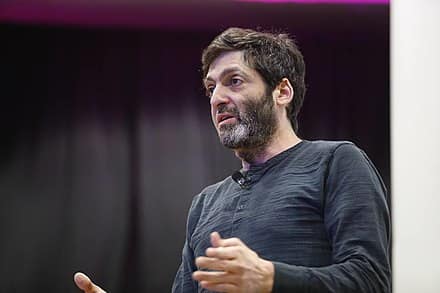
1967년 4월 29일, 미국의 경제학자 댄 애리얼리 (Dan Ariely, 1967 ~ ) 출생
댄 애리얼리 (Dan Ariely, 1967년 4월 29일 ~ )는 심리학과 행동경제학을 가르치는 교수다.
미국 듀크대에서 강의하고 있고, The Center for Advanced Hindsightd의 설립자이다.

– 댄 애리얼리 (Dan Ariely)
.출생: 1967년 4월 29일, 미국 뉴욕 뉴욕
.부모: 다프나 애리얼리, 요람 애리얼리
.자녀: 아미트 애리얼리, 네타 애리얼리
.지도 교수: 제임스 베트만
.유명한 제자: 보리스 마치요브스키
.주요저서: 《상식 밖의 경제학 Predictably Irrational》, 《거짓말하는 착한 사람들 Irrationally Yours》, 《댄 애리얼리 부의 감각 Dollars and Sense》 등
댄 애리얼리는 자신의 주장을 다양하고 기발한 실험을 통해 보여준 첫 책 『상식 밖의 경제학』은 행동경제학의 새로운 열풍을 불러일으키며 세계적인 베스트셀러가 됐다.
인간의 비이성이 갖는 긍정적 영향에 주목하고 이를 합리적으로 활용하는 방법을 제시한 『경제 심리학』 역시 〈뉴욕타임스〉 베스트셀러에 오르며 극찬을 받았다.
이 외에도 인간의 부정행위가 경제성이 아닌 도덕성에 의해 좌우된다는 사실을 밝힌 『거짓말하는 착한 사람들』과 사람들의 비합리적인 소비 심리를 다룬 『댄 애리얼리 부의 감각』을 통해 우리가 마주치게 되는 다양한 일상의 문제들을 행동경제학으로 풀어가며 전 세계의 독자들과 만나고 있다.

○ 생애
댄 애리얼리 (Dan Ariely)는 1967년 4월 29일, 미국 뉴욕에서 출생했다.
텔아비브대학교를 졸업하고 노스캐롤라이나 대학교에서 인지심리학 박사 학위를, 듀크대학교에서 경영학 박사 학위를 받았다.
듀크대학교 경제학과 교수로 경영대학원, 신경과학과, 의대 등에 두루 적을 두고 있다. MIT 미디어랩과 경영대학원 방문교수이자 보스턴 연방준비은행 연구원이기도 하다.
행동경제학 분야의 세계적 권위자로, 다양한 실험을 통해 보다 현실적으로 인간의 행동을 설명할 수 있는 이론적 근거를 마련하는 데 주력해왔다. 일상생활과 기업 경영에 많은 시사점을 던져주는 참신하고 탄탄한 이론을 통해 ‘미국을 대표하는 소장 경제학자’로 떠오르고 있다. 경제전문지 <포천>이 선정한 ‘당신이 꼭 알아야 할 신진 경영 대가 10인’에 이름을 올리기도 했다.
듀크대학교 내에 고급통찰센터 (The Center for Advanced Hindsight)를 설립해 운영하고 있으며, 경제학과 심리학 그리고 경영학을 주제로 여러 선도적인 잡지에 폭넓게 글을 쓴다.
그의 다양한 연구 업적은 <뉴욕타임스>, <월스트리트저널>, <워싱턴포스트>, <보스턴글로브> 등 유수의 매체에 소개되어 큰 반향을 일으킨 바 있다.
행동경제학의 새로운 열풍을 불러일으킨 세계적 베스트셀러 《상식 밖의 경제학 Predictably Irrational》, 《거짓말하는 착한 사람들 Irrationally Yours》, 《댄 애리얼리 부의 감각 Dollars and Sense》의 저자다.
○ 저서
– Book
Ariely, Dan; Kreisler, Jeff (2017), Dollars and Sense: How We Misthink Money and How to Spend Smarter, HarperCollins
Predictably Irrational: The Hidden Forces That Shape Our Decisions, HarperCollins, 2008, pp. 304, Second edition in 2012
The Upside of Irrationality: The Unexpected Benefits of Defying Logic at Work and at Home, HarperCollins, 2010, p. 352
The Honest Truth about Dishonesty, HarperCollins, 2012, p. 255
Irrationally yours: on missing socks, pick-up lines and other existential puzzles, Harper Perennial, 2015
Payoff: The Hidden Logic That Shapes Our Motivations, Simon & Schuster/ TED, 2016, p. 128
Amazing Decisions: The Illustrated Guide to Improving Business Deals and Family Meals (illustrated by Matt R. Trower), Hill & Wang, 2019, p. 224
Misbelief: What Makes Rational People Believe Irrational Things, 2023

– Selected articles
Ariely, Dan; Loewenstein, George; Prelec, Drazen (2003), “Coherent Arbitrariness: Stable demand curves without stable preferences”, The Quarterly Journal of Economics, 118 (1): 73–106, archived from the original on April 4, 2012
Ariely, Dan (2000), “Controlling information flow: Effects on consumers’ decision making and preference”, Journal of Consumer Research, 27 (2): 233–248
Ariely, Dan; Wertenbroch, Klaus (2002), “Procrastination, Deadlines, and Performance: Self-Control by Precommitment” (PDF), Psychological Science, 13 (3): 219–224
Heyman, James; Ariely, Dan (2004), “Effort for Payment: A Tale of Two markets” (PDF), Psychological Science, 15 (11): 787–793(7)
Carmon, Ziv; Ariely, Dan (2000), “Focusing on the Forgone: Why Value can Appear so Different to Buyers and Sellers” (PDF), Journal of Consumer Research, 27 (3): 360–370
Shiv, Baba; Carmon, Ziv; Ariely, Dan (2005), “Placebo Effects of Marketing Actions: Consumers May Get What They Pay For” (PDF), Journal of Marketing Research, XXII (4): 383–393
Mazar, Nina; Ariely, Dan (2006), “Dishonesty in Everyday Life and Its Policy Implications” (PDF), Journal of Public Policy & Marketing, 25 (1): 117–126
Lee, Leonard; Frederick, Shane; Ariely, Dan (2006), “Try it, you’ll like it: The influence of expectation, consumption, and revelation on preferences for beer” (PDF), Psychological Science, 17 (12): 1054–1058
Ariely, Dan; Gregory S. Berns (March 3, 2010). “Neuromarketing: the hope and hype of neuroimaging in business” (PDF). Nature Reviews Neuroscience. 11 (4): 284–292, Archived from the original (PDF) on July 11, 2013.
Ariely, Dan; Michael I. Norton; Daniel Mochon (July 2012). “The IKEA effect: When labor leads to love” (PDF). Journal of Consumer Psychology. 3. 22 (3): 453–460, Archived from the original (PDF) on May 20, 2014.
– Audio and video appearances
How equal do we want the world to be? You’d be surprised (TED2015)
Are we in control of our own decisions? (EG 2008)
Our buggy moral code (TED2009)
Beware conflicts of interest (TED2011)
What makes us feel good about our work? (TEDxRiodelaPlata 2012)
(Dis)Honesty: The Truth About Lies
The Inventor: Out for Blood in Silicon Valley
참고 = 위키백과, 교보문고
크리스천라이프 편집부