
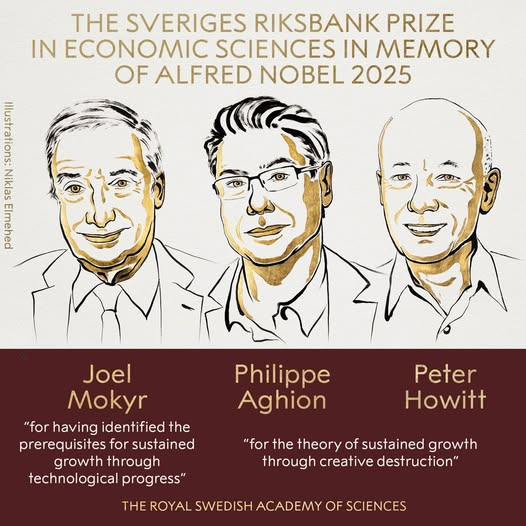
2025 노벨 경제학상
조엘 모키어, 필리프 아기옹, 피터 호위트 수상해
“혁신이 성장 이끈다”
2025년 노벨 경제학상 영예는 ‘혁신 주도 성장’ 연구에 기여한 3명의 학자, 조엘 모키어 (Joel Mokyr) 노스웨스턴대 교수, 필리프 아기옹(Philippe Aghion) 콜레주 드 프랑스 교수, 피터 호위트(Peter Howitt) 브라운대 명예교수에게 돌아갔다.
스웨덴 왕립과학원은 10월 13일 (현지시각) 2025년 노벨 경제학상 수상자를 이같이 발표하면서 “세 수상자는 혁신이 어떻게 지속적인 경제 성장을 이끌어내는지를 규명했다”며 “기술혁신이 경제 발전의 원동력임을 과학적으로 설명한 공로를 인정했다”고 밝혔다.
모키어 교수는 경제사 연구를 통해 산업혁명 이후 인류가 처음으로 지속적 성장을 달성한 원인을 규명했다. 그는 기술이 단순한 발명이 아닌 과학적 원리를 기반으로 한 지식 축적의 산물일 때 비로소 ‘자기발전적 혁신 체계’가 가능하다고 봤다. 산업혁명 전엔 과학적 원리에 대한 설명이 부족했기 때문에 새로운 발명을 바탕으로 발전하기 어려웠다는 것이다.
특히 모키어 교수는 새로운 아이디어와 변화를 수용하는 사회적 개방성이 성장의 토대라고 강조했다.
아기옹 교수와 호위트 교수는 1992년 공동 논문에서 ‘창조적 파괴 (Creative Destruction)’ 모델을 수학적으로 정립했다. 새롭고 더 나은 기술이 등장하면 기존 산업이 도태되는 과정을 통해 경제가 발전한다는 슘페터의 이론을 현대 경제학에 통합한 것이다.
이들은 혁신이 ‘창조적’인 동시에 시대에 뒤떨어진 기술 기업을 경쟁에서 도태시켜 ‘파괴적’이기도 하다는 관점을 제시했다. 또 이 갈등을 어떻게 관리하는지가 지속 성장의 핵심 변수란 것을 연구했다.
이번 수상은 미국 트럼프발 관세 전쟁으로 세계 교역 질서가 흔들리고 보호무역주의가 확산되는 가운데 경제의 근본적 동력은 개방과 경쟁, 혁신에 있다는 사실을 환기시킨다.
존 해슬러 스웨덴 왕립과학원 경제학상 선정위원장은 “세 수상자의 연구는 경제성장이 결코 당연한 것이 아님을 보여준다”며 “창조적 파괴의 메커니즘을 지켜내지 못하면 다시 정체로 돌아갈 수 있다”고 지적했다.
아기옹 교수는 수상자 발표 직후 진행된 전화 인터뷰에서 “감정을 표현하기 어렵다”며 “상금은 연구팀과 프로젝트에 투입할 것”이라고 소감을 밝혔다. 이어 “미국의 보호무역주의를 환영하지 않는다”며 “그러한 정책은 글로벌 성장과 혁신을 저해할 수 있다”고 우려를 표명했다.
이번 수상을 두고 ‘지식·혁신·제도’의 삼박자가 장기 성장을 가능하게 한다는 점을 재확인했다는 평가도 나온다. 모키어 교수가 ‘혁신의 문화적·역사적 기반’을 규명했다면 아기옹과 호위트는 ‘혁신의 경제적 동력’을 이론화했다. 세 교수의 연구는 오늘날 인공지능(AI)과 디지털 전환, 녹색 혁신 등 현대 산업 변화의 경제학적 분석에도 폭넓게 응용되고 있다.
한편 노벨상은 1901년 알프레드 노벨의 유언에 따라 제정됐으며 경제학상은 1968년 스웨덴 국립은행이 창립 300주년을 맞아 신설해 1969년부터 매년 수여하고 있다. 상금은 1100만 스웨덴 크로나 (약 16억5000만원)다.
1969년 이래 매년 수상자를 배출해온 경제학상은 올해까지 99명이 받았다. 지난해에는 대런 애스모글루·사이먼 존슨 MIT 교수, 제임스 A. 로빈슨 시카고대 교수가 국가 간 소득격차 해소를 위한 제도의 중요성을 입증한 공로로 이 상을 수상했다.
The Royal Swedish Academy of Sciences has decided to award the 2025 Sveriges Riksbank Prize in Economic Sciences in Memory of Alfred Nobel to Joel Mokyr, Philippe Aghion and Peter Howitt “for having explained innovation-driven economic growth” with one half to Mokyr “for having identified the prerequisites for sustained growth through technological progress” and the other half jointly to Aghion and Howitt “for the theory of sustained growth through creative destruction.”
The laureates showed how new technology can drive sustained growth.
Over the last two centuries, for the first time in history, the world has seen sustained economic growth. This has lifted vast numbers of people out of poverty and laid the foundation of our prosperity. This year’s laureates in economic sciences, Joel Mokyr, Philippe Aghion and Peter Howitt, explain how innovation provides the impetus for further progress.
Technology advances rapidly and affects us all, with new products and production methods replacing old ones in a never-ending cycle. This is the basis for sustained economic growth, which results in a better standard of living, health and quality of life for people around the globe.
However, this was not always the case. Quite the opposite – stagnation was the norm throughout most of human history. Despite important discoveries now and again, which sometimes led to improved living conditions and higher incomes, growth always eventually levelled off.
Joel Mokyr used historical sources as one means to uncover the causes of sustained growth becoming the new normal. He demonstrated that if innovations are to succeed one another in a self-generating process, we not only need to know that something works, but we also need to have scientific explanations for why. The latter was often lacking prior to the industrial revolution, which made it difficult to build upon new discoveries and inventions. He also emphasised the importance of society being open to new ideas and allowing change.
Philippe Aghion and Peter Howitt also studied the mechanisms behind sustained growth. In an article from 1992, they constructed a mathematical model for what is called creative destruction: when a new and better product enters the market, the companies selling the older products lose out. The innovation represents something new and is thus creative. However, it is also destructive, as the company whose technology becomes passé is outcompeted.
In different ways, the laureates show how creative destruction creates conflicts that must be managed in a constructive manner. Otherwise, innovation will be blocked by established companies and interest groups that risk being put at a disadvantage.
Learn more
Press release: https://bit.ly/48DlmwY
Popular information: https://bit.ly/3Ip1eUW
Advanced information: https://bit.ly/46D8mFa

제공 = 노벨위원회
크리스천라이프 편집부