
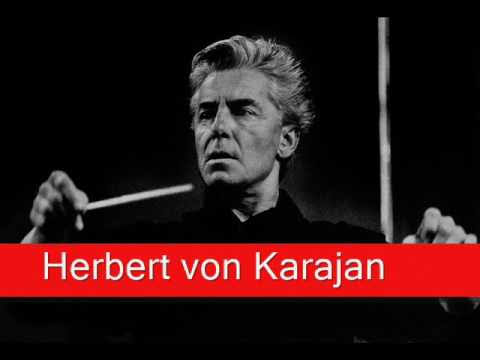
명곡감상
오스트리아의 지휘자 헤르베르트 폰 카라얀 (Herbert von Karajan, 1908 ~ 1989) 지휘, Rossini – La gazza ladra, ‘Overture’
헤르베르트 폰 카라얀 (독: Herbert von Karajan, 1908년 4월 5일 ~ 1989년 7월 16일)의 어릴 적 본명은 헤리베르트 리터 폰 카라얀 (Heribert Ritter von Karajan)으로 스트리아의 지휘자이다. 그는 35년간 베를린 필하모니 오케스트라의 상임지휘자로 재직했다.

– 헤르베르트 폰 카라얀 (Herbert von Karajan)
.출생: 1908년 4월 5일, 오스트리아-헝가리 잘츠부르크
.사망: 1989년 7월 16일 (81세), 오스트리아 잘츠부르크에서 심근경색으로 사망
.국적: 오스트리아
.직업: 지휘자, 피아니스트
.장르: 클래식 음악
.악기: 피아노
.활동 시기: 1929년 ~ 1989년
.배우자: 엘리에트 무레
.학력: 잘츠부르크 모차르테움
.종교: 가톨릭
.레이블: EMI, 소니 클래식, 도이치 그라모폰
.웹사이트: www.karajan.org
그는 1950년대 중반부터 죽음까지 서양 고전 음악의 주요 지휘자였다. 이러한 이유는 그가 엄청난 양의 음반을 제작했기 때문이다.
그의 음반 판매량은 생전에만 1억 1150만장 정도로 추정되며, 사후에 판매된 양을 포함해 2억장이라고 하며 발매되지 않은 녹음들도 존재해 아직도 진행중이다.

○ Herbert Von Karajan: Rossini – La gazza ladra, ‘Overture’
Herbert von Karajan (German pronunciation: [ˈhɛɐbɛɐt fɔn ˈkaʁaˌjan]; born Heribert, Ritter von Karajan; 5 April 1908 – 16 July 1989) was an Austrian conductor. He was principal conductor of the Berlin Philharmonic for 35 years. He is generally regarded as one of the greatest conductors of the 20th century, and he was a dominant figure in European classical music from the mid-1950s until his death. Part of the reason for this was the large number of recordings he made and their prominence during his lifetime.
By one estimate he was the top-selling classical music recording artist of all time, having sold an estimated 200 million records. Karajan was born in Salzburg, Austria-Hungary, as Heribert Ritter von Karajan. He was a child prodigy at the piano.
From 1916 to 1926, he studied at the Mozarteum in Salzburg with Franz Ledwenke, theory with Franz Zauer, and composition with Bernhard Paumgartner.
He was encouraged to concentrate on conducting by Paumgartner, who detected his exceptional promise in that regard. In 1926 Karajan graduated from the conservatory and continued his studies at the Vienna Academy, studying piano with Josef Hofmann (a teacher with the same name as the pianist) and conducting with Alexander Wunderer and Franz Schalk.
In 1929, he conducted Salome at the Festspielhaus in Salzburg and from 1929 to 1934 Karajan served as Kapellmeister at the Stadttheater in Ulm.
His senior colleague in Ulm was Otto Schulmann. After Schulmann was forced to leave Germany in 1933, Karajan became first Kapellmeister. Karajan’s career was given a significant boost in 1935 when he was appointed Germany’s youngest Generalmusikdirektor and performed as a guest conductor in Bucharest, Brussels, Stockholm, Amsterdam and Paris. In 1938 Karajan made his debut with the Berlin Philharmonic and the Berlin State Opera, conducting Fidelio.
He then enjoyed a major success at the State Opera with Tristan und Isolde. Karajan joined the Nazi Party in Salzburg on 8 April 1933; his membership number was 1,607,525. In June 1933, the Nazi Party was outlawed by the Austrian government.
However, Karajan’s membership was valid until 1939. In that year the former Austrian members were verified by the general office of the Nazi Party.
Karajan’s membership was declared invalid but his accession to the party was retroactively determined to have been on 1 May 1933. Karajan’s prominence increased from 1933 to 1945, which has led to speculation that he joined the Nazi Party solely to advance his music career. In 1946, Karajan gave his first post-war concert in Vienna with the Vienna Philharmonic, but he was banned from further conducting activities by the Soviet occupation authorities because of his Nazi party membership.
That summer he participated anonymously in the Salzburg Festival. In 1949, Karajan became artistic director of the Gesellschaft der Musikfreunde, Vienna. He also conducted at La Scala in Milan. in 1951 and 1952, he conducted at the Bayreuth Festspielhaus.

In 1956, he was appointed principal conductor for life of the Berlin Philharmonic as successor to Wilhelm Furtwängler. He conducted and recorded prolifically, mainly with the Berlin Philharmonic and the Vienna Philharmonic.
Although he conducted other orchestras (including the NHK Symphony Orchestra, the New York Philharmonic, the Concertgebouw Orchestra, the Orchestre de Paris and the Orchestra of La Scala, Milan) the vast majority of his recordings were made with the Berlin and Vienna orchestras with which he was most associated.
He also left a considerable legacy of recordings with the Philharmonia Orchestra, his last performance being in 1960. Although he made recordings with several labels, notably EMI, it is Deutsche Grammophon with which he became most associated.
He made 330 recordings with the label during his career. In his later years, Karajan suffered from heart and back problems, needing surgery on the latter. He increasingly came into conflict with his orchestra for an all-controlling dictatorial style of conducting that had vanished from use everywhere else. Karajan resigned as the Principal Conductor of the Berlin Philharmonic on April 24, 1989.
His last concert was Bruckner’s 7th Symphony with the Vienna Philharmonic. He died of a heart attack in his home in Anif on 16 July 1989 at the age of 81.
크리스천라이프 편집부