
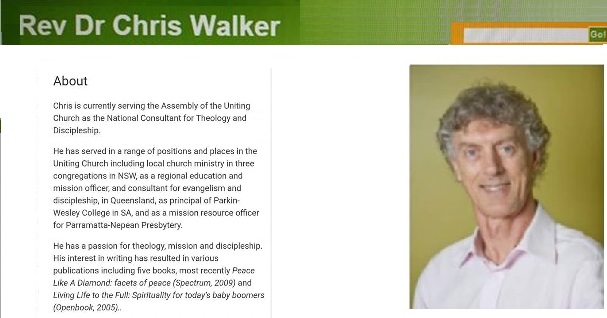
with Rev Dr Chris Walker
The Nature of Current Debate
I am concerned by the way in which much debate is at present being conducted. Social media has not helped when people post brief opinions on Twitter without argument. The most glaring example is President Donald Trump who constantly asserts his opinions on Twitter. Yet even when he addressed the United Nations he was anything but diplomatic. He used the occasion to call the North Korean leader ‘rocket man’ and subsequently threatened to destroy North Korea if they attacked the USA in any way. There was no attempt to offer reasoned argument as to why North Korea and indeed other nations should pull back from developing nuclear weapons. Donald Trump has also made famous such expressions as ‘alternative facts’ and ‘fake news.’ It is worrying that this has been done for the more he asserts it, the more people accept it. Ironically his style of presidency has led to an increase in newspaper readership. Unfortunately, media reports can be very inaccurate as the ABC program Media Watch points out. There has been a reduction in the number of journalists and investigative journalists. News outlets often rely on second-hand reports which are not necessarily accurate. Popular news media are on the look-out for the unusual and extreme to entertain people more than provide in-depth analysis of what is happening around the world.
There are of course those who do provide thoughtful commentary and we need to be looking out for them. Unfortunately, there are also those in the popular media who typically try to shock in order to get ratings and boost their egos. Even parliamentary debate is often characterised more by accusations and name calling than reasoned argument. Again, the media give attention to the times of sharp conflict more than the substantive issues for the most part. While this is understandable in a visual and competitive age, it is a pity this is the case. The alternative should not be between superficial but arresting comments and more thoughtful but boring arguments. The challenge for those who are engaged in debate is to present reasoned arguments in a way that is interesting and captures the imagination. Respectful communication is not just ‘politically correct’ and therefore ignored by those who disagree with politically correct speech. Surely it is appropriate to treat others, even those with whom we disagree, with consideration and respect.
It is not easy for Christians to be heard in the public space. Christian leaders are perceived to be conservative, boring and irrelevant. At least that is how many in the media especially view them. They are mostly given attention in a negative light. The views of many in the media are in line with what has been called ‘the new atheists,’ people such as Richard Dawkins, Christopher Hitchens, Daniel Dennett and Sam Harris. They are supported by people such as Stephen Fry who readily makes negative comments about religion in his programs. The negative views expressed by such people are more emotion laden criticisms than substantive arguments. Religion is seen not just as wrong but evil. Faith is regarded not just as mistaken but contrary to the scientific evidence. Religion is toxic and fosters extremism such as suicide bombers. Believers are scorned as naïve or deluded. There have been very effective responses to the books by the new atheists, such as by Alister McGrath in The Dawkins Delusion and David Bentley Hart in Atheist Delusions. These books, however, do not sell like the atheists’ ones and are not given prominence in the media. As Christians, we need to know about them and not be cowed by the atheists just because they get attention.
Jesus of course was a master communicator not only with the people who wanted to hear him but also when challenged by his critics. For those open to his message of the kingdom of God, he gave indications of it not by long rational argument but by the use of imaginative stories and sayings. He drew on his observations of life to devise stories that were both familiar in what they depicted but surprising in their conclusions. They were not just about farming, business, family relations, robberies, kings etc but gave indications about the way God’s rule functioned. He appealed to the heart and mind in doing so. When his critics tried to catch him out with carefully devised questions he was able to give telling replies and sometimes asked a question in return which they were unable to answer. Asked about paying taxes, for example, he requested a coin which had the emperor’s face on it. He then said, “Give therefore to the emperor the things that are the emperor’s, and to God the things that are God’s.” Everything of course ultimately belongs to God, so we have to discern what is appropriate to give to the emperor. In the early church, the followers of Jesus were not willing to pledge their loyalty to the emperor holding that “Jesus is lord.”
Jesus was willing to be critical of those who abused their positions of authority. He was prepared to call the scribes and Pharisees hypocrites and blind guides. This was not just invective. He gave the reasons for his criticisms. What he wanted were rulers and leaders who were just and caring, who put other people ahead of their own self-interest. That was how God’s reign functioned and he longed for people to respond to him and his message of the kingdom of God for the sake of the people and community.
As Christians in our time, we also need to be like Jesus not only communicating well in our churches but in the wider society, calling for good debate for the sake of the well-being of all people and for our communities. In our world, what is done well in one place can be an inspiration to those in other places thanks to modern communication. Let us pray for and seek to encourage debate that advances the cause of God’s kingdom.
Chris Walker
(National Consultant Christian Unity, Doctrine & Worship)
chrisw@nat.uca.org.au
http://revdrchriswalker.wordpress.com/
Chris is currently serving the Assembly of the Uniting Church as the National Consultant for Theology and Discipleship.
He has served in a range of positions and places in the Uniting Church including local church ministry in three congregations in NSW, as a regional education and mission officer, and consultant for evangelism and discipleship, in Queensland, as principal of Parkin-Wesley College in SA, and as a mission resource officer for Parramatta-Nepean Presbytery.
He has a passion for theology, mission and discipleship. His interest in writing has resulted in various publications including five books, most recently Peace Like A Diamond: facets of peace (Spectrum, 2009) and Living Life to the Full: Spirituality for today’s baby boomers (Openbook, 2005).