
with Rev Dr Chris Walker
Violence and more Violence
In recent days we have had more terrorist attacks. On 9 April we heard about the Palm Sunday attacks on Coptic Christian churches in Egypt, the St George Coptic Church in Tanta and St Mark’s Cathedral in Alexandria, which killed 47 and injured over 100. Only a few months earlier on 11 December 2016 a suicide bomber killed 27 and injured 47 at St Peter and St Paul’s Coptic Church in Cairo. On 7 April in Stockholm, Sweden a stolen truck was driven into a pedestrian shopping street callously killing 4 and injuring 15 more. This was a copycat act to the truck driven into a Christmas market in Berlin on 19 December which killed 12 and injured 56. These were the more publicized terrorist acts. We hear less of the terrorist attacks that have been carried out in places such as Afghanistan, Iraq, Libya, Somalia, Nigeria, Pakistan and Bangladesh.
Then of course is the ongoing war in Syria which has now lasted over six years and there is no end in sight to the tragedy. The Syrian regime is even willing to use chemical weapons on its own people. Russia backs the Regime. The USA has retaliated with targeted bombs on one airfield. While lauded by many as a sign of strength, it is hard to see how it does anything to lead to peace and the end of the war. It complicates an already complicated situation. Not only is it a protracted civil war, it now has Russia and the USA at odds with each other with the danger of escalation.
War is the major contributor to the massive numbers of refugees that are fleeing the violence seeking a safe place and somewhere to start again. I was one of many involved in the Palm Sunday rally and march for refugees and asylum seekers in Sydney. At the event I spoke with a person I know, Father Shenouda Mansour of the St Antonious & St Paul Coptic Orthodox Church in Sydney. At that time I had not heard of the terrorist attacks on Coptic Christians in Egypt.
Palm Sunday is when Christians remember Jesus riding on a donkey among his disciples and pilgrims heading into Jerusalem for the Passover festival. Jesus was hailed as a prophet, as one who came in the name of the Lord. People put palm branches and their cloaks on the road to honour him. He came as God’s anointed one humble and riding on a donkey, a symbol of peace and grace.
What we do not always realise is that Pontius Pilate, the Roman Governor would also have entered the city that week. Major Jewish festivals meant the city swelled with pilgrims filled with religious fervour. Passover celebrated the ancient and central story of the people of Israel in which Moses led their ancestors out of slavery under the Egyptian Pharaoh. The Jewish people of Jesus’ time longed for liberation from Roman domination in the same way as their ancestors longed for liberation from Egypt. So there was the danger of unrest and uprising especially at such a time. From another direction, possibly even on the same day Jesus rode into Jerusalem, Pilate entered the city. He would have been riding on a mighty war horse decked out in military and imperial attire, accompanied by Roman soldiers on horseback and on foot. There would have been the sound of marching boots and the clatter of horse hoofs on the road. Trumpets and heralds would have cried out that Roman authority was here. There was pomp and ceremony aimed to be a show of power and might to conjure fear and warning into the hearts of the people. Peace would be maintained at the end of a sword if need be.
So we have two contrasting people entering Jerusalem: Jesus, the prince of peace, on a humble donkey vulnerably coming to proclaim God’s reign of compassion, justice and peace; and Pilate coming with the might of Rome threatening violence and seeking to inculcate fear in order that peace be maintained.
Peace through domination needs to be vigilant and repeatedly has to deal with those who threaten to challenge it. There are likely to be attacks out of resentment even if they know they cannot overturn the ruling power.
Our present world has elements of all this. We have greater powers, most notably the USA which acts like the empire. There are also other powers such as Russia which deliberately acts in opposition. A newer power such as China also wants to expand its influence and is rapidly doing so. Nations such as Afghanistan, Iraq, Iran and Syria are places that have many who consciously reject what the West represents. Terrorist groups have emerged which deliberately use methods and targets that are difficult to detect and stop. The way of violence has led to many people being killed and maimed, shocked and displaced.
Unfortunately the typical response to violence used against people, and in war, is to want to retaliate in kind, namely with more violence. The attacks on 11 September, 2001 in New York and Washington led to the USA invading Afghanistan and then Iraq in retaliation. The so-called ‘war on terrorism’ has now led the USA into Syria. The violence and counter violence has been disastrous for the people of those places. Instead of helping, the result has been thousands of people killed, infrastructure destroyed, and people forced to cope by fleeing into refugee camps or be possibly killed in the violence that has been unleashed.
The world needs to develop and commit to peaceful non-violent means to resolving conflict. Jesus showed the way but worldly people continue to rely on violence which leads to further violence. When will we learn the way of Jesus and reject the way of violence? This Easter let us honour Jesus as the prince of peace who wants to lead us non-violently into justice, compassion and peace.
Chris Walker
(National Consultant Christian Unity, Doctrine & Worship)
chrisw@nat.uca.org.au
http://revdrchriswalker.wordpress.com/
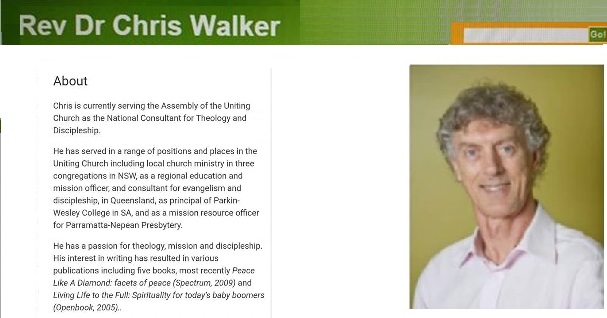
Chris is currently serving the Assembly of the Uniting Church as the National Consultant for Theology and Discipleship.
He has served in a range of positions and places in the Uniting Church including local church ministry in three congregations in NSW, as a regional education and mission officer, and consultant for evangelism and discipleship, in Queensland, as principal of Parkin-Wesley College in SA, and as a mission resource officer for Parramatta-Nepean Presbytery.
He has a passion for theology, mission and discipleship. His interest in writing has resulted in various publications including five books, most recently Peace Like A Diamond: facets of peace (Spectrum, 2009) and Living Life to the Full: Spirituality for today’s baby boomers (Openbook, 2005).