
with Rev Dr Chris Walker
The Legal System
I am now on a 9 month good behaviour bond. This was the sentence given by the magistrate I came before on Friday 14 October at the Downing Centre Court in Sydney. Six of us from the Breakfree Protest in regard to coal and climate change came before this magistrate. On 8 May we had trespassed on a rail bridge in Newcastle as part of an international protest against governments not doing enough in relation to climate change. In Australia, Newcastle was chosen because it is the largest coal port in the world. It was a peaceful protest. No damage was done. We co-operated with the police when arrested. Nearly 60 people were arrested on that day.
On 6 September most of those arrested made their way to the Newcastle Court. The magistrate, however, chose to deal with people one by one, rather than as a group despite the charge being identical. He sentenced seven people giving them all a criminal conviction and a fine. All the other people were deferred to local courts, such as Newcastle, Lismore, Sydney and Canberra. Since then other magistrates have given some people a warning and no conviction or bond and they did not even have to pay court costs.
The magistrate I came before dealt with six people. Four of us were over 60 and each had not been arrested before. We had served the community in various ways over a long period. It was our concern to draw attention to the seriousness of climate change that led to this action. We were each given a 9 month good behaviour bond and required to pay court costs. The two younger women, however, who had been arrested once before for similar protest action were given a criminal conviction and a fine.
So, depending on the magistrate, there have been three outcomes: a warning, a good behaviour bond, and a criminal conviction. The latter in my view is very harsh. The people involved, some of whom were arrested for the first time and some who had been arrested before for a similar offence, acted out of conscience and protested. They are not criminals who broke the law for personal gain. In fact it cost to join the well-organised protest in Newcastle. We had to register and pay to be part of it. To be given a criminal conviction is not good, especially for younger people starting out in their careers. Those convicted will be appealing. Hopefully they will come before a more considerate magistrate but they may not. It will be December before their next court appearance – the third time for those people.
Not having had much to do with the legal system, all this has been an eye opener. I knew the legal system was slow. It certainly is. For some it has meant the following: protest on 8 May, court in Newcastle on 6 September, court in Sydney on 14 October, court again in Sydney in December. The legal system also seems deliberately inefficient. If the charge was the same for all why not deal with everyone together rather than in small groups? Even those of us referred to the Sydney court appeared on successive days with different magistrates and different outcomes.
One of the people in the protest commented in an email, “This whole thing is such an insight into the arbitrary nature of our justice system…..Good luck with the appeals.” I can only concur, though I would refer to it as the ‘legal system’ rather than the ‘justice system,’ as justice is not necessarily being served. For those appealing it does seem it will be a matter of ‘luck’ as to what magistrate they come before. If the magistrate is sympathetic their charge will be reduced; if not their criminal conviction will stand. The magistrates have all the power. It is their subjective views that determine the outcome. Each magistrate makes up his or her own mind.
God’s justice is better than this. As a Christian I hold that God does care about justice. The prophets and Jesus affirm this. The prophet Amos proclaimed God’s word against Israel, “This is what the Lord says: For three sins of Israel, even for four, I will not turn back my wrath. They sell the righteous for silver, and the needy for a pair of sandals. They trample on the heads of the poor as upon the dust of the ground and deny justice to the oppressed” (Amos 2: 6-7). In one of Jesus’ parables he tells of a widow who pleaded for justice against her adversary. Though the judge refused, he finally gave her justice because of the woman’s persistence. Jesus contrasts this unjust judge with God who does hear people’s cry for justice and responds (Luke 18:1-8).
Meanwhile we are to seek the common good and side with those who are treated unjustly. In our context that especially applies to indigenous people, refugees and asylum seekers, and other marginalised people. It also means calling for the tax system to ensure that rich people and companies pay their fair share of tax. In Australia we do have legal aid for those who cannot afford it. The Australian legal system is better than in many countries in which there is often corruption and where people can receive death penalties for crimes. We live in a democracy in which we can speak out against the government and protest against their actions, or lack of actions, that we believe in such as climate change. This might even mean civil disobedience. If we do so we have to face up to what we have done and argue our case publicly and in a court of law if necessary. Nevertheless, my experience this year in relation to the protest in Newcastle, and also in a second different matter, has led me to be critical of how just our legal system really is.
Chris Walker
(National Consultant Christian Unity, Doctrine & Worship)
chrisw@nat.uca.org.au
http://revdrchriswalker.wordpress.com/
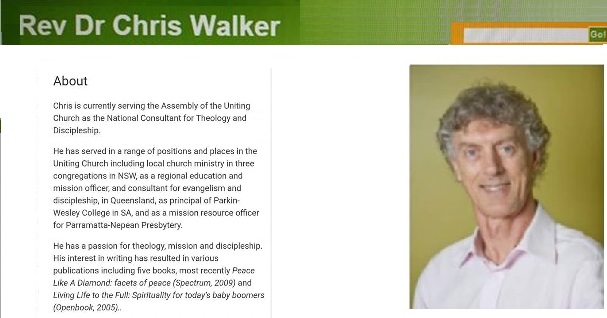
Chris is currently serving the Assembly of the Uniting Church as the National Consultant for Theology and Discipleship.
He has served in a range of positions and places in the Uniting Church including local church ministry in three congregations in NSW, as a regional education and mission officer, and consultant for evangelism and discipleship, in Queensland, as principal of Parkin-Wesley College in SA, and as a mission resource officer for Parramatta-Nepean Presbytery.
He has a passion for theology, mission and discipleship. His interest in writing has resulted in various publications including five books, most recently Peace Like A Diamond: facets of peace (Spectrum, 2009) and Living Life to the Full: Spirituality for today’s baby boomers (Openbook, 2005).