
with Rev Dr Chris Walker

Australians and War Crimes
We have recently heard the disturbing outcome of the four-year inquiry into war crimes committed by Australian Special Forces in Afghanistan. The report was presented by Major General Paul Brereton. The report has rightly damaged Australia’s reputation. The Prime Minister Scott Morrison prepared people for the distressing report and has apologised to the President of Afghanistan. I will say more about this report and Australia’s involvement in the wars in Afghanistan and Iraq.
Australia under Prime Minister John Howard readily accepted President George W. Bush’s request for joining the USA in a war on Afghanistan. This was in response to the 11 September, 2001 terrorist attacks in New York and Washington. John Howard has publicly said it was in retaliation for those attacks and Australia stood by its US ally. The terrorist attacks were carried out by the Islamist terrorist group Al-Qaeda with Osama Bin Laden as its head. He was thought to be in Afghanistan. The attacks in the USA resulted in 2,977 fatalities. In the years since then there have been some 3,500 coalition forces deaths while over 111,000 Afghan civilians have been killed and indirectly it may be as high as 360,000 who have lost their lives. Taliban fighters continue the civil war and President Donald Trump has sought to negotiate with them.
Australia was involved in a twelve-year deployment in Afghanistan. It was first called Operation Slipper (from 2001-2014) and then Operation Highroad (from 2015). Australian troops were withdrawn at the end of 2013 but 400 remained as advisors and trainers. Over 26,000 Australian personnel have served in Afghanistan. It is estimated that Australian soldiers killed more than 5,000 most of whom were suspected Taliban fighters though some were civilians.
What the War Crimes report has revealed was a toxic culture among Australia’s Special Forces. Stories have emerged, despite the code of silence, of the murder of at least 39 civilians and the torture of others. There were stories of the killing of teenage boys, cruel torture, the slitting of throats and walking men to their death. The experienced soldiers required junior soldiers to have “target practice” and have “bloodings” to get them used to killing Afghans. These were not in the heat of battle but in other settings. This “warrior culture” was not what Australian soldiers were supposed to be about but was either accepted or not known by senior officers who are therefore implicated also for neglecting their duty.
When George W. Bush turned his attention from Afghanistan to Iraq calling for ‘regime change,’ Australia again readily followed. The pretext was that Iraq had ‘weapons of mass destruction’ despite no credible evidence that they had them. Later no such weapons were found. Nevertheless, the USA, with Australia and some others, initiated a war. In January 2003 Australia, again under Prime Minister John Howard, committed troops. In February 2003 over 250,000 people protested in Sydney against going to war in Iraq but to no effect. I was one of them. In March 2003 the war began. Australian troops continued until the next Prime Minister Kevin Rudd called for our troops to be withdrawn. This took place from June 2008 until completed in July 2009. The estimated death toll in the war in Iraq ranges from 100,000 to a million.
While the war crimes committed by Australian soldiers are terrible and those involved should be called to account, the larger question is whether Australia should have gone to war in Afghanistan and Iraq in the first place. Was it appropriate for Australia to send any troops to be involved in these wars? If ‘just war’ criteria are used, these wars cannot be justified. Australia was following the USA in its desire for revenge and should not have agreed to join in these wars. Australia would do better to take a more independent position, rather than so readily following the USA into war out of a mistaken belief it needs to do so to keep an ally.
As a Christian, there are two primary ways to respond to the issue of war: the ‘just war’ approach or ‘pacifism.’ Ronald Sider in his recent book, If Jesus is Lord, Loving our enemies in an age of violence, persuasively argues the case for pacifism. He points out that the choice is not between only two options (to kill or do nothing). He rightly says, “There is always a third possibility: to intervene non-violently to oppose and seek to restrain the aggressor.”
He says further that non-violent resistance to evil is not a utopian, ineffective approach. He points out that in the past one hundred years non-violent resistance to injustice, tyranny, and brutal dictatorship has repeatedly proved astonishingly successful. Gandhi’s non-violence defeated the British Empire leading to independence. Martin Luther King Jr.’s non-violent civil rights movement changed the USA. Solidarity’s non-violent campaign defied and conquered the Polish communist dictatorship. He notes that a recent scholarly book examined all the known cases (323) of both armed and unarmed insurrections from 1900 to 2006 and discovered an amazing result: “Non-violent resistance campaigns were nearly twice as likely to achieve full or partial success as their violent counterparts” (Chenoweth and Stephan, Why Civil Resistance Works, 2011).
In my view, the USA made a huge mistake in initiating wars in Afghanistan and Iraq. Instead of asking why the terrorist attacks took place on 11 September, 2001, President Bush initiated wars. The terrorist attacks were because of grievances against the USA. Had the USA responded differently, and worked to alleviate the perceived injustices, the world could have become a better place. The cost of the wars for the USA and others, such as Australia, was huge. If that money had instead gone to humanitarian and other assistance in places such as Afghanistan and Iraq, and also elsewhere, a great deal of good could have been achieved. Instead there was massive death and destruction. Using non-violent ways of dealing with conflict and working to achieve justice and people’s well-being would have been so much better.

Chris Walker
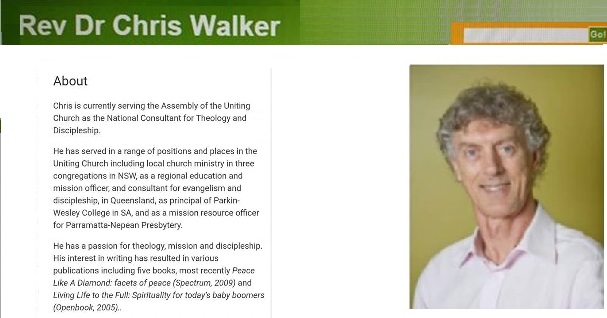
Chris is currently serving the Assembly of the Uniting Church as the National Consultant for Theology and Discipleship.
He has served in a range of positions and places in the Uniting Church including local church ministry in three congregations in NSW, as a regional education and mission officer, and consultant for evangelism and discipleship, in Queensland, as principal of Parkin-Wesley College in SA, and as a mission resource officer for Parramatta-Nepean Presbytery.
He has a passion for theology, mission and discipleship. His interest in writing has resulted in various publications including five books, most recently Peace Like A Diamond: facets of peace (Spectrum, 2009) and Living Life to the Full: Spirituality for today’s baby boomers (Openbook, 2005).