
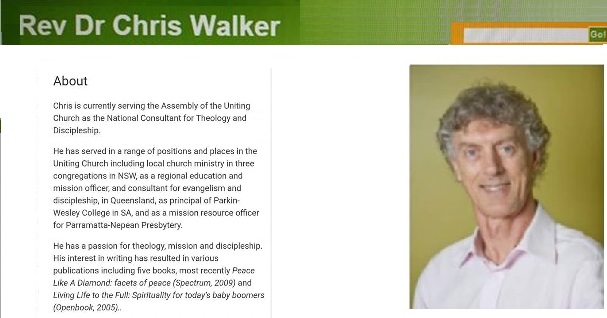
with Rev Dr Chris Walker

Advent
Advent is the season leading up to Christmas. It focuses on the hope and expectation of the coming of Jesus Christ, past, present and future. I will focus on hope and also its opposite despair. Christian hope is not just about the coming birth of the Christ child but has to do with hope for the whole world.
Secular society sees Christmas in Australia as a time of holidays, of the end of the working year, of relaxing with family and friends. The continuing influence of Christianity tends to be reduced to joyful songs, whether actual Christmas carols or not, and the birth of a child interpreted as a family occasion. For Christians the birth of Jesus in the first century has major significance. It was the key event of all history when God chose to enter human society through sending his Son Jesus to be born of a woman, Mary. Christian theology speaks of this in terms of incarnation, God becoming human in the person of Jesus of Nazareth. Moreover, Jesus’ very name means ‘God saves’ or ‘God will save’. In Jesus God was acting for the salvation of the world.
The birth of any child means hope. The parents and those around the newborn hope this child will live a full and positive life. For Christians the birth of Jesus was a sign of hope. That hope was subsequently fulfilled as the child grew and became the prophet Jesus who proclaimed God’s coming kingdom and demonstrated it in his healings and activities. People’s lives were transformed as they responded to Jesus’ message and became his followers. These followers hoped that Jesus would establish God’s kingdom in Israel in their lifetime. Jesus had to explain that God’s kingdom was different to earthly kingdoms. His parables and sayings give indications of the nature of God’s reign. The Jewish authorities rightly saw Jesus as a threat to their position and understanding, and plotted successfully to do away with him. The outcome was an unjust Jewish trial, being handed over to the Roman governor who then had Jesus executed.
For the first followers of Jesus this was devastating. It threw them into despair. Their hopes were dashed. Two of Jesus’ followers on the road to Emmaus told a stranger who had joined them, “we had hoped that he was the one to redeem Israel.” They also mentioned the astounding finding of the women followers who discovered the tomb empty and said they had seen a vision of angels who said Jesus was alive. Subsequently Jesus explained the scriptures to them and later at the meal table they recognised the stranger as the risen Jesus. Their despair turned to hope again and they hurried back to Jerusalem to tell the other disciples.
Christian hope is not just based on the birth of a special child. It is not even based only on the life and teachings of a prophet, Jesus of Nazareth. For he not only lived and died for God’s cause, he was raised again to be the living Lord. He was confirmed by the resurrection to be really God’s Son who lived among us and died our death, but was then raised by God to be one with God the Father.
Many people know what despair is about. It is not simply that terrible things have happened, such as the death of a loved one, the ravages of war and displacement, grinding poverty, the loss of life and property as a result of natural disasters. Despair takes over when people see no future, no hope, no possibility for a better life. Despair can result in depression with the worst outcome being suicide. People feel they have nothing to live for and cannot bear the blackness they experience.
Jesus’ crucifixion certainly had that depressing effect on his followers. The cause of the kingdom he led seemed lost. Evil and unjust people had succeeded in silencing him. Death brought an end to the leader they loved, trusted and put their hope in. However, Jesus’ death was not the final outcome. Sinful powerful people did not have the last say. God’s purposes in Jesus were not thwarted. God raised Jesus from the dead to be the name above all names, the living Lord. The risen Jesus commissioned his followers to continue the cause he started and to recruit new people to be his followers, his community, to serve God’s mission in the world. God’s desire for the reconciliation and renewal of the world continued empowered by God’s Spirit.
Christians are people of hope, not just for themselves but for the whole world. God’s kingdom is not only for a few but is for anyone who follows the way of Jesus. Soon it was not only Jews but especially Gentiles who responded to the Christian message proclaimed by people such as Paul. The first followers of Jesus after the resurrection felt that he was still present with them. He was with them by the Spirit to lead, comfort and guide them as they continued to follow him and serve God’s purposes. They also had a lively hope that Christ would come again to conclude history and bring in the fullness of God’s reign. They recognised that no-one knows when that might be but they prayed, “Our lord come.”
Advent is a season that continues to have a past, present and future outlook. We look forward to Christmas and the celebration of the coming of the Christ child over 2,000 years ago. Jesus Christ, however, is not just a figure from the past. As the risen Lord he continues to be with us. Phillips Brookes concludes his carol, “O little town of Bethlehem” with the words, “O come to us, abide with us, our Lord Emmanuel.” We also look to the final coming of Jesus when God will bring all history to an end and usher in the fullness of God’s reign. We are people of hope because Christ has come, Christ is risen and Christ will come again.
Chris Walker
Chris is currently serving the Assembly of the Uniting Church as the National Consultant for Theology and Discipleship.
He has served in a range of positions and places in the Uniting Church including local church ministry in three congregations in NSW, as a regional education and mission officer, and consultant for evangelism and discipleship, in Queensland, as principal of Parkin-Wesley College in SA, and as a mission resource officer for Parramatta-Nepean Presbytery.
He has a passion for theology, mission and discipleship. His interest in writing has resulted in various publications including five books, most recently Peace Like A Diamond: facets of peace (Spectrum, 2009) and Living Life to the Full: Spirituality for today’s baby boomers (Openbook, 2005).