
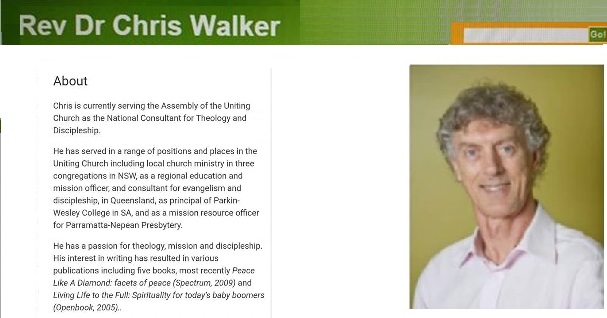
with Rev Dr Chris Walker
Cardinal Pell
Guilty. That was the verdict given to Cardinal George Pell in regard to instances of child sexual abuse with which he was charged. It is a terrible outcome. The evidence must have been compelling, and though he will appeal, it would seem the guilty verdict was justified. This verdict not only impacts Cardinal Pell’s reputation but that of the Roman Catholic church and all churches.
It first of all changes forever how Cardinal Pell will be regarded and remembered. Instead of being known as an impressive Christian leader who rose to be Archbishop of Melbourne, Archbishop of Sydney and then a Cardinal, the first Australian to become one, he will be remembered as a child sexual abuser. Instead of being remembered as a writer and speaker who was awarded the Centenary Medal from the Australian government in 2003 and made a Companion of the Order of Australian in 2005, he will be reviled as a person who took advantage of his position of power to satisfy his own sexual urges. I find it hard to conceive of an archbishop taking advantage of choir boys in this way. It is so demeaning, so contrary to the way of Christ. Whatever the outcome of the appeal, he will be recalled as a person who could not control his sexual drive and took advantage of boys who were accessible to him. No downplaying of the seriousness of what he did will remove the negative judgment on him. Child sexual abuse is not tolerable and can only be abhorred. Pope Francis removed Pell from the Council of Cardinal Advisors and an investigation by the Roman Catholic Church itself will be undertaken. Cardinal Pell may well be defrocked as a result.
Cardinal Pell represents the highest-ranking figure in the Roman Catholic Church to be found guilty of child sexual abuse. That a Cardinal could be a person who acted so inappropriately, and did so while he was an archbishop is appalling. The Roman Catholic Church has had many cases of priests sexually abusing children and all too often tried to cover up what took place and simply moved the person on. The Church has now had to face the seriousness of child sexual abuse from secular courts with huge payouts. This has not only required large amounts of money to be paid in court costs, legal expenses and compensation but more importantly has seriously damaged the reputation of the Roman Catholic Church as an institution. Ironically by trying to protect the reputation of the church instead of siding with the victims its reputation was further damaged. With its large constituency, Cathedrals, churches and schools it is no longer perceived as providing safe spaces for children. Clergy and lay leaders are viewed with suspicion as possible abusers of children. Though Pope Francis has acted and spoken strongly on this issue the reputational damage will not be readily restored. Child sexual abuse has clearly taken place for a long time in many places. It may be only some priests and religious in different locations, but for even a Cardinal to be found guilty shows it has been a problem throughout the Roman Catholic Church.
Not only the Roman Catholic Church but all churches have suffered reputational damage as a result of the coming to light of child sexual abuse in the institutions of the churches. The guilty verdict for Cardinal Pell demonstrates to many that even those with high position cannot be trusted. This makes it hard for church leaders to offer leadership in the public square that they previously often exercised. They are no longer given the respect that went with their position as Christian leaders. They are less likely to be turned to for their comments or have their views reported in the media. More generally the public are understandably critical and suspicious of the churches. Instead of regarding leaders in the churches and their institutions such as schools with respect, they are now sceptical of them. They question whether avowed Christian principles, such as love and consideration for one another, are really practiced. They wonder if there are still undetected predators involved in churches and schools. While churches have put in place more accountable procedures and seek to have safe places the loss of trust is significant.
Cardinal Pell himself has said that child sexual abuse goes against the teaching of the church. Unfortunately, it would appear he gave in to his sexual drive and did not uphold the teaching he intellectually adhered to. Jesus was critical of the hypocritical religious leaders of his day who did not practice what they preached. He opposed their desire for status and recognition while taking advantage of others. He affirmed children in an age in which children were not given the recognition we now afford them. On one occasion he put a child among his disciples and said, “Truly I tell you, unless you change and become like children, you will never enter the kingdom of heaven.” He went on to say, “If any of you put a stumbling block before one of these little ones who believe in me, it would be better for you if a great millstone were fastened around your neck and you were drowned in the depth of the sea” (Matthew 18:2-6). These are strong words not to be taken literally but indicate how Jesus valued children and the need to be considerate of them. Unlike the Graeco-Roman attitude to children, Jesus rejected seeing children as objects which adults could use for their own gratification.
The case of Cardinal Pell is salutary. It highlights for those of us who identify with Jesus Christ and his way that we need to ensure we are not enticed into un-Christlike behaviour. Jesus in the Lord’s prayer has us pray “save us from the time of trial” or in older versions “lead us not into temptation.” May we remain true to Jesus in every aspect of our lives.

Chris Walker
Chris is currently serving the Assembly of the Uniting Church as the National Consultant for Theology and Discipleship.
He has served in a range of positions and places in the Uniting Church including local church ministry in three congregations in NSW, as a regional education and mission officer, and consultant for evangelism and discipleship, in Queensland, as principal of Parkin-Wesley College in SA, and as a mission resource officer for Parramatta-Nepean Presbytery.
He has a passion for theology, mission and discipleship. His interest in writing has resulted in various publications including five books, most recently Peace Like A Diamond: facets of peace (Spectrum, 2009) and Living Life to the Full: Spirituality for today’s baby boomers (Openbook, 2005).