
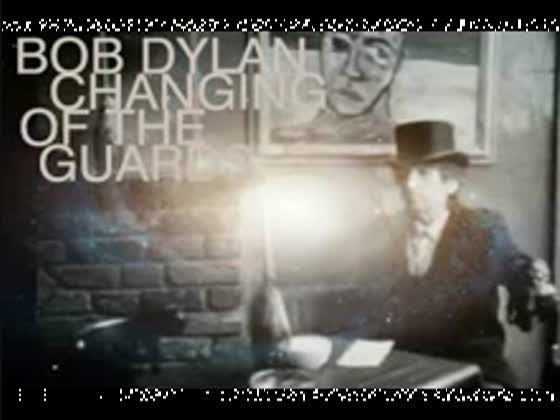
with Rev Dr Chris Walker
Changing of the Guards
One of Bob Dylan’s most enigmatic songs is ‘Changing of the Guards’. It has a driving beat, backing singers and images that defy clear explanation. It comes from his Street Legal album of 1978 and is included in the two album The Essential Bob Dylan collection of 2001. Having read a number of attempts to understand or at least make comment on the song, let me offer my thoughts.
The first thing to say is that I like the song for its music. I can imagine the backing singers being baffled by what they were singing though each phrase they sing makes sense in itself. The images are intriguing and contain some of Dylan’s typical themes. These include desperate men and women, powerful people who cheat others, a captain longing for love, a woman who draws one to follow her, a palace with mirrors and empty rooms, Eden lost, the threat of elimination, the need to embrace change, a new order of peace, and death. Dylan draws on the Bible, Greco-Roman mythology, medieval society, and lovers, among others, for his images. The song does not have a clear theme unlike “The Times They are a Changing” or the later “Gotta serve somebody” with its call to serve God not the devil and the images all connected to that theme. In my view, it would have been a better song had Dylan made the images relate to a theme more clearly. But that may well have been Dylan’s intention at this point in time.
His career had been going for sixteen years and he had been hailed as a prophet which he was not willing to accept despite his songs giving voice to the counter culture generation of the 1960s. In this song he is almost saying, if you want to find something profound in my words, try understanding this song but you won’t be able to. Just enjoy the music and the images. Let them carry you and intrigue you. But he does not give up on the need for a changing of the guards. He still holds that peace will come and violent death will surrender.
In the opening verse he hints at Jesus, the good shepherd, grieving over dead and desperate men and women in a field. Then he moves to the marketplace where merchants and thieves are hungry for power. This contrasts with a sweet, smelling woman. Next, we have a captain thinking of a beloved maid’s black face believing his love will be repaid. Then we have the woman again torn between Jupiter (a figure of power?) and Apollo (a figure of youth and love?). A messenger brings a black nightingale (a symbol of death). She is being taken somewhere. He follows riding past destruction in the ditches (a war image) with stitches still mending beneath a heart-shaped tattoo. Renegade priests and treacherous witches somehow have the flowers he’d given the woman and are handing them out to others. We then are at a palace of mirrors where dog soldiers are reflected. Chimes wail in empty rooms where the woman’s memory is protected mysteriously and angels’ voices whisper. The woman then wakes him up (whoever this is?) forty-eight hours later. There are broken chains, mountain flowers and rolling rocks nearby. She begs to know what measures he will be taking. He pulls her down and she clutches his long golden hair. Then we suddenly have a conversation between the man and his superiors. He says he does not need their organization, he has shined their shoes like a slave, moved mountains for them and marked their cards (for they are cheats). He tells them Eden is not just lost but burning. They have a choice between elimination or have the courage to accept the changing of the guards. Lastly the voice of the narrator affirms peace will come both with tranquillity and splendour on wheels of fire. That will not bring us a reward if we are on the side of her (presumably the woman’s) false idols. Death will be defeated and will retreat along with violence depicted as the king and queen of swords.
The key I think is the changing of the guards. Like “When the ship comes in” the old order will change. There are more than hints of apocalyptic with the woman caught in the middle. We are mistaken to try to identify what the images are pointing to other than be like a dream. In a dream sequence one scene gives way to another without clear logic. What matters is the overall impression. In this song, it is not even clear what that is. I think Dylan is deliberately obscure. As I said earlier I suspect he wrote the song to fit the music and just used a range of images drawing on his usual themes.
Already in his songs Dylan had many biblical images and apocalyptic themes. He grew up in a Jewish family and community so these would have been taken into his imagination. He has been a person who enjoys clear images drawn from wherever, but especially from the past such as medieval times with its kings and queens, princes and princesses, palaces and horsemen. He is a master with words and putting together memorable phrases and expressions. Many of his songs do tell stories such as “Hurricane”. Others focus on a theme such as “Everything is Broken.” Many are sophisticated love and relationship songs. In “Changing of the Guards” we have the hints of a story but it is more of a dream sequence. There are images drawn from his criticism of society. Some aspects of a love song are present. There is the expression of belief in peace coming in an apocalyptic sense not a gradual improvement of society. Dylan was religious and was about to embrace Christianity. This song I think was leading into a deepening of his faith in God who will judge and save through Jesus Christ.
Chris Walker
(National Consultant Christian Unity, Doctrine & Worship)
chrisw@nat.uca.org.au
http://revdrchriswalker.wordpress.com/
Chris is currently serving the Assembly of the Uniting Church as the National Consultant for Theology and Discipleship.
He has served in a range of positions and places in the Uniting Church including local church ministry in three congregations in NSW, as a regional education and mission officer, and consultant for evangelism and discipleship, in Queensland, as principal of Parkin-Wesley College in SA, and as a mission resource officer for Parramatta-Nepean Presbytery.
He has a passion for theology, mission and discipleship. His interest in writing has resulted in various publications including five books, most recently Peace Like A Diamond: facets of peace (Spectrum, 2009) and Living Life to the Full: Spirituality for today’s baby boomers (Openbook, 2005).