
with Rev Dr Chris Walker
Christmas without Jesus?
We are into the lead up to Christmas with the shops all hoping people will spend up big to help their bottom line. The television commercials are all about presents, having a good time and Santa Claus. Radio commentators I have heard say they love Christmas because it is a season of people getting together, enjoying meals, and sharing as family and friends. Jesus for the most part is overlooked. It is like a Bruegel painting, or rather copy, that I have which is called “The Fall of Icarus.” The scene has farmers working, ships in the harbour, and the land and seascape. Only if you look very closely do you see the legs of Icarus as he has fallen from the sky into the water at one small point in the painting. Yet that is what the painting is really about. Our Australian culture likes Christmas but wants to have it without considering Jesus. They want him not at the centre but at the edge of Christmas. In our secular, multicultural and multi-religious Australian society we want the Christmas holidays but it is politically incorrect now to speak about Jesus.
As a Christian, I do want to speak about Jesus and indeed about the incarnation which is what Christmas is really about. God did something remarkable in sending his Son Jesus to be born among us and to take on human life. The Son of God, the Word of God, became flesh and lived with us. In doing so God demonstrated that he is not only a transcendent God far greater than we mere humans. God is in fact that and we are mistaken if we do not recognize how awesome God is. God is holy, namely other than we are. The Swiss theologian Karl Barth spoke of God as “wholly Other.” Danish philosopher and theologian Soren Kierkegaard wrote about the “infinite qualitative difference” between God and us. God is eternal, not bound by our space-time dimensions for God is the Creator of all that is. Yet God in creating the universe and human beings in particular did so in freedom and love. God called the world he created “good” and desires to be in positive relationship with the humans who are made in God’s image. God loved the world so much that he chose to identify fully with humanity by sending his Son. Jesus was born among us on the first Christmas at Bethlehem, grew up in a family in Nazareth, and became a prophet and more than a prophet in first century Israel. At a particular time and place God entered human history for our benefit. Jesus came to teach and heal, to announce and demonstrate the nature of God’s kingdom and invite people into it, especially those who thought they were unworthy. Those in positions of authority were threatened by what Jesus said and did for he challenged the religious and political powers. He called for justice and compassion not exploitation and self-interest. They did what those in authority so often do, they unjustly had him killed thinking they had got rid of him. But God raised him from the dead to be the risen Lord for all who would recognise him.
Does our world not need Jesus and his message of the reign of God? As I hear the news everyday it seems to me we need to look to Jesus as much if not more than ever. I am unimpressed with the world’s political leaders: from Donald Trump in the USA, to Vladimir Putin in Russia, to Theresa May in the UK, to our own Malcolm Turnbull. I do not hold out much hope for their leadership and capacity to lead the world into a more just and peaceful future. There are people and movements that I believe are on the side of God’s purposes, such as those working for the environment, for refugees, for overcoming poverty and modern slavery to name a few causes.
Where does the inspiration come from to work for a better world, to care for marginalised people, to keep going despite opposition? Jesus is the primary motivation even if many people do not realise it. Jesus’ teaching and practice, his willingness to go to Jerusalem to confront the leaders of his nation despite knowing it would lead to his death, have led countless people to follow his way. Moreover, as the crucified risen One he promises to continue to be with us. His Spirit is at work in the world and can empower people especially if they consciously seek to live as his disciples.
Acknowledging Jesus is not just a personal religious preference. It is to follow the One who is not just the Lord of the Christian church but the One who initiated a new humanity and a new world order. The unashamed Christian conviction is that Jesus has universal significance. He is the leader for all people and all contexts. The Christian church for all its failings has spread the good news of Jesus to all continents and diverse people have responded to Jesus’ call on their lives to follow him. The Western Church may now be in a post-Christendom and post-modern context with a declining number of people relating to the churches, though some are growing nevertheless. In other parts of the world the church is growing, such as in Africa, Asia and South America. The growth of the church in China I think is especially significant.
On the television news recently, there was the report of the sale of a private Leonardo da Vinci painting for the highest amount ever. The painting has Jesus with a globe. The painting is of Jesus Christ Saviour of the world. He continues to be so for those who would acknowledge him. At the conclusion of history, it will become apparent to all. For Jesus is the Son of God who came to be one of us on the first Christmas. That is worth celebrating.
Chris Walker
(National Consultant Christian Unity, Doctrine & Worship)
chrisw@nat.uca.org.au
http://revdrchriswalker.wordpress.com/
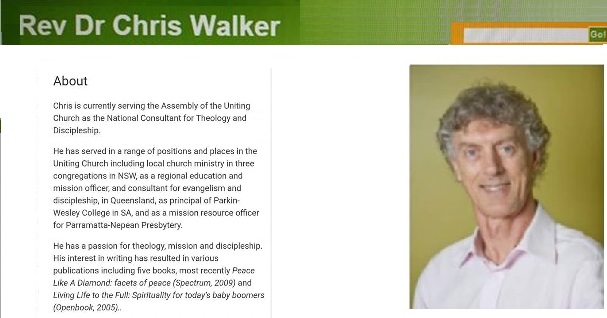
Chris is currently serving the Assembly of the Uniting Church as the National Consultant for Theology and Discipleship.
He has served in a range of positions and places in the Uniting Church including local church ministry in three congregations in NSW, as a regional education and mission officer, and consultant for evangelism and discipleship, in Queensland, as principal of Parkin-Wesley College in SA, and as a mission resource officer for Parramatta-Nepean Presbytery.
He has a passion for theology, mission and discipleship. His interest in writing has resulted in various publications including five books, most recently Peace Like A Diamond: facets of peace (Spectrum, 2009) and Living Life to the Full: Spirituality for today’s baby boomers (Openbook, 2005).