
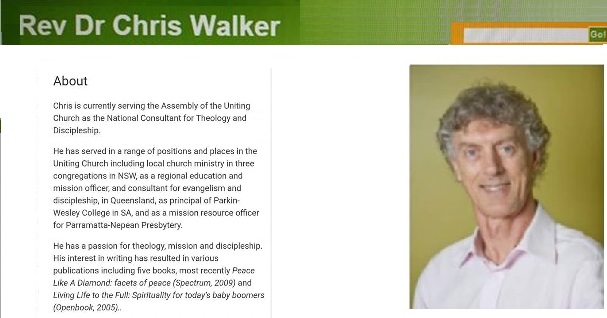
with Rev Dr Chris Walker
Commending the Faith
I have been teaching a course on “Commending the Faith in Australia Today.” Recommending the Christian faith to others is a task that is given to all Christians. The risen Jesus commissioned us to “make disciples of all nations” (Matthew 28:19-20). Peter says “Always be ready to make your defence to anyone who demands from you an accounting of the hope that is in you; yet do it with gentleness and respect” (1 Peter 3:15-16). Commending the faith involves people sharing their faith as well as public proclamation of Jesus and his message of the reign of God.
Recommending the faith to others takes place in specific contexts. Contemporary Australia is secular, multicultural, multiethnic and multi-religious. While the 2016 Census had 52% of Australians still identifying as Christians it also had nearly 30% saying they had no religion. Muslims now represent 2.6% of the population. Australia no longer favours Christianity though it never really was like Christendom in Europe. People are likely to raise objections against Christians and the church. The National Church Life Survey a number of years ago asked attenders of churches what concerns about Christianity were most often raised by people in the wider community. The most common objection was that there are too many hypocrites, that Christians do not practice what they preach (39%). The next most common issues are the problem of suffering (28%) and whether the Bible is true (24%). Some said it was good but not for me (18%) while others regarded it as irrelevant (16%). Only a few said that science disproves Christianity (6%). The frequency of the hypocritical accusation may be an easy throw-away line which allows them to dismiss considering the Christian faith. But it also highlights the importance of Christians living a consistent life and acknowledging their failings.
In order to commend the faith appropriately and effectively it is important to develop relationships with people and listen to them. Then you can respond in ways that are helpful and relevant. While some claim that Christianity is good but not for them or regard it as something for weak people, our response can point out aspects to Christianity that highlight it is for everyone and calls people to be part of God’s mission in the world. Most people do have a sense that there is more to life than just secular, materialist living. They do desire to live better lives, become who they are, and make a difference in the world. We can say that Christianity enables this. It is relevant to life. We do need to show that faith does relate to everyday life and demonstrate that by living authentic Christian lives.
There are in fact several points of contact, or points of engagement, that we can look out for as we relate with people and mutually share with them. I will outline some of them. Many people do have a sense of ‘unsatisfied longing’. They want something more in life but may not realise that it is God, though some do and start to seek God in different ways. Christians affirm the famous words of Augustine, “You have made us for yourself, and our hearts are restless until they find their rest in you.”
Many people do want to ‘make sense of the world’. The atheist position that rejects God and says life is simply a chance outcome of evolutionary forces, and that we just have to make the most out of life, is not finally satisfying. The order and beauty of the world and the fact that we can investigate it and discover more of how it works is suggestive of a Creator God. C. S. Lewis says, “What is behind the universe is more like a mind than it is like anything else we know. That is to say it is conscious and has purposes.” While there are no proofs of God, we can affirm there are indications that God made the world and that God has purposes for us and for the world. To acknowledge God is rational and more satisfying than the alternative.
Most people have a sense of ‘morality’. Where does this come from? When there are disagreements about something that has taken place, people appeal to a sense that there is some underlying moral truth or agreed difference between right and wrong. It is not the case that we can function on holding that what is right for me and what is right for you can be totally different. Morality and law requires that there are standards which are common. Are these just human constructs or is there more to it than that? Christian faith says we are made ‘in the image of God’ and therefore divine notions of justice and righteousness are in our nature. They are not arbitrary.
There are those who feel ‘anxious and alienated’. They feel their lives are threatened and they do not fit in the world. They may have had experiences that led them to feel this way. People are looking for a sense of security, belonging, and peace of mind. We can point to God who is characterised by steadfast love and faithfulness. In Jesus, we see the extent of God’s love for us. God’s Spirit can provide peace and strength for living. The Christian community can show acceptance and love.
Many people have a sense of ‘social justice’. They are concerned about poverty, discrimination, violence, and the environment. While there are various groups they can link up with regarding these, there is also the need for an overall perspective. Political parties are characteristically limited and flawed. Christians can point to Jesus and his message of the reign of God. The kingdom of God, God’s rule of love, justice and peace is to be sought on earth as in heaven, as we pray in the Lord’s prayer. Christians look to Jesus who relativizes all leaders and causes yet calls us to follow him and be about God’s mission in the world.
In these kinds of ways, we can commend the faith.
Chris Walker
(National Consultant Christian Unity, Doctrine & Worship)
chrisw@nat.uca.org.au
http://revdrchriswalker.wordpress.com/
Chris is currently serving the Assembly of the Uniting Church as the National Consultant for Theology and Discipleship.
He has served in a range of positions and places in the Uniting Church including local church ministry in three congregations in NSW, as a regional education and mission officer, and consultant for evangelism and discipleship, in Queensland, as principal of Parkin-Wesley College in SA, and as a mission resource officer for Parramatta-Nepean Presbytery.
He has a passion for theology, mission and discipleship. His interest in writing has resulted in various publications including five books, most recently Peace Like A Diamond: facets of peace (Spectrum, 2009) and Living Life to the Full: Spirituality for today’s baby boomers (Openbook, 2005).