
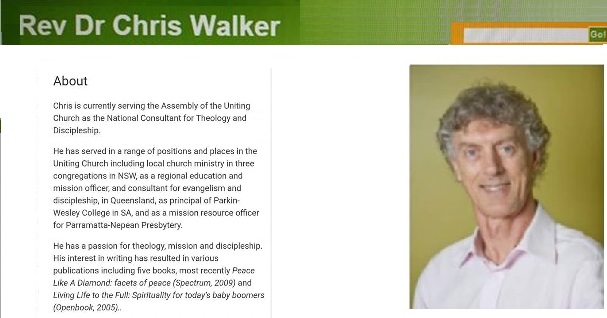
with Rev Dr Chris Walker

Television Series
During the restrictions due to the coronavirus pandemic I, like many people, have watched some television series. These have included: The Americans, focused on two Russian spies living in the USA in the 1980s, The Dublin Murders with a male and female detective both with traumatic childhood experiences, and Bad Banks based in Germany. I have found them compelling watching but the contrast with my Christian values is often stark.
The Americans is set in the 1980s Cold War when Ronald Reagan was President of the United States of America. Russian-USA relations were fraught and suspicious. The two Russian spies, a man and woman with two children living as a family in the USA, are caught up with seeking intelligence which often leads to acts of violence and murder. Sex also comes into it on both nations’ sides as they use intimate relationships to gain information. The Dublin Murders has the two main detectives with troubled personalities which occasionally leads to extreme behaviour such as getting drunk and violence. Bad Banks has a good deal of swearing as the characters get angry at one another in the corporate world. For relaxation and enjoyment, they turn to alcohol or cocaine and of course sex.
The supreme value in The Americans is Mother Russia for the two Russian spies. This necessitates loyalty and trust in the Communist leaders. For their counterpart spies in the USA, American nationalism is unquestioned. Acts of deceit and violence are justified for the higher good of serving one’s nation. The Dublin Murders has the goal of seeking to find out what actually happened in relation to the murders which has a personal as well as professional interest for the lead character. However, in pursuing the case appropriate lines of behaviour are crossed. Bad Banks is about corporate greed and deceit for the goal is to be successful and to cover up failures. Those who genuinely want to do well in their careers get caught up in the larger machinations of the heads of the banks.
Relationships inevitably suffer in each of these series. While the two Russian spies do care for each other, they have their issues and get into other relationships. The man even marries an American and lives a double life in order to get information. You get the impression that while sex is a means to an end for him, for her there is some unease about this. Similarly, a CIA agent gets into a relationship with a Russian woman who he comes to love but for her it becomes a means of getting information from him. She really loves a younger Russian. The CIA person’s marriage not surprisingly ends but he is not willing to provide secret information to save the Russian woman from deportation back to a Moscow prison. The lead male detective in The Dublin Murders comes to realise he really does care for his partner, who he has treated badly, but fails to tell her so. In Bad Banks a young career-oriented woman is in a relationship with a man with a daughter but gets so caught up in her demanding work that she fails to foster the relationship. When she wants to reconnect, she discovers her partner has re-established a relationship with his ex-wife. She responds by being distraught then has sex with a casual acquaintance.
The values displayed are somewhat extreme but do highlight secular values in the world of spies, crime and bad banks. As mentioned above the spy world requires unequivocal allegiance to one’s nation. It is never questioned and loyalty justifies deceit and violence. There are many detective series with somewhat similar values to The Dublin Murders. The lead detective is often conflicted, divorced and likes whiskey. There is commitment to the task of finding the truth of what happened and arresting the killer. But there is certainly a lack of work-life balance. In Bad Banks the greed of the corporate world is evident. Money, success, covering up failure, using people, are all part of the way the banks operate. Self-interest rules and being really able to trust others is in short supply.
So how does this compare with my Christian values? In relation to the spy series, my ultimate loyalty is to God and Jesus. The biblical prophets and Jesus did question their national leaders and their policies if they went against God’s righteousness. Sensitivity to the leading of the Spirit may well result in disagreeing with governmental leaders and policies that go against what I understand to be God’s will. In regard to the detective series, while seeking the truth of a crime is appropriate, there are limits to the methods used. Nor should the task be so all consuming that positive relationships cannot also be maintained. These relationships assist to keep perspective on life and work. The bad banks series as I said often had people swearing at others. While swearing is not the worst sin, abusive language is hardly respectful. It is an emotional response rather than a more considered one. The pervasive use of the “f” word I frankly find annoying. I would much prefer people to be more creative and use the language more effectively. English is a rich language. There has always been greed which Jesus warned about in his first century context. Christians are called to live such that there is mutual concern between people, not taking advantage of others. We are to love our neighbours as ourselves which means self-interest should be balanced by equal interest in the well-being of others. In our individualistic society this means that caring about our community and not just ourselves, or even only our family, is what is needed.
Christianity emphasizes relationships: with God and with others. Relationships are not always easy and straightforward. Nevertheless, positive relationships are really important and worth working on. There is the need for truthfulness, commitment and loyalty. Above all God is to be trusted and his will sought in all areas of life.
Chris Walker
Chris is currently serving the Assembly of the Uniting Church as the National Consultant for Theology and Discipleship.
He has served in a range of positions and places in the Uniting Church including local church ministry in three congregations in NSW, as a regional education and mission officer, and consultant for evangelism and discipleship, in Queensland, as principal of Parkin-Wesley College in SA, and as a mission resource officer for Parramatta-Nepean Presbytery.
He has a passion for theology, mission and discipleship. His interest in writing has resulted in various publications including five books, most recently Peace Like A Diamond: facets of peace (Spectrum, 2009) and Living Life to the Full: Spirituality for today’s baby boomers (Openbook, 2005).