
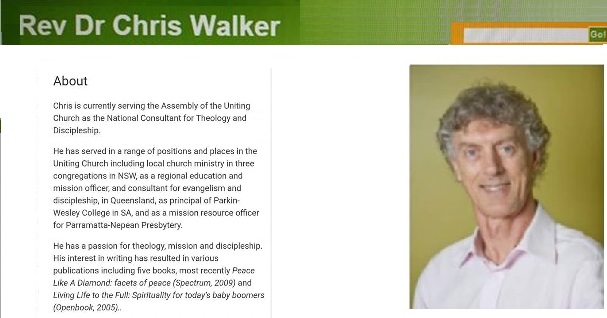
with Rev Dr Chris Walker
The Christchurch Massacre
We have had another massacre. Not in the USA, not in Pakistan or Egypt or Nigeria, not even in France or England but in Christchurch, New Zealand. Christchurch had already suffered the effects of a massive earthquake in 2011 which killed 185 people. Now it was a terrorist who killed 50 people and many others will have their lives forever affected. Nor was it a Muslim terrorist or suicide bomber but an Australian white supremacist who cynically used social media to show the world. What do we learn from this terrible tragedy?
The first thing to note is that terrorists can strike anywhere. Who would have thought that Christchurch, New Zealand would be the place for such an attack? The terrorist chose Friday prayers at two mosques as places where Muslims would be. They were an easy target for his murderous acts. He filmed what he did and put it on social media to gain world wide attention. Unfortunately, it worked in the sense that it immediately went viral and was later used even by the Turkish President for his political purposes. We live in a world with global news and therefore terrorists can carry out their deadly activity anywhere and gain international attention.
Terrorists can kill people using readily obtained guns, even military style automatic rifles. Others, as we have seen, use bombs even if they kill themselves in the process. Or even cars and trucks to run people over. It does not take much for people to carry out terrorist attacks. Guns, automatic rifles especially, can rapidly kill people as we have seen in the USA and now in New Zealand. Despite massive protest rallies calling for gun control, the USA government has foolishly refused to tighten gun laws. Australia did so after the Port Arthur massacre of 1996 in which 35 people were killed and 23 others wounded. The New Zealand Prime Minister immediately acted to introduce stronger gun laws in order to reduce the possibility of a similar terrorist attack in the future. This surely makes sense for all countries.
Terrorists are not only Muslims. In the popular imagination terrorists and Muslims were connected. Admittedly many terrorists have been Muslims saying they were acting out of their religion despite Muslim leaders rejecting this saying their faith is peaceful. However, the Australian right-wing extremist who carried out the attack in New Zealand was not the first. In 2011 Norway, a small nation like New Zealand, suffered the experience of a right-wing terrorist killing 69 people and seriously wounding another 55 at a summer camp. Extremists, whether Muslim or white supremacists, can become terrorists and justify their actions saying they are acting for their group or cause in killing those seen as enemies.
The activity of terrorists arises from the belief that their group is the only worthy group, that others are undermining it and therefore they are justified in killing those perceived as enemies. Extreme terrorist Muslims see the West as the enemy. Attacks on Western people are to create fear and damage social confidence. Extreme white supremacists see Muslims as infiltrating Western society which will lead to them taking over or at least now living where they do not belong. They are the enemy. This labelling of people as “other” and as “enemy” is of concern to any fair-minded government and people of good will.
The use of social media to publicise the massacre was a sinister new development in the Christchurch massacre. The Prime Minister of New Zealand and also the Prime Minister of Australia have acted quickly to call the social media platform leaders to account. They rightly have said it took too long, 17 minutes, for the vision of the violence to be taken down. Facebook and Google need to be more socially responsible in such matters.
The reality of the 21 century is that societies are becoming increasingly multicultural, multi-ethnic and multi-religious. People migrating from one place to another is not new. The scale of what is happening is new and is massive. The notion that nations should be mono-ethnic is no longer the reality for most nations. In countries such as Australia and New Zealand we have recently become conscious that white people invaded and took over the land from the indigenous people, the first people. More recently there has been an influx of a range of other people who have come to make their home in Australia or New Zealand. We are all second people in comparison to the indigenous people. This includes Muslims who understandably want to have their mosques and practice their religion. In a democracy this should be respected for freedom of religion is one of the values that are basic. Civil society accepts people living as they wish, so long as they act within the law. Fostering tolerance and mutual respect is what is promoted and needed in societies such as Australia and New Zealand.
The Christian faith goes further and not only calls for tolerance but says we are to love our neighbour as we love ourselves(Matthew 22:39). We are to do to others as we would have them do to us(Matthew 7:12). Jesus even calls us to love our enemies(Matthew 5:44). He rejected the way of violence. The author of Ephesians says that in Christ the dividing wall, the hostility, between Gentiles and Jews has been broken down. Christ would create peace and one humanity reconciling both groups to God(Ephesians 2:13-16). The Spirit is given to help us live according to the way of love, the way of Jesus.
The Christian vision is for a multicultural society in which people do genuinely care for one another. This includes people different from ourselves, those from a different ethnicity, culture or religion. Those who have been regarded as enemies are to be loved not hated, treated well not badly. All people are to be given respect. We need to see all people as children of God, sons and daughters of God.
Chris Walker
Chris is currently serving the Assembly of the Uniting Church as the National Consultant for Theology and Discipleship.
He has served in a range of positions and places in the Uniting Church including local church ministry in three congregations in NSW, as a regional education and mission officer, and consultant for evangelism and discipleship, in Queensland, as principal of Parkin-Wesley College in SA, and as a mission resource officer for Parramatta-Nepean Presbytery.
He has a passion for theology, mission and discipleship. His interest in writing has resulted in various publications including five books, most recently Peace Like A Diamond: facets of peace (Spectrum, 2009) and Living Life to the Full: Spirituality for today’s baby boomers (Openbook, 2005).