
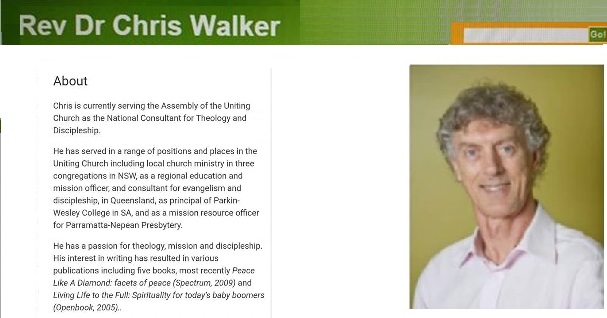
with Rev Dr Chris Walker
Transitions
I have moved from Sydney to Perth and from working for the Assembly of the Uniting Church as national consultant for Christian Unity, Doctrine and Worship to working for the WA Synod and Murdoch University teaching theology. It has been quite a change. I sought to finish my previous role well and commence the new role with as much readiness as I could. It has been a time of transition with both excitement and some anxiety and difficulties. We are all living in a time of rapid change. The Christian church is facing many challenges. I will share some of what being in transition involves if we are to navigate it positively.
Transition means leaving the past. For me, that meant leaving my previous role in the Assembly. I did so by meeting with the main groups and people with which I was involved. I spoke with them affirming and thanking them, and helping them to move on without me. I appreciated the opportunity to formally and informally conclude my role through farewells and a closure of ministry service. This enabled those leading these events to say something about what I had done and I could respond. Marking significant endings like this is important. It makes it clear the role has come to a conclusion and helps everyone, especially the person involved, to have a sense of completion and be appreciated for what they have done.
This same process is what is needed in our larger context also. Churches for example need to honour the past and what has been achieved by many people. But in a time of major transition, they cannot continue to function like in the past. Society has moved on, change has come. Hoping that doing the same things as was done in the past will only lead to decline. Often people can feel they have somehow failed because what used to work and attract people no longer does so. It is a matter of being grateful for the past but being willing to mark its conclusion and set out in new directions.
Transition also requires embracing the future. This can be disorienting as inevitably it involves having to take on what is unfamiliar and learn to grasp what the new situation requires. For myself it first of all meant leaving a familiar city, Sydney, and moving to another city, Perth, where I had only visited previously and had never lived there. When you are a visitor it is relatively easy to do what you want. You make your plans and see what you want with the assistance of others and then leave to go home again. As someone moving to live in a place you have to find you way around and become established. For myself, while I was provided with a house and car, that meant getting organised in the house, learning where the local stores were and becoming oriented to where I was now living. In relation to my role as a teacher of theology at Murdoch University, there were a number of things to sort out: my office, computer, access to information about my classes and students. I also had to go to the WA Synod office in the city to meet people, discuss my role and finalise the paperwork for my position. While people were helpful and friendly, there were some frustrations with getting into the university system as a recognised staff person. I had to become oriented to a very different work context than the one I had left.
Embracing the future is a challenge especially for churches that have a history. They can feel that time has moved on and it is not easy to adjust to changed circumstances. Yet that is what is required. There is no going back to a more readily understood time. Like it or not the future has arrived. It does require working out how to function in this changed context. Changed social patterns, changed families, changed technology have to be accepted and adapted to. There is the need to be quite intentional about all this. Strategic planning has to be done. Trial and error is part of the process. We will make mistakes but that is acceptable. We just need to learn from them and keep trying until we do find what works. Unlike the past when churches could follow a similar way of being church, whether they were Catholic, Presbyterian, Methodist, Baptist etc. now each church has to discern its own community and how it is called to be and do church in order to serve God’s mission.
Transitions necessitate new learning. In my new teaching role it has meant getting university theology courses ready and deciding how to conduct my classes. The old lecture pattern is not sufficient for students will learn best by more active participation. I am doing seminar lectures in which I seek to engage the students while providing some input as required. I am also intending to lead some seminars in the churches around Perth. It will be a matter of offering subjects, finding out who is likely to be present, and seeking to speak so as to engage and assist their thinking.
The same applies to churches. Local churches have to learn different ways of being church. Synods need to do strategic planning to assist the church to develop. I think this also means becoming clearer as to the core functions of the church. The local church is not just to offer worship and pastoral care for its members and keep the building open. It has to prayerfully discern how it is called to be the body of Christ in that location making a difference to the lives, not only of its members, but also to those in the wider community. Synods and church leaders can foster the development of new faith communities, the re-invigoration of older congregations, and ensure there are relevant training opportunities. The goal is to make disciples and be about God’s mission in the world.
Chris Walker
(National Consultant Christian Unity, Doctrine & Worship)
chrisw@nat.uca.org.au
http://revdrchriswalker.wordpress.com/
Chris is currently serving the Assembly of the Uniting Church as the National Consultant for Theology and Discipleship.
He has served in a range of positions and places in the Uniting Church including local church ministry in three congregations in NSW, as a regional education and mission officer, and consultant for evangelism and discipleship, in Queensland, as principal of Parkin-Wesley College in SA, and as a mission resource officer for Parramatta-Nepean Presbytery.
He has a passion for theology, mission and discipleship. His interest in writing has resulted in various publications including five books, most recently Peace Like A Diamond: facets of peace (Spectrum, 2009) and Living Life to the Full: Spirituality for today’s baby boomers (Openbook, 2005).