
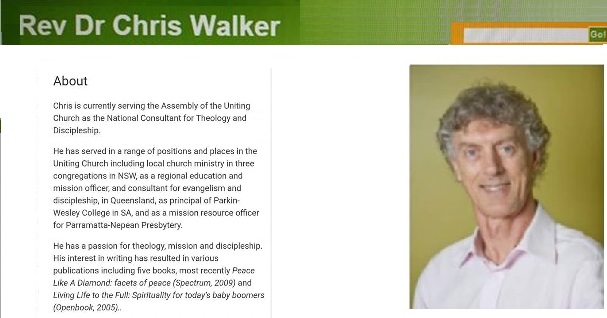
with Rev Dr Chris Walker
What does the 2016 Census really tell us?
The figures for the 2016 Census are now available. News reports gave some preliminary findings, some with the statement “Losing my religion,” the title of a popular song by the rock group REM in the 1990s. The number of people stating “No Religion” has been increasing each census – from 18.7% in 2006 to 22.3% in 2011 and is now 29.6% – up more than 10% in ten years. I suspect it is less a matter of people losing their religion as being more willing to say they were not connected to any religion. This was helped by putting “No Religion” the first option in the census list. Our society is predominantly secular and materialistic so the census figures understandably reflect this. We do well to note that Christianity still represents 52% of the population.
Catholics continue to be the largest religious group with 22.6% of the population down from 25.3% in 2011. Given the bad publicity surrounding the Royal Commission into Institutional Responses to Child Sexual Abuse, it is no wonder that many no longer call themselves Catholic. Yet it was the Anglicans who had the biggest loss in terms of nominal adherents. Over half a million people less said they were Anglican. Anglicans now represent 13.3% of the population. The Uniting Church also saw a significant loss of people saying they were nominally linked, down more than 190,000. The Uniting Church is now 3.7% of the population. Its social services in particular continue to mean it is a major contributor to Australian life. It is in fact the largest non-government welfare provider with its aged care, child care, Lifeline centres etc. The multiethnic composition of the Uniting Church is increasingly significant. The Tongan National Conference organised by the Uniting Church had some 1,500 people recently. There are many Korean congregations and there is a Korean presbytery in NSW. People worship in 26 languages across the Uniting Church as well as in a number of indigenous languages.
Islam has received frequent attention in the media, especially due to radical voices here and overseas and those joining terrorist groups such as Islamic State. Most Muslims want to live peacefully in Australia as Australians. They now represent 2.6% of the population and have overtaken the Buddhists who have 2.4%. Hindus have grown to 1.9%. They are here to stay as part of our Australian society.
Australia is a secular, multicultural, multiethnic, multi-religious society. While this is not new it is increasingly the case. The Australian population is now some 24.4 million people having doubled in the past 50 years. Those 50 years have also seen Australia become very multicultural having abandoned the notorious “white Australia policy.” In the past five years there have been 1.3 million new migrants from 180 countries. We are a country made up of an ever increasing number of people from all kinds of cultural backgrounds. After World War II it was people from Europe who were assisted to migrate to Australia. Middle Eastern people have come and continue to do so, such as people fleeing the violence in Syria. Pacific islanders have come to make Australia home though they continue to have strong links to their countries of origin. Africans, such as from Sudan, have recently migrated here. However, it is people from Asia who are the majority of new migrants, especially from China and India.
Overall the number of people born overseas is 26.3% of the population. If you add parents born overseas, it is nearly 50%. Sydney and Melbourne are the cities with the greatest mix of people which is not surprising as New South Wales and Victoria are the most populous states. Two thirds of our population live in the capital cities with Sydney the largest at 4.8 million.
It is also worth noting that while many former mainstream churches are aging, so too is the population. One in six people are over 65 years of age. Ministry with older Australians is important and governments will have to provide adequately for an increasing number of older people.
The census is a snapshot of present Australia that represents a challenge to churches and to governments. How do we read the figures and respond appropriately? Governments need to think in terms of providing infrastructure especially in the growing cities but not forgetting rural people, and for the people who are in need, such as those who cannot afford housing, have disabilities, or are aging.
Churches have to recognise the reality of the context which is no longer favourable to them. Sunday is just another day or a day for sport for many. Younger people are attracted to other younger people and technology. Older people can no longer do all the tasks that they willingly did in their mid-years. However, we also need to be discerning the new thing God’s Spirit is doing. The challenge for churches in a less supportive and at times antagonistic environment is in fact the ongoing one of assisting people to become, grow and serve as genuine followers of Jesus Christ and not just be nominal in their allegiance. All churches are to point people to Jesus Christ and his message of God’s reign of compassion, justice and peace and serve God’s mission in the world.
World-wide Christianity continues to grow with China likely to become a source of active Christians not only in China but around the world. Many cities now have strong ethnic congregations and they are made up of whole families. Sports stars from ethnic communities are more like to be openly Christian. My Uniting Church is aware of this change and is seeking to adapt appropriately to enable people to become and live as disciples of Jesus Christ serving God and the community
Chris Walker
(National Consultant Christian Unity, Doctrine & Worship)
chrisw@nat.uca.org.au
http://revdrchriswalker.wordpress.com/
Chris is currently serving the Assembly of the Uniting Church as the National Consultant for Theology and Discipleship.
He has served in a range of positions and places in the Uniting Church including local church ministry in three congregations in NSW, as a regional education and mission officer, and consultant for evangelism and discipleship, in Queensland, as principal of Parkin-Wesley College in SA, and as a mission resource officer for Parramatta-Nepean Presbytery.
He has a passion for theology, mission and discipleship. His interest in writing has resulted in various publications including five books, most recently Peace Like A Diamond: facets of peace (Spectrum, 2009) and Living Life to the Full: Spirituality for today’s baby boomers (Openbook, 2005).