호주 칼럼리스트 “북 김정은 관련 추측보도 난무한 한국 언론” 지적
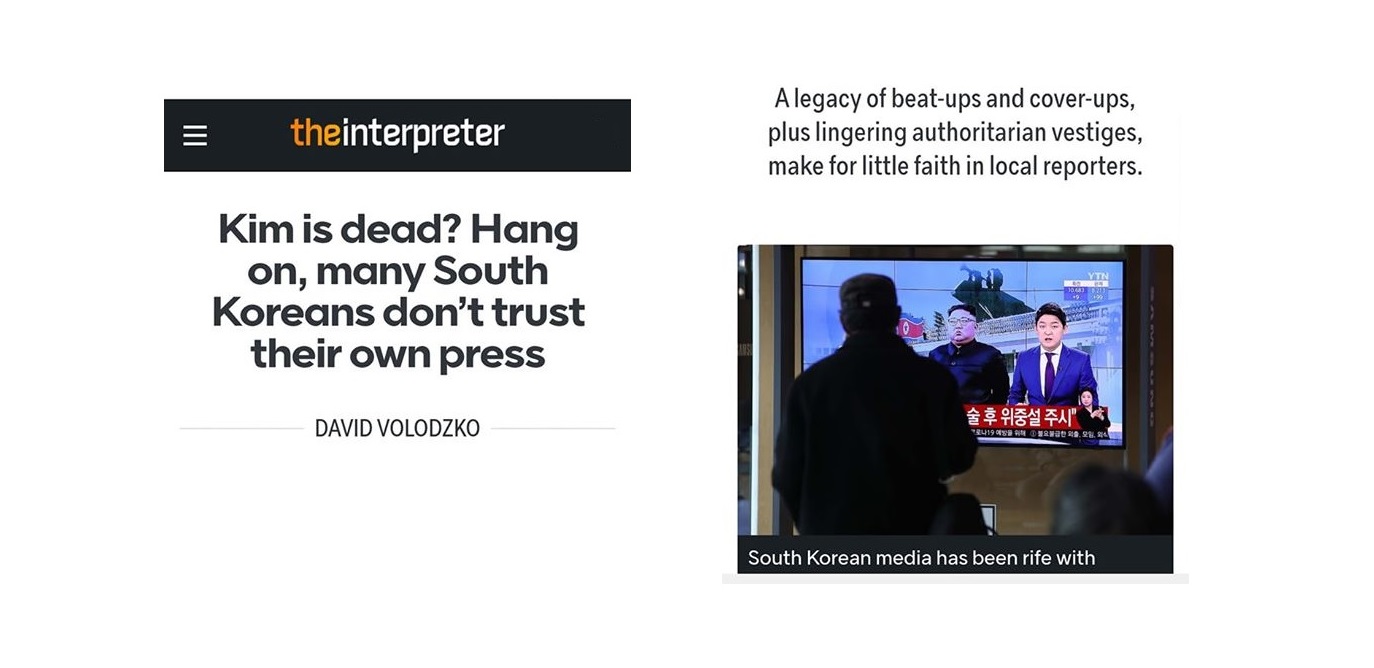
김정은 북한 국무위원장의 신변과 관련해 확인되지 않은 설들이 기사화되어 연일 보도되고 있는 가운데 호주의 로위연구소가 운영하는 The Interpreter가 4월 27일자에 DAVID VOLODZKO씨의 “Kim is dead? Hang on, many South Koreans don’t trust their own press”(김정은이 죽었다? 잠깐만, 한국사람들은 자신들의 언론을 믿지 않는다)란 제목의 칼럼을 게재했다.

게재 내용은 김정은 위원장이 죽었을지 모르지만 보도하는 기사들이 구체적인 자료 언급이 없이 다른 언론사의 익명의 기사를 인용하고, 또 다른 언론사가 재인용하며 구체적인 증거를 제시하지 못하다며 언론의 허위 조합은 신뢰받을 수 없다는 입장이다.
특히 구체적으로 미 CNN 보도의 인용실태를 지적하며 한국언론사들은 이러한 보고서가 얼마나 신뢰할 수 없는지를 누구보다 잘 알고 있어야 한다 … (CNN)은 김일성이나 김정일이 일시적으로 사라졌을 부정확한 기사를 게시한 다음 삭제했다고 꼬집었다.
이어 이와 같은 실수는 한국이 아시아의 가장 자유로운 언론을 자랑하는 것으로 평가되었지만 기존 미디어에 대한 대중의 신뢰가 2014년에서 2019년 사이 60%에서 42%로 감소한 이유를 설명하는데 도움이 된다고 했다.
그러면서 “왜 한국인들이 국내 뉴스에 대해 그렇게 낮은 신뢰를 가지고 있을까?” 반문 후
한 주요 뉴스사는 “대기업의 불법 행위에 대한 보고서를 인쇄하지 않기로 결정하고 젊은 기자들의 항의로 이어졌다”며, 한국의 가장 큰 유력 언론사들은 언론의 자세를 망각한 게으름, 그리고 과거 군사정권의 권위주의 시대부터 내려오는 부패로 인해 신뢰를 받지 못하고 있다고 지적했다.
아래는 지난 4월 27일 The Interpreter에 게재된 DAVID VOLODZKO씨의 “Kim is dead? Hang on, many South Koreans don’t trust their own press”(김정은이 죽었다? 잠깐만, 한국사람들은 자신들의 언론을 믿지 않는다) 칼럼 내용의 전문이다.
Kim is dead? Hang on, many South Koreans don’t trust their own press _ DAVID VOLODZKO
A legacy of beat-ups and cover-ups, plus lingering authoritarian vestiges, make for little faith in local reporters.
Kim Jong-un may well be dead, but North Korea experts will be the first to tell you how little we know and how important it is not to speculate. Yet South Korean media spent last week doing just that. It appears more evidence that although the people of North Korea are pinned by the grip of state-controlled propaganda, across the border, South Korea is in the midst of a media crisis – its biggest players are unreliable due to a combination of journalistic sloppiness and corruption that stems from the nation’s history of authoritarian rule.
After Kim’s absence on 15 April from his late grandfather Kim Il-sung’s birthday ceremony, Daily NK quoted one anonymous source who said he was recovering from heart surgery. CNN cited the report, adding that US intelligence suggested Kim was “in grave danger”.
The CNN story was picked-up by every major newspaper and cable news network in South Korea, but South Korean news organizations should know better than anyone how unreliable these reports can be. Kim Jong-un’s father Kim Jong-il disappeared for nine months after suffering a stroke in 2008, and Kim Jong-un himself disappeared for six weeks in 2014. Last week ended with Kim Jong-un reported dead after a pre-written article was accidentally published and then deleted.
Missteps like these help explain why, despite South Korea being ranked as boasting Asia’s most free press, one survey found public trust in its traditional media fell from 60% to 42% from 2014 to 2019. But laziness and carelessness are not the only problems. So why do South Koreans have such low levels of trust in domestic news?
“The reasons are clear,” the Korea Press Foundation said in a 2019 report, noting that only 21% of respondents feel the media adequately covers powerful entities. One leading newsroom, it added, “decided not to print a report about misconduct of a large corporation, leading to protests by young reporters”.
The public share such concerns. The survey of attitudes towards the press also found that when forming an opinion of a company, respondents said journalists were the least credible sources of information. By way of example, in the recent book Samsung Rising, Geoffrey Cain writes about how the JoongAng Ilbo daily newspaper was founded by Samsung in 1965 to give the company “a way of defending itself against political attack”. Samsung and the paper separated in 1999 but, Cain said via email, “Samsung still looms large in the day-to-day coverage of the company. It’s common to find friendly Samsung stories in the JoongAng newspapers.”
This is the legacy of South Korean authoritarianism. Park Chung-hee muzzled criticism of the government during the 1970s. Chun Doo-hwan took even more control in the 1980s with the Basic Press Law, taking over news agencies, banning provincial correspondents and ordering journalists fired. Chun’s daily “press guidelines” included instructions to label anti-government protests “pro-communist”.
Finally in 1987, Roh Tae-woo promised to abolish the Basic Press Law in what became his famous 29 June declaration. Five years later, in 1992, the number of daily papers in the country had risen from 32 to 177, and the number of weeklies rose from 201 to 1,561. This was followed by coverage and opinion polls on previously taboo subjects. But the shadow of authoritarianism lingers.
“Excessive political intervention by the media is a truly South Korean phenomenon,” senior Hankyoreh reporter Han-Yang Sung wrote in November. Sung, who was also one of the paper’s founders, said news broadcasters have been repeatedly forced to take each new ruling party’s side, and while they managed to gain some public trust during the presidencies of Kim Dae-jung and Roh Moo-hyun, this was “squandered” during the years of Lee Myung-bak and Park Geun-hye. “It seems hopeless now,” he said, noting that the internet, social media and YouTube are “leading the South Korean media to ruin”. The problem is so bad, Sung added, that when prosecutors began their probe into Moon Jae-in’s Justice Minister Cho Kuk, protesters held signs targeting not just conservative anti-Moon outlets but all journalists.
This is a problem because the lack of trust in media can be dangerous. Consider the country’s coronavirus coverage. KyungChon Yun, a member of the infection control committee at the Korea Centers for Disease Control and Prevention (KCDC), described foreign coverage of Korea’s response to the pandemic as “objective and accurate”. But he was less charitable about South Korean media.
The problem is that from the very beginning some domestic media outlets have been pouring out articles that promote public dissatisfaction and distrust regarding the government’s response to the epidemic.
Now only 48.3% of South Koreans trust local media coverage of the pandemic. Moon has hasn’t helped the nation’s problems with press freedom. Meanwhile, the National Security Law, which lets the government censor pro-North Korean or communist content, the interpretation of which was broadened under Lee Myung-bak, remains in place.
Thankfully, a number of very good alternative news sources are already in place. And at least now, when we see Korean outlets doing hasty pick-ups, they’re from CNN rather than sites reporting the discovery of an alien graveyard.

크리스천라이프 편집부