
with Rev Dr Chris Walker
A War Worth Fighting
The coronavirus pandemic is the greatest threat to people’s health and the world economy for a hundred years. French President Emmanuel Macron spoke of it in terms of being at war with an invisible enemy. Other leaders have also used similar language. Unlike other wars it is a war worth fighting. Let me offer some thoughts on this.
Wars, whether within nations, civil wars, or between nations, not only cause a great deal of death and destruction, they have a lasting impact in terms of the effect they have on people. We tend to think in terms of those who lose their lives in war. Many time that number are seriously injured never to be the same, and the psychological impact, such as post-traumatic-stress disorder, affects many for years to follow. The suicide rate among military personnel after they return home is now recognised to be very significant. Civilian casualties and dislocation, and the destruction of property and the land are immense. Yet the world’s leaders continue to resort to war all too readily. In my lifetime there has been the war in Vietnam, the Falklands war, the Gulf wars, war in Afghanistan, and the Syrian war to name the most publicised. In my view all were unjustified.
The war on the coronavirus, using the word ‘war’ metaphorically, is very different. It is worth fighting with all the combined expertise and resources the nations of the world have. Once it broke out in Wuhan, China the world looked on as China sought to contain its spread and deal with it. Unfortunately, international travel meant that many people caught the virus and took it to other places around the world. While China took drastic measures to contain the virus, some other nations were slow to do so and are now paying the price. As at 2 April, Italy has become the epicentre with over 13,000 deaths with Spain next with over 9,000 deaths. The USA has now nearly 5,000 deaths and is likely to become the epicentre in the coming weeks. New York is particularly serious with an increasing number of confirmed cases and a growing death count.
The coronavirus is now a pandemic with nations all over world having to implement strategies to contain it. The effect on the world economy is huge with people losing jobs, businesses closing, the travel and the tourist industries being impacted the most. People are being urged to stay home, work from home, practice hygiene such as frequent handwashing, and social distancing. Panic buying has taken place as people fear they might need to be isolated for weeks if not longer. New conventions have become standard such as no longer shaking hands and not touching others except family members.
The coronavirus is like an invisible enemy which readily invades. It can be caught not only via coughs and sneezes, especially likely in confined spaces such as airplanes and cruise ships, but also from surfaces that people touch. The virus waits, as it were, to pounce and infect unsuspecting people. Increasingly it has been recognized that the only way to contain it is social isolation. In Australia in March we have gone from allowing football games to go ahead with crowds, to recommending no more than 500 people should gather, to now saying no more than two people can be together. We are rightly concerned about going the way of Italy which has a hospital system that is struggling to cope with the number of serious cases to the point of having to triage those who can receive intensive care treatment. Doctors and health workers have died and the psychological impact of dealing with the pandemic and so many deaths is very hard on those working in hospitals, let alone the loved ones of those infected. The image of trucks taking the bodies of people away to be buried is stark.
The positive aspect to the coronavirus is the way the international community especially health scientists are cooperating to come up with ways to deal with it and find a vaccine. Australian medical people have been on the forefront of this combined effort. The need for protective masks, gloves and coats has also resulted in assistance being provided across national and ideological boundaries. Some manufacturing industries have changed their usual products to providing sanitizer and other needed products.
In wartime the focus of a nation’s efforts is towards assisting the war effort. With the coronavirus the same kind of things are happening. Governments are having to impose restrictions on people which are being accepted as necessary to contain the spread of the virus. The governments are making available huge amounts to ensure people and businesses can have finances to continue at a time when so many are losing their jobs and income.
I am not particularly fond of military images but they are to be found in the Bible. Used metaphorically they are appropriate to describe fighting against the unseen enemy of COVID-19. They are also used to convey that God is stronger than evil. The author of Ephesians says “our struggle is not against enemies of blood and flesh, but against the rulers, against the authorities, against the cosmic powers of this present darkness, against the spiritual forces of evil in the heavenly places” (Ephesians 6:12). He urges taking up the whole armour of God so that we may be able to withstand on that evil day. He speaks about praying and keeping alert and persevering. While what he is speaking about is not the coronavirus, I do not think it is too much of a stretch to apply it to our current context with the pandemic.
Moreover, I hope that as nations do cooperate in fighting the pandemic and as we do feel concern for those suffering in other places as well as in our own country, we may learn the ways of peaceful cooperation and mutual compassion that can be applied in the future.
Chris Walker
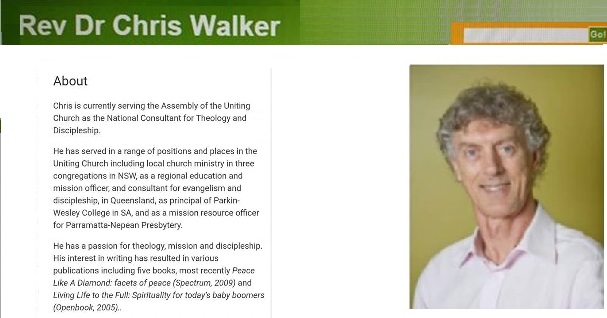
Chris is currently serving the Assembly of the Uniting Church as the National Consultant for Theology and Discipleship.
He has served in a range of positions and places in the Uniting Church including local church ministry in three congregations in NSW, as a regional education and mission officer, and consultant for evangelism and discipleship, in Queensland, as principal of Parkin-Wesley College in SA, and as a mission resource officer for Parramatta-Nepean Presbytery.
He has a passion for theology, mission and discipleship. His interest in writing has resulted in various publications including five books, most recently Peace Like A Diamond: facets of peace (Spectrum, 2009) and Living Life to the Full: Spirituality for today’s baby boomers (Openbook, 2005).