
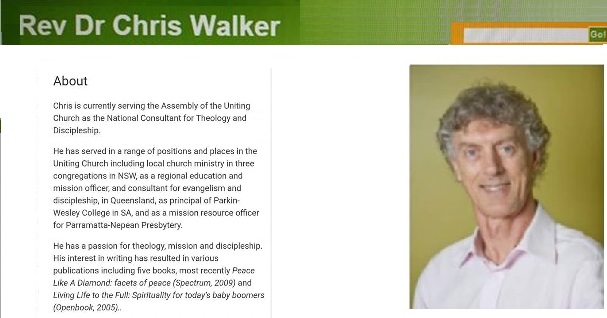
with Rev Dr Chris Walker

Australians and Sexual Abuse
Recently we have heard of sexual abuse, harassment, lewd videos and rape in Parliament House in Canberra itself. It seems that the culture at our national government is not one that respects all people equally and treats everyone appropriately. Thousands of women and men marched across Australia calling for justice and better treatment of women. Previously we had a Royal Commission into Institutional Responses to Child Sexual Abuse. The extent of abuse by priests and others was exposed and rightly condemned. Child sexual abuse has no place in Australian or any society. I will explore this issue of sexual abuse further.
In the 21st century in Australia we should be at a point in history in which children are able to live in safety as they grow and women are regarded as equals and treated with mutual regard. Unfortunately, the reality is that we have not achieved this yet. Child abuse and in particular child sexual abuse occurs not just in other places but here in Australia. Nor should it be taken offshore. Australians have been identified as being involved in paedophile activities in Thailand and elsewhere. At the Women’s March 4 Justice rally in Canberra Brittany Higgins retold of her rape in Parliament House and said “the system is broken.” Sexual abuse survivor and Australian of the Year Grace Tame told a crowd in Hobart that “behaviour unspoken, behaviour ignored, is behaviour endorsed.” March 4 Justice organiser Janine Hendry appealed to Deputy Prime Minister Michael McCormack to act on a Sexual Harassment National Inquiry Report during a terse exchange inside the corridors of Parliament. Treatment of women is not what it should be.
Australians value our culture and the privilege we have of living in a stable, multicultural society. We are finally giving greater recognition to indigenous Australians. Australia often does very well in comparison with other nations. The political response to the challenges of the COVID-19 pandemic has been commendable. We have been kept safe and provided for in a way that other nations envy. While some Asians have had negative experiences due to their ethnicity, for the most part Australians have not blamed China for the pandemic but have focused on doing what is needed to get through it. The vast majority will get vaccinated for the common good.
It has come to light that we have not done as well as we thought in relation to sexual abuse of children and women. Sexual abuse is not simply a matter of misplaced sexual desire. It has more to do with power over others than just sexual activity. People, mostly men, abuse women and children using their greater power to dominate others and satisfy their sexual appetites. Concern for the other person is almost totally lacking. It is a matter of using the other person for one’s own ends. I say ‘almost’ for some try to justify what they do saying they do care for the child or woman. They also try to suggest it was consensual. This carries no weight when a child is under the age of consent. For women resistance or saying “No” is regarded as temporary reluctance. Power over the person means men can forcefully get what they want. They are likely to be proud of their achievement. Some even take videos and post them on social media.
What can be done to change this culture that accepts such abuse? Raising awareness is the first step. That has happened with the Royal Commission into Institutional Responses to Child Sexual Abuse. It has come to the fore with the revelations about what has taken place even in Parliament House. The Parliament House disclosures are particularly significant for they have occurred in a location that represents the values and law making of the nation. It highlights that if abuse of women takes place even there, then it clearly happens in many places. Women having been saying so but for the most part have not been listened to. Those who do make complaints mostly experience difficulty being believed and the legal system is biased against getting convictions. Not surprisingly most women remain silent rather than open themselves to these likely outcomes. Yet as Grace Tame said, “behaviour unspoken, behaviour ignored, is behaviour endorsed.” It will take brave women to speak out and highlight the mistaken culture of acceptance of bad behaviour. The legal system could help by changing its approach to be more willing to believe women’s stories and convict those who abuse them.
As a follower of Jesus Christ, I take him as the model to follow in this as in other matters. In a patriarchal society he did not endorse male privilege and affirmed children and women. He deliberately accepted children and blessed them (Mark 10:13-16). He said, “If any of you put a stumbling block before one of these little ones who believe in me, it would be better for you if a great millstone were hung around your neck and you were thrown into the sea” (Mark 9:42). Jesus was considerate and respectful of women. He willingly engaged in conversation with women such as the Samaritan woman at the well (John 4:1-42). Jesus refused to condemn the woman caught in adultery (John 8:1-11). He commended Mary for wanting to listen to him and not just be about what were regarded as women’s tasks of hospitality (Luke 10: 38-42).
The clear implication from considering Jesus is that children are to be cared for and never abused. Women are to be regarded as equals and given mutual respect. There is no position in the church or society that cannot be carried out by a woman. In the Uniting Church in Australia this is affirmed in its Basis of Union and practiced. Our current national President is a woman and the President-elect is also. Australian society needs to ensure that women are enabled to live in safety and use their gifts and talents in whatever way they choose.
Chris Walker
http://revdrchriswalker.wordpress.com/
Chris is currently serving the Assembly of the Uniting Church as the National Consultant for Theology and Discipleship.
He has served in a range of positions and places in the Uniting Church including local church ministry in three congregations in NSW, as a regional education and mission officer, and consultant for evangelism and discipleship, in Queensland, as principal of Parkin-Wesley College in SA, and as a mission resource officer for Parramatta-Nepean Presbytery.
He has a passion for theology, mission and discipleship. His interest in writing has resulted in various publications including five books, most recently Peace Like A Diamond: facets of peace (Spectrum, 2009) and Living Life to the Full: Spirituality for today’s baby boomers (Openbook, 2005).