
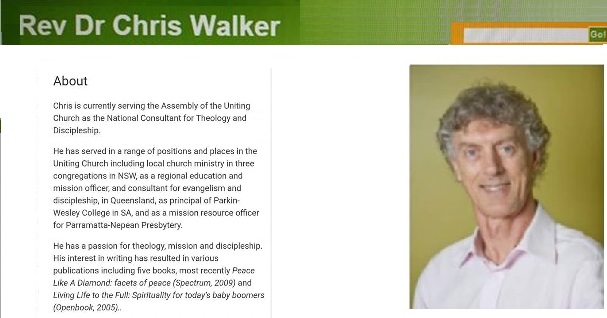
with Rev Dr Chris Walker
New Year, new approaches
New Year’s eve was celebrated around the world with people excitedly counting down the end of 2017 and ushering in 2018. Fireworks exploded and people experienced a new year dawning. While in one sense it is just another turn of the world from one day to the next; in another sense, a new year represents a new start. It may be just another day but as our calendar shows, it means the end of one period of time and the commencement of a new one. It has the meaning of closing one year and beginning a new one; putting 2017 behind us and starting again. Cynics might not hold out any new hope but most people do hope for a better year both personally and in relation to the world.
The world’s problems have not gone away. War and terrorism continue in many places, the number of people in refugee camps is huge, people seeking to escape from danger and poverty goes on. At a personal level disease and accidents will continue to affect people and families. Nevertheless, a new year does bring the possibility of better responses and better outcomes.
The Christian faith is a message of hope based on what God has done in Jesus Christ. We celebrated the coming of Jesus into the world on Christmas day. Soon after Joseph had to take Mary and the baby Jesus to Egypt to escape from King Herod who had babies killed in an endeavour to ensure his despotic rule would not be overthrown by a rival. Jesus was a refugee like so many in the middle East today. He was able to return to Nazareth and grow up in a peaceful small town. The reality of Roman rule however was always evident and the potential for people to rise up violently against their Roman overlords was something Jesus was very aware of as he grew up.
Jesus’ message was about a new rule, namely of the reign of God characterized by love, justice and peace. He refused the way of violence. Instead, he chose the way of peace and persuasion. He was not passive, actively speaking out about the kingdom of God, which contrasted with the ways of the world, the ways of the religious and political leaders of his day. He employed stories and sayings and responded to questions in telling ways. Moreover, he demonstrated God’s reign in action as well as powerful words. He healed people in body and mind and enabled them to be whole and free again. In symbolic actions, he indicated the kind of Messiah he was and the nature of the rule of God he proclaimed.
What implications does this have for us as we commence another year? Let me suggest three approaches we might take as we embark on this year of 2018. The first is gratitude. God has given us a dynamic, changing, beautiful and interesting world. God has given us life and in human life the capacity to reflect on life and make a difference in the world. Most of us have much to be grateful for in our lives. An attitude of gratitude, of appreciation for what we have is appropriate. We can be especially grateful that we can know God’s love as we see it demonstrated so clearly in Jesus. While there are always things we dislike and can complain about, a grateful attitude can positively influence the way we approach life.
We can practice a co-operative approach. Rather than be adversarial or deliberately combative we can endeavour to co-operate with others as far as possible. This applies not just to our personal lives but also to political life. At a personal level we can work on our relationships trying to understand the other person’s point of view and not just our own. As we do so, we are likely to be able to get on better and work through issues to mutually satisfactory outcomes. At a political level, my prayer is that political leaders will be more willing to speak to one another and resolve issues without resort to name calling, threats and violence. Parents and teachers do not tolerate such behaviour among children, yet it is common practice among some political leaders. For the sake of the world and its people, we need leaders who respect one another and can work through to acceptable outcomes. The common people are the ones who mostly have to deal with the consequences of political leaders who do not have the interests of their people at heart but only their own prestige and power.
Helpfulness is the third approach I propose. The criterion of helpfulness is one I find very useful. I can ask myself in relation to saying something or taking some action, Will this be helpful or not? Will it assist the situation or not? Often it is a matter of realizing that it is better not to say something or to say it carefully rather than come out with some response that is not thought through and is just reactive. Again, this applies to the political as well as the personal arena. Politicians can say and do things just to get attention and votes while not actually showing real leadership. If they are to be genuinely helpful, they need to think about what is in the best interests of the people and for this to be long term not just short term. From my Christian perspective, they also should have the interests of the most vulnerable people in mind as well and not just what will benefit those who are already well off. The helpfulness I want to see politically shows consideration for people who need jobs, education, healthcare and an environment, both built and natural, that is appealing and sustainable.
My prayer is that in 2018 we will move towards practicing what I have outlined above and will overcome some of the problems we currently experience.
Chris Walker
(National Consultant Christian Unity, Doctrine & Worship)
chrisw@nat.uca.org.au
http://revdrchriswalker.wordpress.com/
Chris is currently serving the Assembly of the Uniting Church as the National Consultant for Theology and Discipleship.
He has served in a range of positions and places in the Uniting Church including local church ministry in three congregations in NSW, as a regional education and mission officer, and consultant for evangelism and discipleship, in Queensland, as principal of Parkin-Wesley College in SA, and as a mission resource officer for Parramatta-Nepean Presbytery.
He has a passion for theology, mission and discipleship. His interest in writing has resulted in various publications including five books, most recently Peace Like A Diamond: facets of peace (Spectrum, 2009) and Living Life to the Full: Spirituality for today’s baby boomers (Openbook, 2005).