
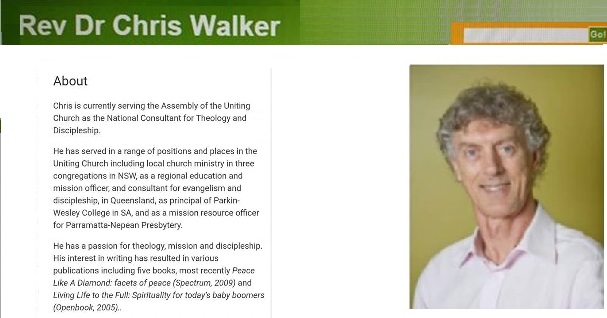
with Rev Dr Chris Walker
The Second Coming
Advent is the Christian season that leads up to Christmas. It is a season of preparation and hope. We look to the coming of Jesus, past, present and future. Many people have difficulty with the final or second coming of Jesus. Tim Costello in his memoir tells of a conversation he had with Gough Whitlam. The former prime minister said, “I believe Jesus died – of course. I believe he rose from the dead, as all the evidence points to that. But I cannot believe he is coming back again.” What do we mean when we speak of the second coming of Jesus?
Conservative and sectarian groups have often given the second coming prominence taking literally the descriptions in the New Testament about being “left behind.” In the USA there was a whole series of end time novels by Tim LaHaye and Jerry Jenkins. It was so successful that it became a film franchise as well. Jesus will come again on the clouds with power and glory and take his own people to heaven and leave the others to their fate. The humility and powerlessness of Jesus’ first coming is contrasted with the glory and might of his second coming. Jesus came at first in the form of a servant; he comes again in the form of a king and judge.
This view also is finally negative towards this life and sees Jesus coming to rescue us for a different world, a different creation. The unfortunate implication is that responsibility for what humans do to this planet are not taken seriously as it will all pass away eventually.
German theologian Jürgen Moltmann is critical of such views. He rightly says the expectation of the coming Christ must not become a dream of revenge or desire for power for those who are at present powerless. He says it has to do with the hope resulting from Jesus’ resurrection and the experience of his Spirit in the life of his followers. The technical term for the so called “second coming” is the “Parousia of Christ”. It has to do with the completion of Jesus’s ministry and mission. His saving work is finalised. The crucified Christ is the criterion for the expectation of the Parousia. Moltmann says, “Only Christological concentration can prevent the fantasies surrounding the expectation of the Parousia from running riot.”
In the Nicene Creed we have the statement, “He will come again in glory to judge the living and the dead, and his kingdom will have no end.” Moltmann says the expectation of Christ’s coming again has emphasised the last judgment and little attention has been given to the kingdom having no end. The Apostles’ Creed does not even have the second part, only the part about judgment. Christ’s second coming was linked with judgment filling the common people in the medieval church with apprehension and fear rather than joyful expectation. He points out that the last judgment is meant to emphasize the victory of the divine righteousness which is the foundation of the new creation of all things. The judge who is coming is the One who gave himself up for sinners. “The crucified One will judge according to his gospel of the saving righteousness of God, and according to no other law.” He will judge in order to put things right. The crucified One will be the judge. The judgment is the precondition for the coming of the eternal kingdom.
Just as in Christian theology God is the Creator who established the universe and upholds it, so there is the conviction that at the end God will bring the universe to an end and transform it into the new creation, the eternal kingdom. Jesus ushered in the reign of God and its full realisation is at the end when he comes to finalise what was begun. Jesus will come to judge by bringing God’s righteousness to bear leading to the eternal kingdom. The judgment will mean that those who have wilfully gone against God’s will and brought pain and suffering to others will be brought to account. For others there will be the joy of being welcomed into the fulfilled eternal kingdom in which crying, pain and death are no more.
This is a very different hope and expectation to the secular perspective of Brian Cox. In the series on “The Universe” he says the universe began as dark matter and gravity. Gradually huge stars formed giving out light, then exploded leading to galaxies and worlds being formed and amazingly life becoming a reality on Earth. Ultimately the stars will use up their energy and cease to emit light. The universe will finally be a starless ever-expanding cold, dark universe.
Brian Cox presents this as scientific realism but it really is a philosophical position that refuses to take account of God. How the universe came to have dark matter and gravity is a given. Christians say God created and did so with a purpose. The development of the universe and life was not just random. Nor will it finally resort back to darkness only ever expanding. At some point God will draw the universe to an end.
The symbol of this is the Parousia of Christ. As the incarnate One, Jesus announced God’s reign and called people to “strive first for the kingdom of God and his righteousness.” This calls for responsibility for this world as we seek to make it more like what God wants, namely characterised by compassion, justice and peace for all creatures. Jesus will come again as the second person of the Trinity to fulfill God’s purposes on earth by exercising judgment and bringing about the new creation, the eternal heavenly kingdom. It is a mistake to claim to know too much about this. We can, however, hold on to the conviction that God will bring this life and world to an end and Jesus will be involved as judge and saviour. We can look forward to the fullness of God’s eternal kingdom.
Chris Walker
http://revdrchriswalker.wordpress.com/
Chris is currently serving the Assembly of the Uniting Church as the National Consultant for Theology and Discipleship.
He has served in a range of positions and places in the Uniting Church including local church ministry in three congregations in NSW, as a regional education and mission officer, and consultant for evangelism and discipleship, in Queensland, as principal of Parkin-Wesley College in SA, and as a mission resource officer for Parramatta-Nepean Presbytery.
He has a passion for theology, mission and discipleship. His interest in writing has resulted in various publications including five books, most recently Peace Like A Diamond: facets of peace (Spectrum, 2009) and Living Life to the Full: Spirituality for today’s baby boomers (Openbook, 2005).
재림
대림절은 성탄절로 이어지는 기독교 절기다. 준비와 소망의 계절이다. 우리는 과거와 현재와 미래의 예수님의 재림을 바라보고 있다. 많은 사람들이 예수의 마지막 또는 재림을 어렵게 생각한다. Tim Costello는 회고하며 Gough Whitlam과 나눈 대화에 대해 이야기한다. 전 총리는 “예수님이 돌아가셨다고 믿습니다. 물론이죠. 나는 그가 죽음에서 부활했다고 믿습니다. 모든 증거가 그것을 지적하고 있기 때문입니다. 하지만 그가 다시 돌아온다는 사실을 믿을 수 없다”고 말했다. 우리가 예수의 재림에 대해 말할 때 그것은 무엇을 의미하는가?
보수 및 종파 단체는 종종 신약 성경에서 “뒤에 남겨진” 것에 대한 설명을 문자 그대로 재림을 강조했다. 미국에는 팀 라헤이 (Tim LaHaye)와 제리 젠킨스 (Jerry Jenkins)의 마지막 시간 소설 시리즈가 있다. 너무 성공적이어서 영화화 되기도 했다. 예수는 권세와 영광으로 구름을 타고 다시 오실 것이며 자기 백성은 하늘로 데려가시고 다른 백성은 운명에 맡기실 것이다. 예수 초림의 겸손 · 무력함은 재림의 영광 · 능력과 대조된다. 예수는 초림에 종의 모습으로 오셨다. 다시 오실 때에는 왕과 재판관으로 오신다.
이 견해는 또한 이생에 대해 결국 부정적이며, 다른 세상, 다른 창조를 위해 우리를 구원하러 오신 예수를 본다. 불행한 의미는 인간이 이 행성에 한 일에 대한 책임이 결국 모두 사라질 것이기 때문에 심각하게 받아들여지지 않는다는 것이다.
독일 신학자 몰트만 (Jürgen Moltmann)은 그러한 견해에 대해 비판적이다. 그는 오실 그리스도에 대한 기대가 현재 무력한 자들에게 복수의 꿈이나 권력욕의 꿈이 되어서는 안 된다고 말했다. 그는 그것이 예수의 부활과 그분을 따르는 사람들의 삶에서 그분의 영 체험으로 인한 희망과 관련이 있다고 말한다. 소위 “재림”에 대한 전문 용어는 “그리스도의 파루시아”다. 그것은 예수의 사역과 사명의 완성과 관련이 있다. 그의 구원 사업이 마무리되었다. 십자가에 못 박히신 그리스도는 파루시아를 기대하는 기준이다. 몰트만은 “기독론적 집중만이 파루시아의 기대를 둘러싼 환상이 폭동을 일으키는 것을 막을 수 있다”고 말했다.
니케아 신경에는 “그가 영광 중에 산 자와 죽은 자를 심판하러 다시 오시리니 그의 나라가 무궁하리라”는 말씀이 있다. 몰트만은 그리스도의 재림에 대한 기대가 마지막 심판을 강조했고 끝이 없는 왕국에 대해서는 거의 관심을 기울이지 않았다고 말한다. 사도신경에는 두 번째 부분도 없고 심판에 관한 부분만 있다. 그리스도의 재림은 중세 교회의 서민들에게 기쁜 기대가 아니라 근심과 두려움으로 가득 찬 심판과 연결되어 있었다. 마지막 심판은 만물의 새 창조의 기초가 되는 신의 의의 승리를 강조하기 위한 것이라고 지적한다. 오실 심판자는 죄인들을 위하여 자신을 내어주신 분이다. “십자가에 못 박히신 이가 자기 복음대로 하나님의 구원하시는 의를 따라 심판하시며 다른 어떤 법도 좇지 아니하시리라” 그는 일을 바로 잡기 위해 심판하실 것이다. 십자가에 못 박히신 분이 심판자가 되실 것이다. 심판은 영원한 왕국의 도래를 위한 전제 조건이다.
기독교 신학에서 하나님은 우주를 창조하시고 붙드시는 창조주이시듯이, 결국 하나님께서 우주를 끝내고 새로운 창조, 영원한 나라로 변화시키실 것이라는 확신이 있다. 예수는 하나님의 통치를 도래하셨고 그 완전한 실현은 그가 오실 때 시작된 일을 완성하실 때 끝난다. 예수는 하나님의 의를 영원한 나라로 인도하여 심판하러 오실 것이다. 심판은 고의적으로 하나님의 뜻을 거스르고 다른 사람들에게 고통과 고통을 가져다 준 사람들이 책임을 지게 될 것임을 의미한다. 다른 사람들에게는 더 이상 울음과 고통과 죽음이 없는 영원한 왕국이 완성된 왕국으로 영접되는 기쁨이 있을 것이다.
이것은 Brian Cox의 세속적 관점과는 매우 다른 희망이자 기대이다. “우주” 시리즈에서 그는 우주가 암흑 물질과 중력으로 시작되었다고 말한다. 점차적으로 거대한 별이 형성되어 빛을 내다가 폭발하여 은하와 세계가 형성되고 놀랍게도 생명체가 지구에 나타나게 되었다. 궁극적으로 별은 에너지를 소모하고 빛을 방출하지 않을 것이다. 우주는 마침내 별이 없고 끊임없이 팽창하는 차갑고 어두운 우주가 될 것이다.
브라이언 콕스 (Brian Cox)는 이것을 과학적 실재론으로 제시하지만 실제로는 신에 대한 고려를 거부하는 철학적 입장이다. 우주가 어떻게 암흑 물질과 중력을 갖게 되었는지는 이미 밝혀져 있다. 기독교인들은 하나님이 목적을 가지고 창조하셨고 그렇게 하셨다고 말한다. 우주와 생명의 발전은 그저 무작위가 아니었다. 또한 마침내 확대될 뿐인 어둠에 다시 의지하지도 않을 것이다. 어느 시점에서 신은 우주의 종말을 고할 것이다.
이것의 상징은 그리스도의 파루시아이다. 성육신하신 예수는 하나님의 통치를 선포하고 사람들에게 “먼저 하나님의 나라와 그의 의를 위하여 힘쓰라”고 부르셨다. 이것은 우리가 이 세상을 하나님이 원하시는 것, 즉 모든 피조물에 대한 연민, 정의, 평화를 특징으로 하는 것과 같이 만들려고 할 때 이 세상에 대한 책임을 요구힌다. 예수는 삼위일체 제2인격으로 다시 오셔서 심판하시고 새 창조, 영원한 천국을 이루시어 이 땅에서 하나님의 뜻을 이루실 것이다. 이것에 대해 너무 많이 알고 있다고 주장하는 것은 실수다. 그러나 우리는 하나님께서 이 세상과 이 세상을 끝내실 것이라는 확신을 가질 수 있으며, 예수는 심판자와 구주로 참여하실 것이다. 우리는 하나님의 영원한 나라의 온전함을 기대할 수 있다.
번역 = 크리스천라이프 편집부