
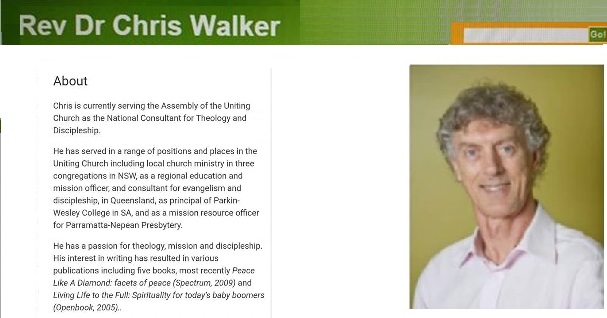
with Rev Dr Chris Walker
The Triune God
Next Sunday is Trinity Sunday so as a theologian I thought it would be appropriate for me to say something about the Christian understanding of God as triune. The Christian understanding of God is that we know God through Jesus Christ and in the Spirit. R. L. Wilkins says “Christian life is Trinitarian, oriented towards God the supreme good, formed by the life of Christ, and moved toward the good by the indwelling of the Holy Spirit.” So Trinitarian thinking is not esoteric, it is fundamental to Christian thought and life.
Thinking of God as triune stems from our Christian baptism formula. Matthew records the risen Jesus’ commission to his followers, “Go therefore and make disciples of all nations, baptising them in the name of the Father, and of the Son and of the Holy Spirit” (Matthew 28:19). Mark describes Jesus’ own baptism by John at the river Jordon as follows: “just as he was coming out of the water, he saw the heavens torn apart and the Spirit descending like a dove on him. And a voice came from heaven, ‘You are my Son, the Beloved, with you I am well pleased’” (Mark 1:10-11). Father, Son and Spirit are intimately related.
Trinitarian expressions are found in the New Testament such as the statement in Ephesians, “There is one body and one Spirit, just as you were called to the one hope of your calling, one Lord, one faith, one baptism, one God and Father who is above all and through all and in all” (Ephesians 4:4-6). Note: one Spirit, one Lord, one God and Father. Paul concludes the second letter to the Corinthians with the blessing, “The grace of the Lord Jesus Christ, the love of God, and the communion of the Holy Spirit be with you all” (2 Corinthians 13:13). There are many other significant biblical passages about Jesus and the Spirit that call for further interpretation. While these do not represent a full doctrine of the Trinity, they were the starting point. God as triune was not imposed upon but rather emerged out of the biblical passages. The understanding of God as one had to be deepened beyond a simple mathematical unity to embrace an understanding of God as a differentiated and complex unity. What was the relationship between God the Father, Jesus the Son, and the Holy Spirit? The early followers of Jesus rejected polytheism but had to develop their perspective on God as one in the light of the experience of Jesus as the crucified and risen Lord and the work of the Holy Spirit.
After affirming that Jesus was fully divine and not just human at the Council of Nicea in 325, the question emerged as to the status of the Spirit. The Spirit too was then understood to be not less than God or just an emanation from God but fully divine also. At the Council of Constantinople in 381 the Nicene Creed was expanded to include the third article about the Holy Spirit and to affirm God as Trinity. There were difficulties in coming to an adequate terminology to speak of God, especially as the terms in Greek and Latin did not exactly correspond. Finally the agreed understanding was that God was to be understood as ‘one God in three persons’. The Cappadocian fathers in the east and Augustine in the west provided treatises that assisted the church to understand God as triune: God is Father, Son and Holy Spirit together.
This understanding of God was not just a matter of the way in which God reached out to the world in love through sending his Son Jesus and the Spirit. Christian experience was that God sent his Son to live, teach, die and be raised again for us. The Spirit was given to enable us to recognise Jesus as Lord, to grow towards maturity in Christ and to continue his ministry and mission in the world. This ‘economic’ Trinity refers to God the Father sending the Son and the Spirit for the sake of reconciliation and renewal. Christians recognised Jesus as the Son of God, as the Word of God made flesh. The Holy Spirit was God’s Spirit, the Spirit of Christ indwelling us and at work in the world.
Christians have taken this revelation of God through Jesus and the Spirit to be a clear indication of the nature of God in God’s very self, namely that God is a Trinity of three persons. God is Father, Son and Spirit bound together in love. This is the ‘immanent’ Trinity. Roman Catholic theologian Karl Rahner wrote that the economic Trinity is the immanent Trinity. To confess God as Trinity is to affirm that God is relational, communal, and self-giving love. God’s love was not restricted to the inner life of God between Father, Son and Spirit but reaches out to the world which God created and loves deeply. Nevertheless we do well to recognise that God remains a mystery we cannot fully comprehend.
We have this Trinitarian understanding expressed not only in the baptism formula, but in hymns and blessings. For example, the hymn “Holy, holy, holy! Lord God almighty” (TIS 132) concludes, “God in three persons, blessed Trinity.” “Praise with joy the world’s Creator” (TIS 179) has “Praise the Maker, Son and Spirit, one God in community.” Many blessings are Trinitarian in form such as the suggested blessings at the end of the Service of the Lord’s Day in Uniting in Worship 2. Two of them are as follows, a traditional and a contemporary one: “The blessing of God almighty, the Father, the Son and the Holy Spirit, be upon you and remain with you always” (UiW2 p184); “The love of God enfold you, the wisdom of Christ enlighten you, and the fire of the Spirit inflame you; and may the blessing of the holy triune God rest upon you and abide with you, now and evermore. Amen” (UiW2 p223).
Chris Walker
http://revdrchriswalker.wordpress.com/
Chris is currently serving the Assembly of the Uniting Church as the National Consultant for Theology and Discipleship.
He has served in a range of positions and places in the Uniting Church including local church ministry in three congregations in NSW, as a regional education and mission officer, and consultant for evangelism and discipleship, in Queensland, as principal of Parkin-Wesley College in SA, and as a mission resource officer for Parramatta-Nepean Presbytery.
He has a passion for theology, mission and discipleship. His interest in writing has resulted in various publications including five books, most recently Peace Like A Diamond: facets of peace (Spectrum, 2009) and Living Life to the Full: Spirituality for today’s baby boomers (Openbook, 2005).